Peace Culture Bunker
평화문화진지
A former fortress built to protect the northern entrance to Seoul from North Korean tanks, now transformed into a centre for art and culture.


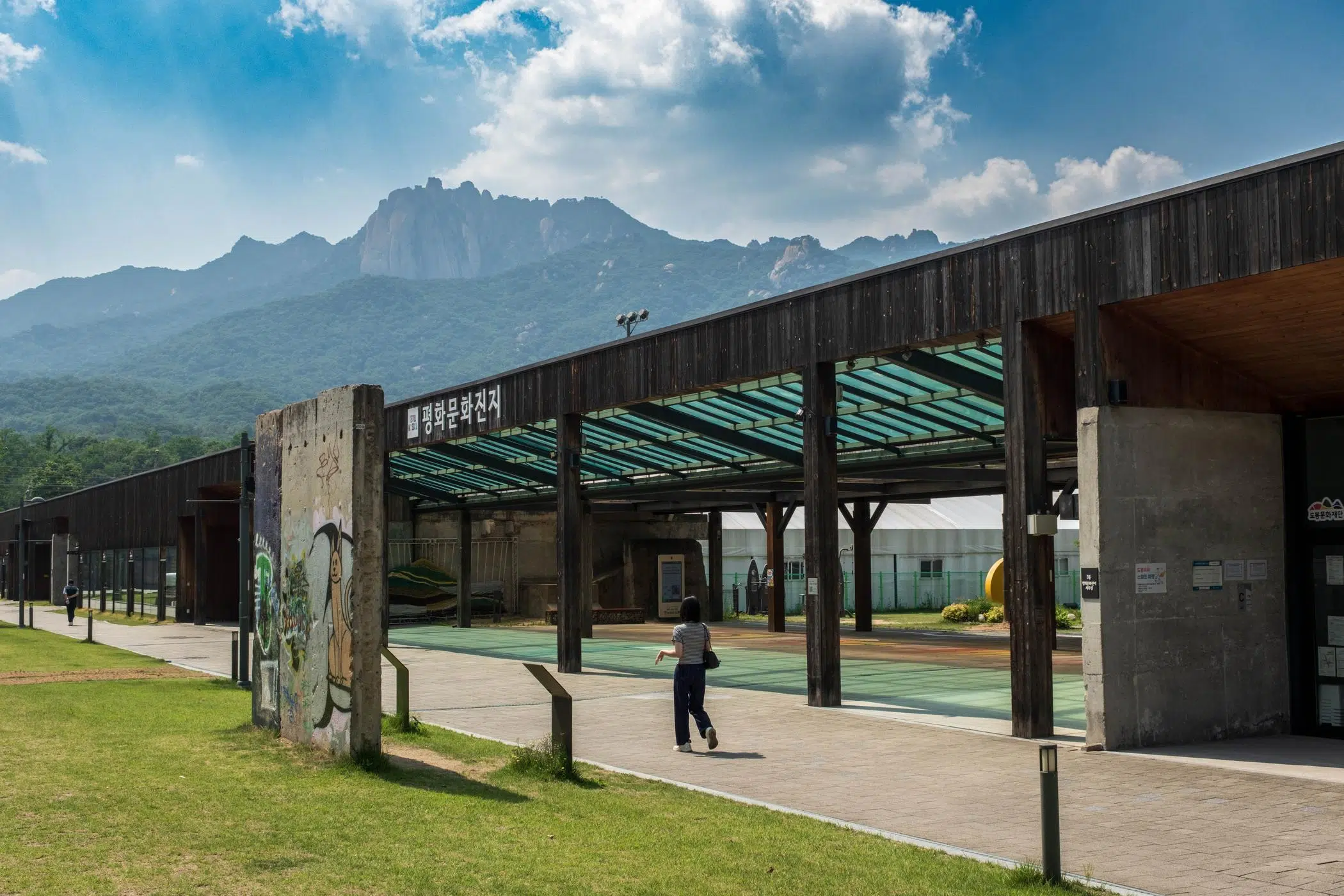
The Peace Culture Bunker, in northern Seoul: a former secret fortress strategically located along an invasion corridor, converted into an art venue (June 2026).
Transforming symbols of division and war into venues for art and culture is a South Korean specialty, a way of subverting the country’s painful partition. One of the best examples of this trend is the Peace Culture Bunker in Seoul.
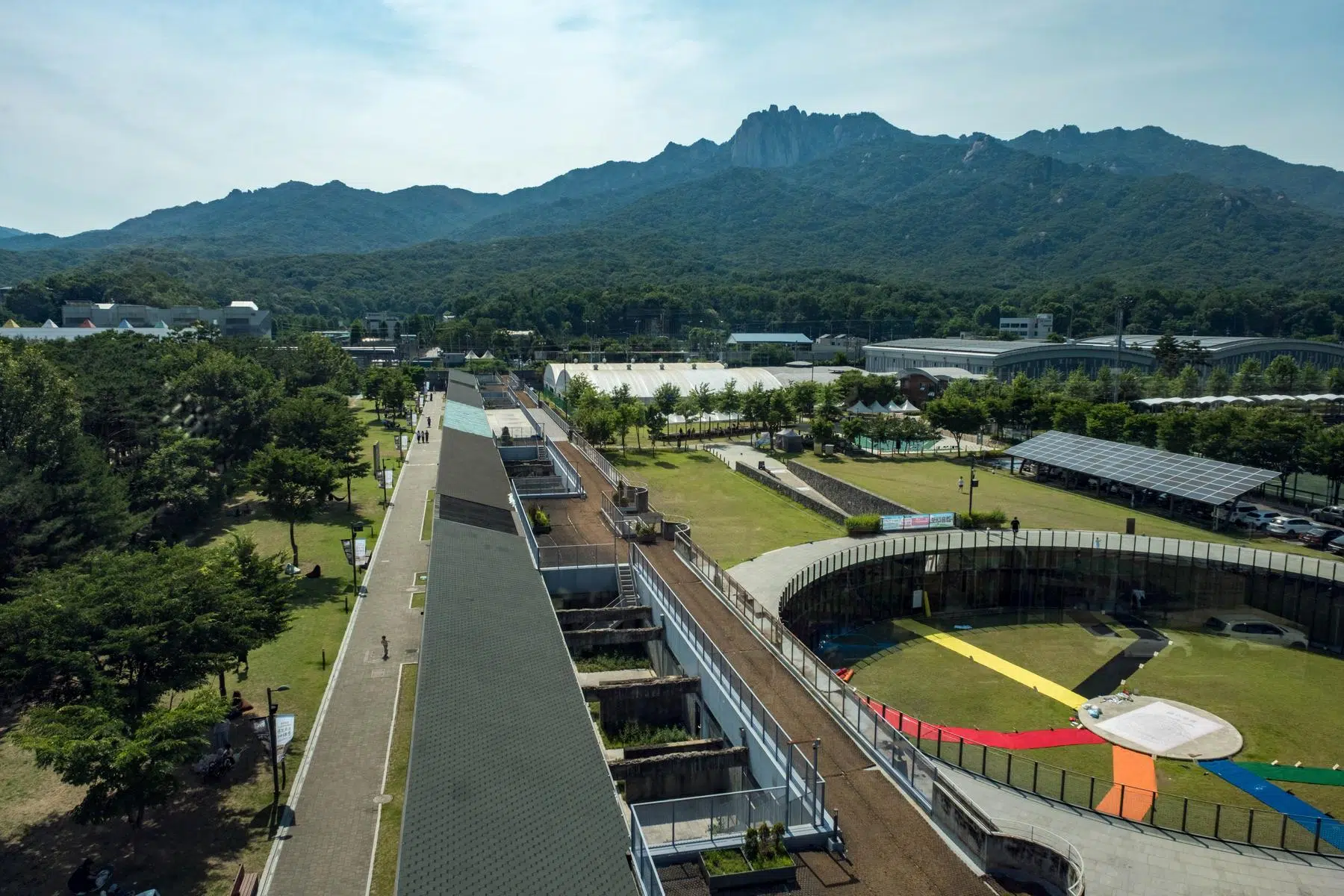
The building at the northern edge of the capital does not look like much from the outside. Five squat concrete blocks, arranged in a loose row along the eastern bank of the Jungnangcheon stream. The Dobongsan ridge fills the skyline to the northwest. A rooftop walkway connects the structures. What weekend visitors at the Peace Culture Bunker are standing on is a fortress originally designed to counter a North Korean ground invasion.
The secret defense facility was built between 1968 and 1970 on a bottleneck of strategic importance that communist forces had used when they swept through this corridor at the start of the Korean War, in the summer of 1950. It was designed to block any repeat of that movement.
The ground floor of each block contained large reinforced bays capable of sheltering armored vehicles and their crews. The upper three floors were apartments, occupied by military personnel and their families. The residential function served as a cover. The complex operated under the innocuous name “Simin Apartments”. Anyone looking at the building saw an unremarkable housing block. Photos and floor plans of the site in its original state can be viewed in the official Peace Culture Bunker brochure.
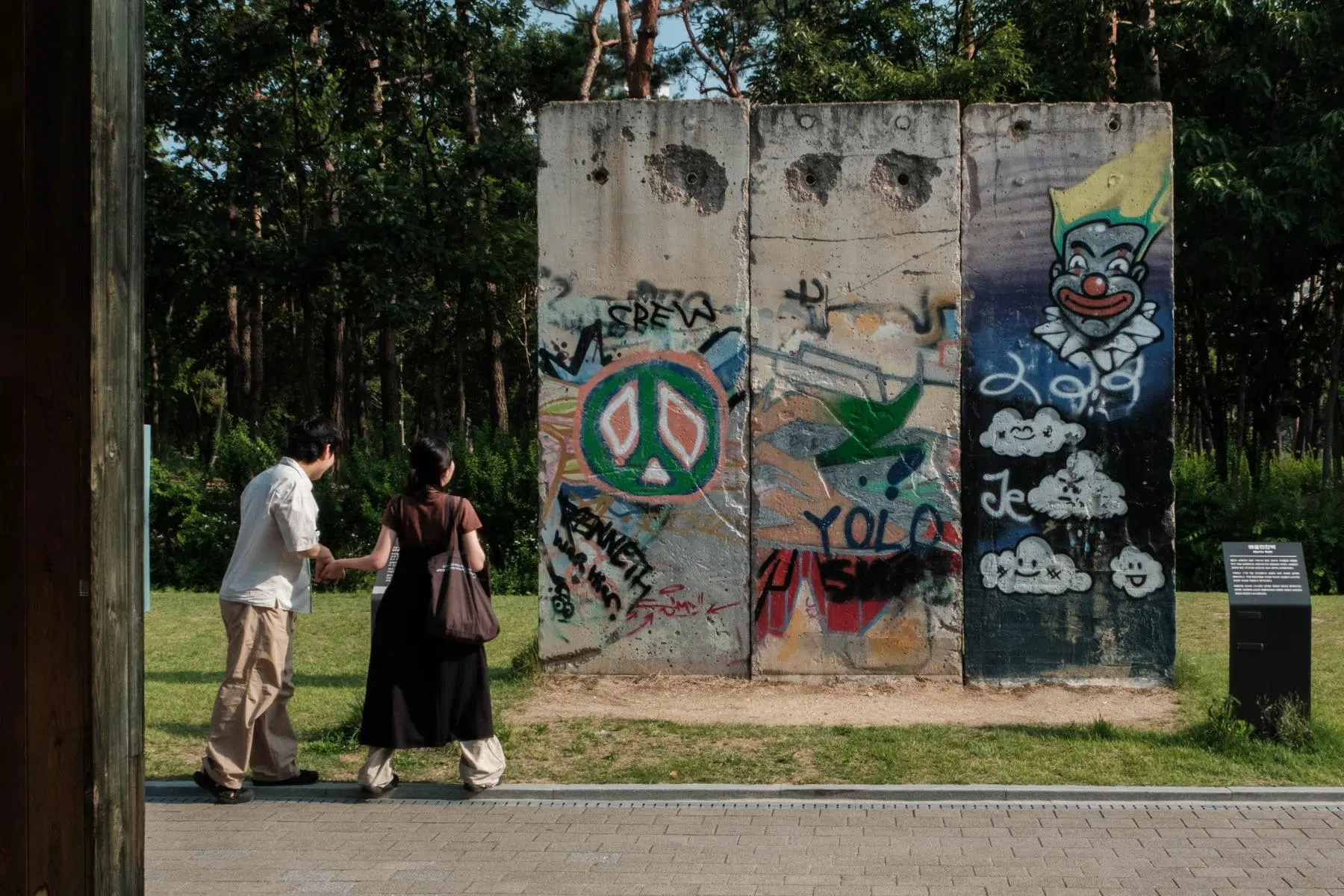
Three original sections of the Berlin Wall, donated by the City of Berlin, on display in front of the Peace Culture Bunker (June 2026).
The complex is more than 200 meters wide and about 40 meters deep. Similar dual-purpose structures were built elsewhere in Seoul during the same period, including the Yujin Arcade in Seodaemun-gu, constructed on the same logic: military infrastructure wrapped in the appearance of civilian life.
Both reflected the anxieties of the late 1960s, when a North Korean commando unit came within meters of the Blue House in January 1968 and president Park Chung-hee ordered an accelerated program of urban defense works across the capital.
The upper floors of the bunker deteriorated over the following decades. By 2004 they were deemed structurally unsafe and demolished, leaving only the five C-shaped ground-floor units.
For several years the site sat idle. In 2009 a riverside park was developed around the adjacent Dobongsan metro station. The question of what to do with the remaining hulk acquired some urgency.
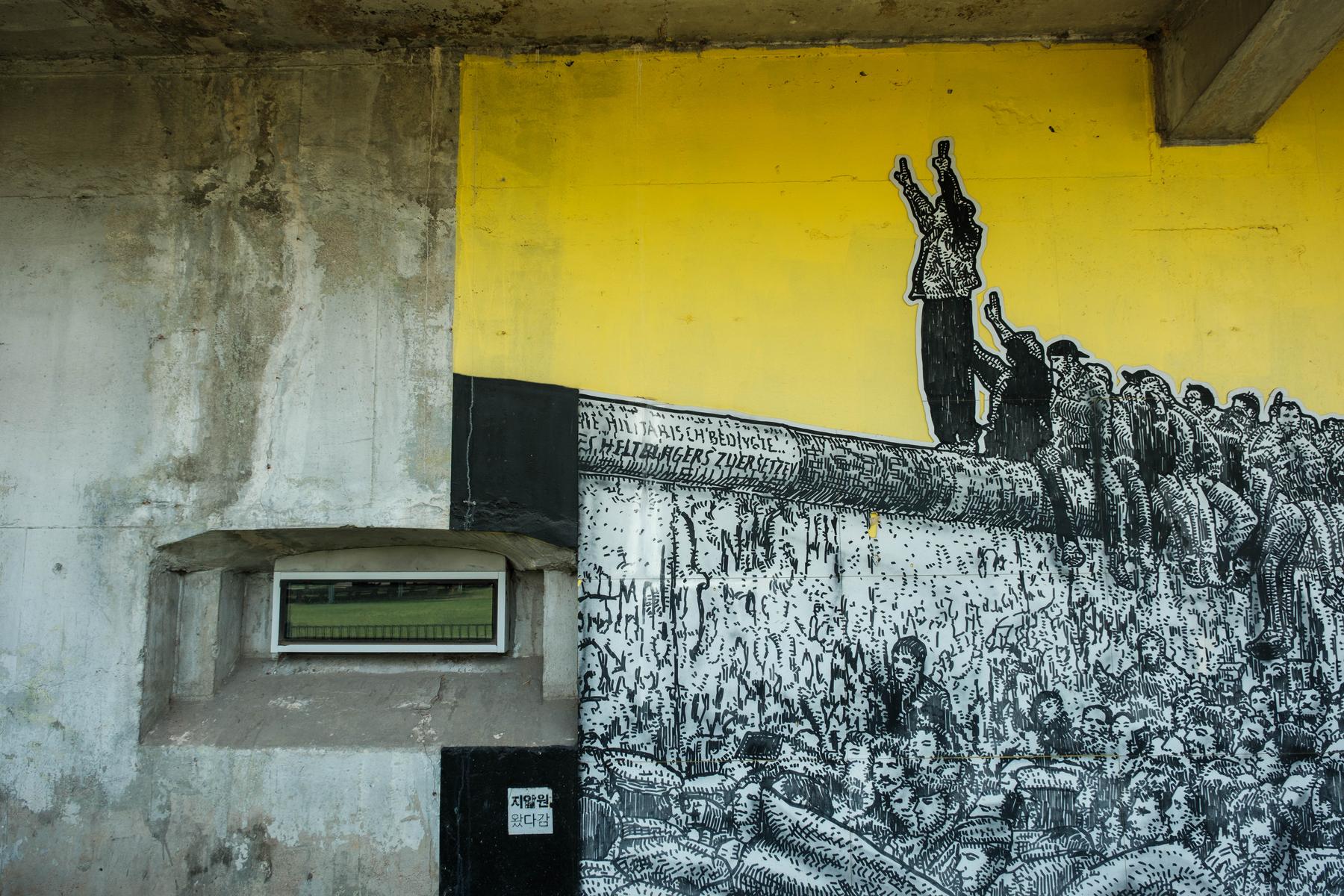
A mural depicting the fall of the Berlin Wall, next to a gun port from a former tank emplacement (June 2026).
In 2016, following an architectural competition, the Seoul Metropolitan Government commissioned CoRe Architects to convert the installation. The firm retained the raw concrete character of the original structure, added a 20-meter observation tower on the western end, and connected the rooftops of all five blocks into a continuous walking circuit.
The site opened to the public in October 2017 under its current name. In its first twelve months, more than 60,000 people visited.
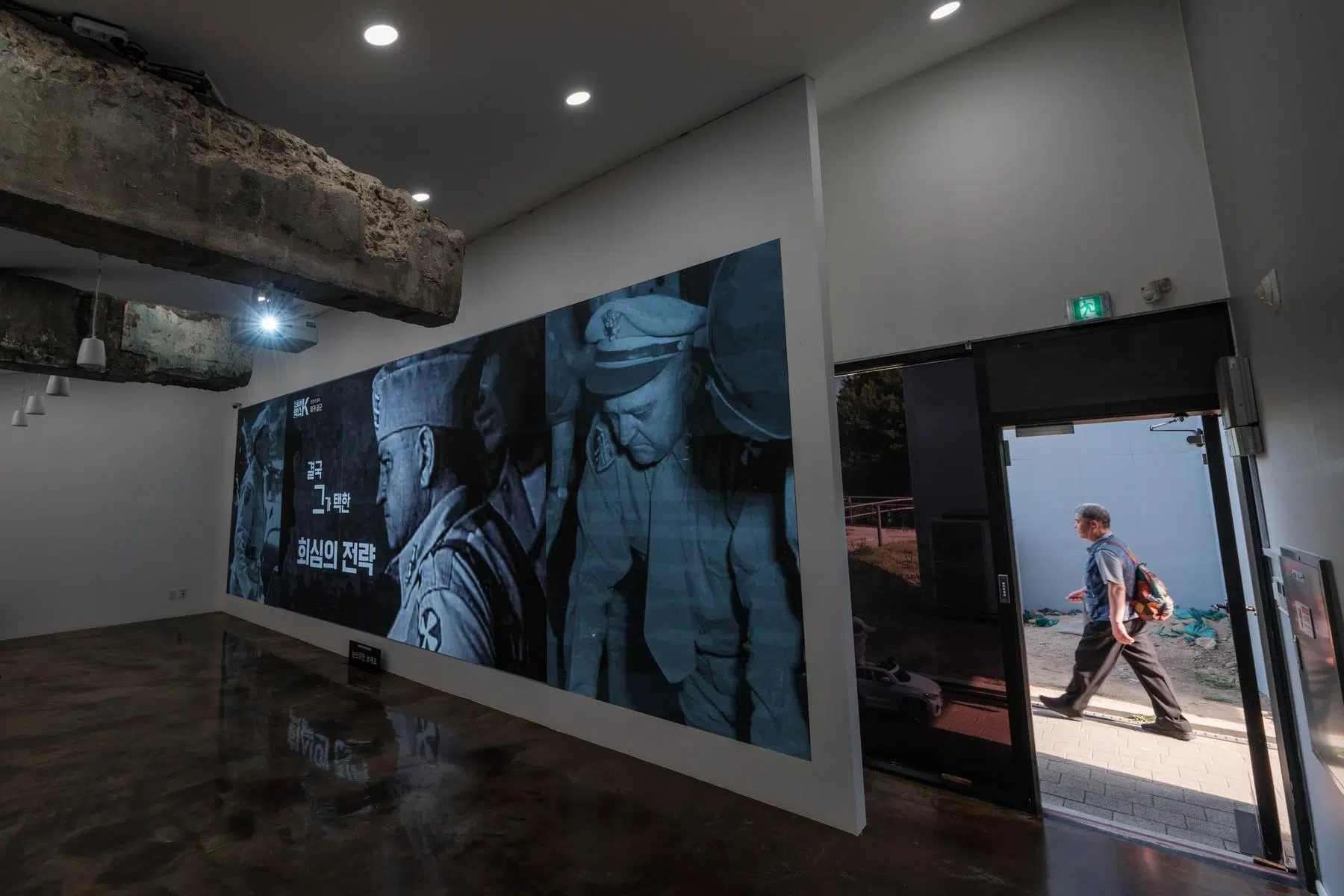
The programming at the Peace Culture Bunker is modest by the standards of Seoul’s larger cultural venues, which is part of its appeal.
The former tank bays are used as exhibition galleries and flexible event spaces. Several of the units function as residency studios leased to working artists, whose doors are often open during visiting hours. The fifth and easternmost block houses a small permanent exhibition on the history of the installation, with photographs and diagrams explaining its original military purpose.
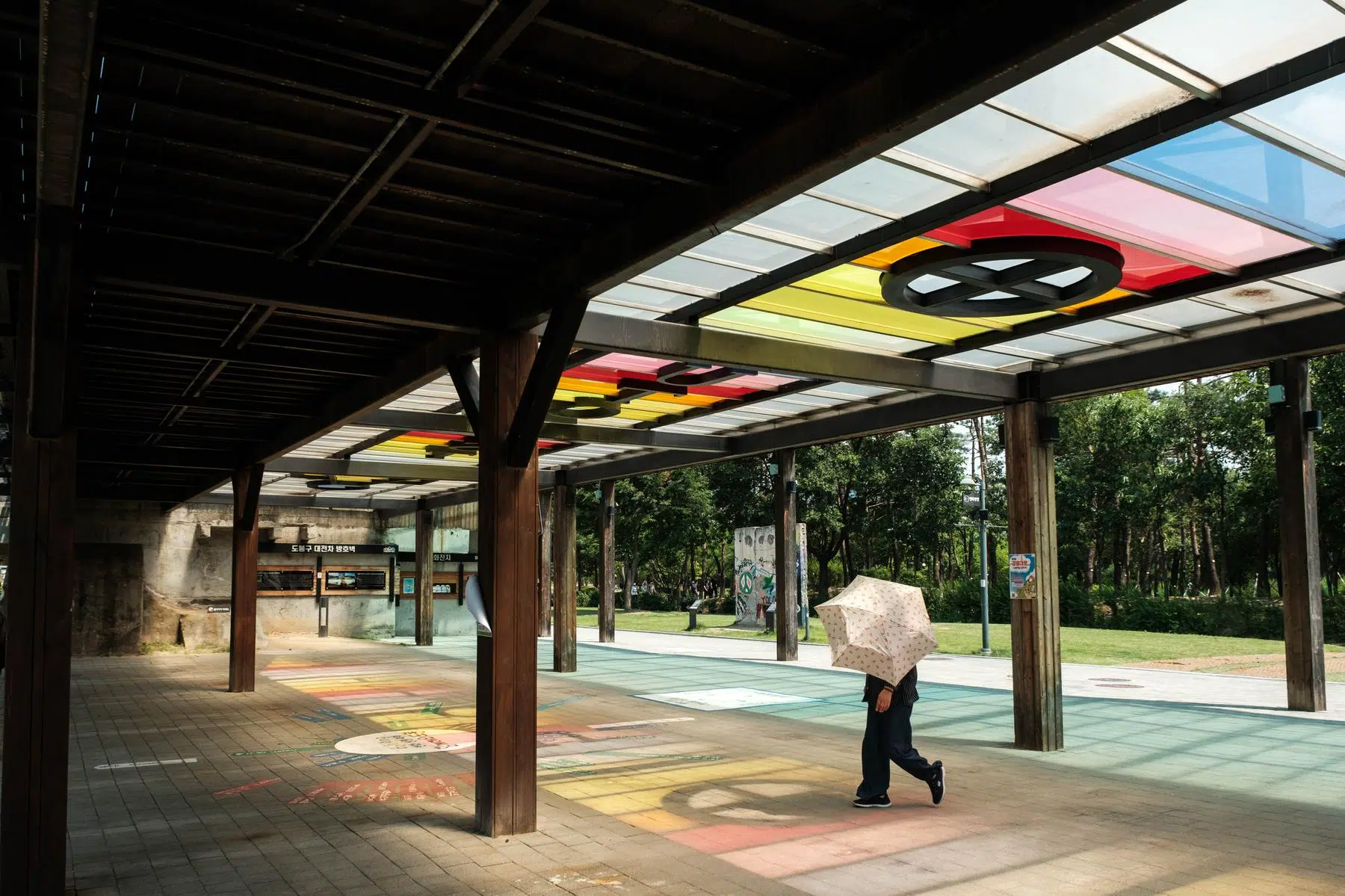
Temporary exhibitions rotate through the complex on themes that tend toward the abstract: questions of peace, memory, and urban space rather than the more explicit Korean War iconography found at sites closer to the DMZ. Weekend flea markets occupy the outdoor forecourt in spring and autumn. Craft workshops are offered on a reservation basis. Three slices of the Berlin Wall, donated by the city of Berlin, stand in the open courtyard.
To the north, across the administrative boundary between Seoul and Gyeonggi Province, Uijeongbu occupies a natural defile between the Bukhansan mountains to the west and the Suraksan and Cheonbosan ridges to the east.
The valley is narrow enough that any armored column moving south from the Dongducheon area toward Seoul is effectively funneled through it. Uijeongbu housed South Korean army units throughout the Cold War and hosted U.S. 2nd Infantry Division elements until their redeployment after 2004 to Camp Humphreys in Pyeongtaek, about 70 kilometers south of Seoul.
A few hundred meters north of the Peace Culture Bunker, where the Jungnangcheon crosses the Seoul-Uijeongbu municipal boundary, a row of concrete dragon’s teeth spans the stream channel.
The obstacles are visible from the riverbank path. They are the same type of pyramidal reinforced concrete blocks used across the northern approaches to Seoul: low enough to cross on foot, designed to hang up the belly of a tank attempting to ford the shallow water at this point. No sign identifies them. Most joggers and cyclists crossing the footbridge just above don’t even glance at it.
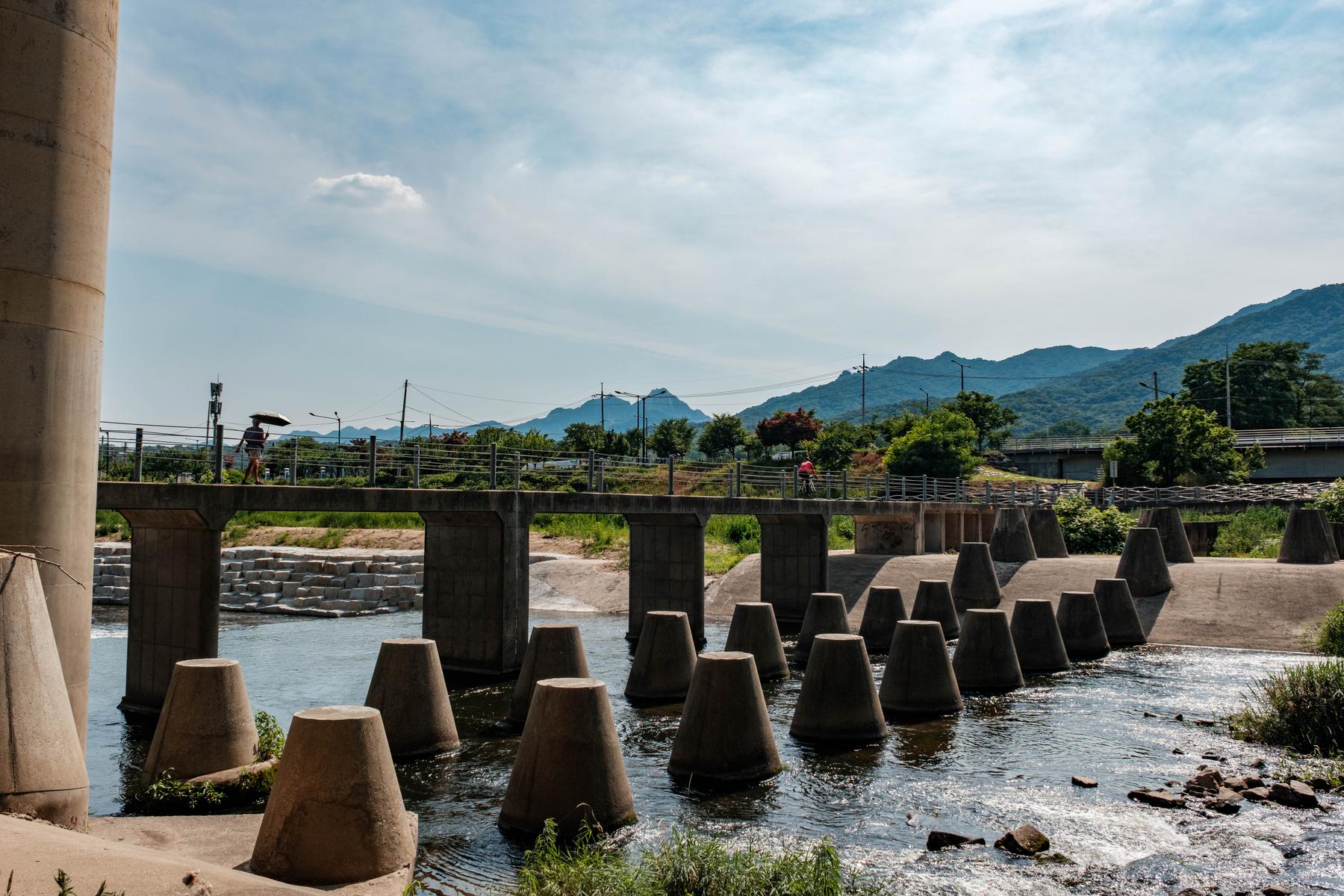
Dragon’s teeth anti-tank barriers straddle the Jungnangcheon stream in Uijeongbu, a few hundred meters north of the Peace Culture Bunker (June 2026).
This post was last updated on: June 16, 2026