Central Front
중부 전선
The most remote part of the DMZ winds through wild landscapes and rugged ridges.


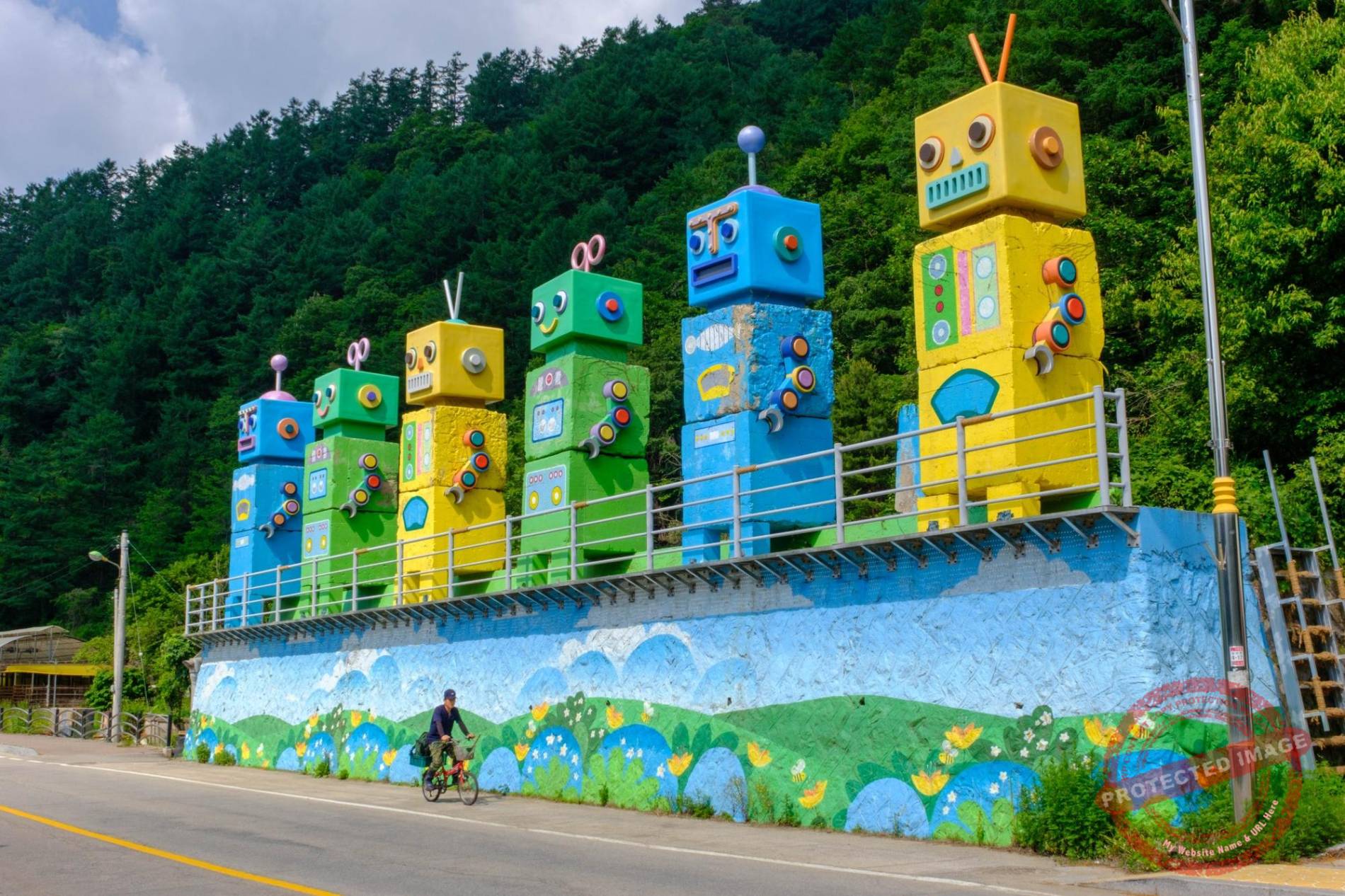
An imaginatively decorated anti-tank obstacle in Sanyang, north of Hwacheon (June 2025).
To the east of Cheorwon stretches the wildest and most inaccessible part of the border. On the Central Front of the unfinished Korean War, the Military Demarcation Line runs along ridgelines often exceeding 1,000 meters in elevation, over cliffs and remote rivers.
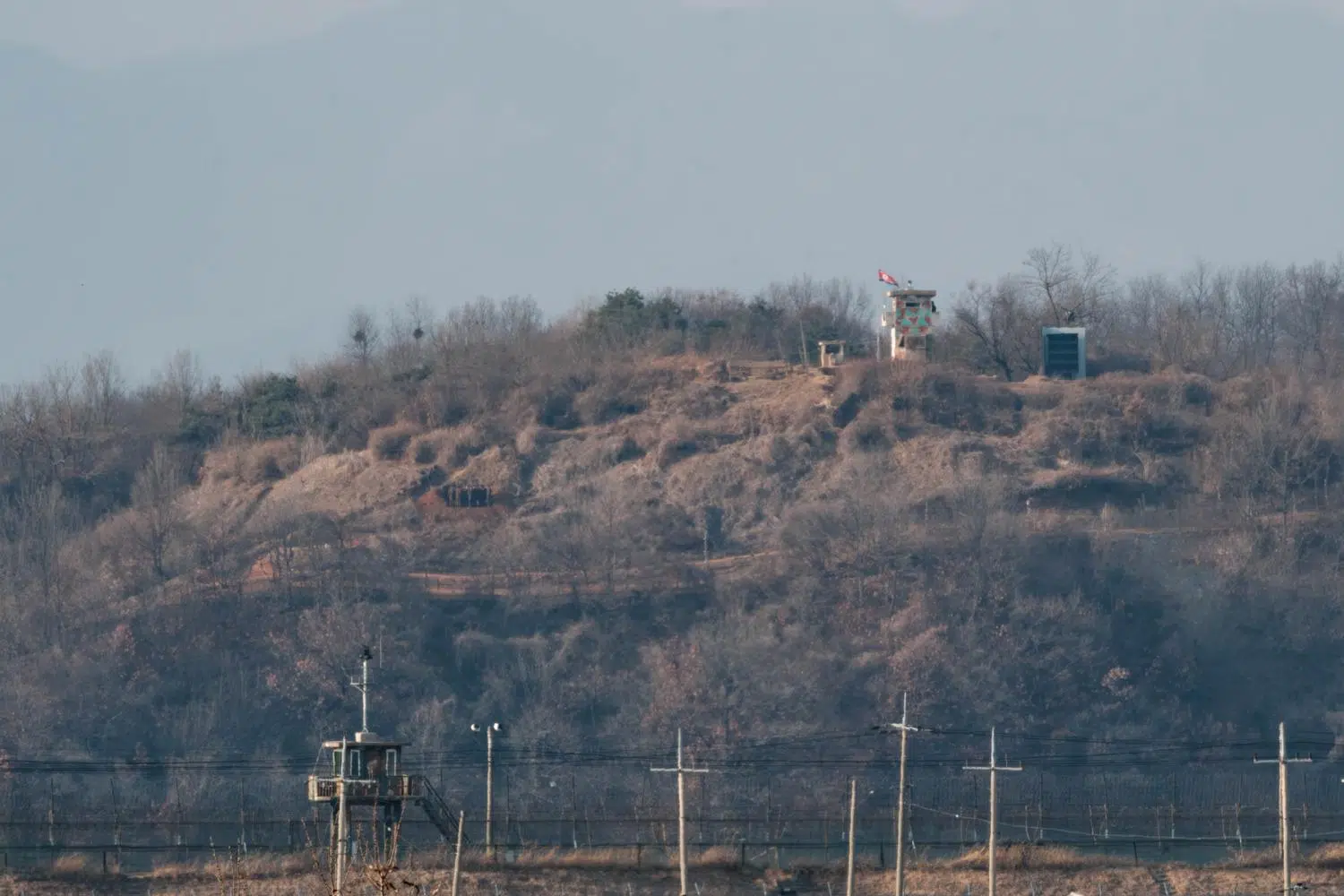
From a distance, one can sometimes spot a guard Post perched atop a hill, and trenches slicing through the dense forest along the mountainside. When you’re unfamiliar with the area, it’s often hard to tell from a distance where the border is and which side a particular guard post belongs to. It is an ultra-militarized region where civilians are not exactly welcome, even if a few observation posts allow some visitors under strict conditions.
The mountains of the central front were the scene of particularly horrific battles during the final year of the Korean War, such as those at Triangle Hill or Sniper Ridge, which resulted in tens of thousands of deaths. Each side sought to seize the high ground overlooking the strategic “Iron Triangle” between Cheorwon, Gimhwa, and Pyeonggang. Securing total control of this plain, which provides access to the entire Peninsula, would have been tantamount to winning the war. In the end, neither side succeeded.
As you leave Cheorwon heading east, you can spot in the distance to the north Mount Oseong (Oseongsan), which rises to 1,062 meters, and the massive antenna installed at its summit by the North Korean military to eavesdrop on the South. The strategic importance of this mountain is extreme.

Birds forage in a river east of Cheorwon. In the background is Sniper Ridge, the DMZ and Mount Oseong (alt. 1,062 m), in North Korea, whose summit houses a military radio observation post with a huge antenna to spy on the South’s communications (June 2025).
“Whoever loses Mount Wuseong (the Chinese name of the mountain) will have to take responsibility for the history of Korea”, said Peng Dehuai, the commander of the Chinese army during the Korean War, when giving to his troops the order to hold it at all costs, adding: “Mount Wuseong is the gateway to the central front of Korea. If we lose Mount Wuseong, we will have to retreat 200 km.” In the end, the communists held their ground. But legend has it that the mountain’s altitude dropped by three meters during the war due to heavy bombing and shelling.
Today, Mount Oseong has been somewhat forgotten by the South Koreans but remains a site of major strategic importance for the North. Every North Korean leader has reportedly visited it at least once during their time in power.
There is no better location to observe the South. Under ideal weather conditions, such as an exceptionally clear winter night, Seoul’s 555-meter-tall Lotte World Tower, 94 km away, can be seen from its summit.
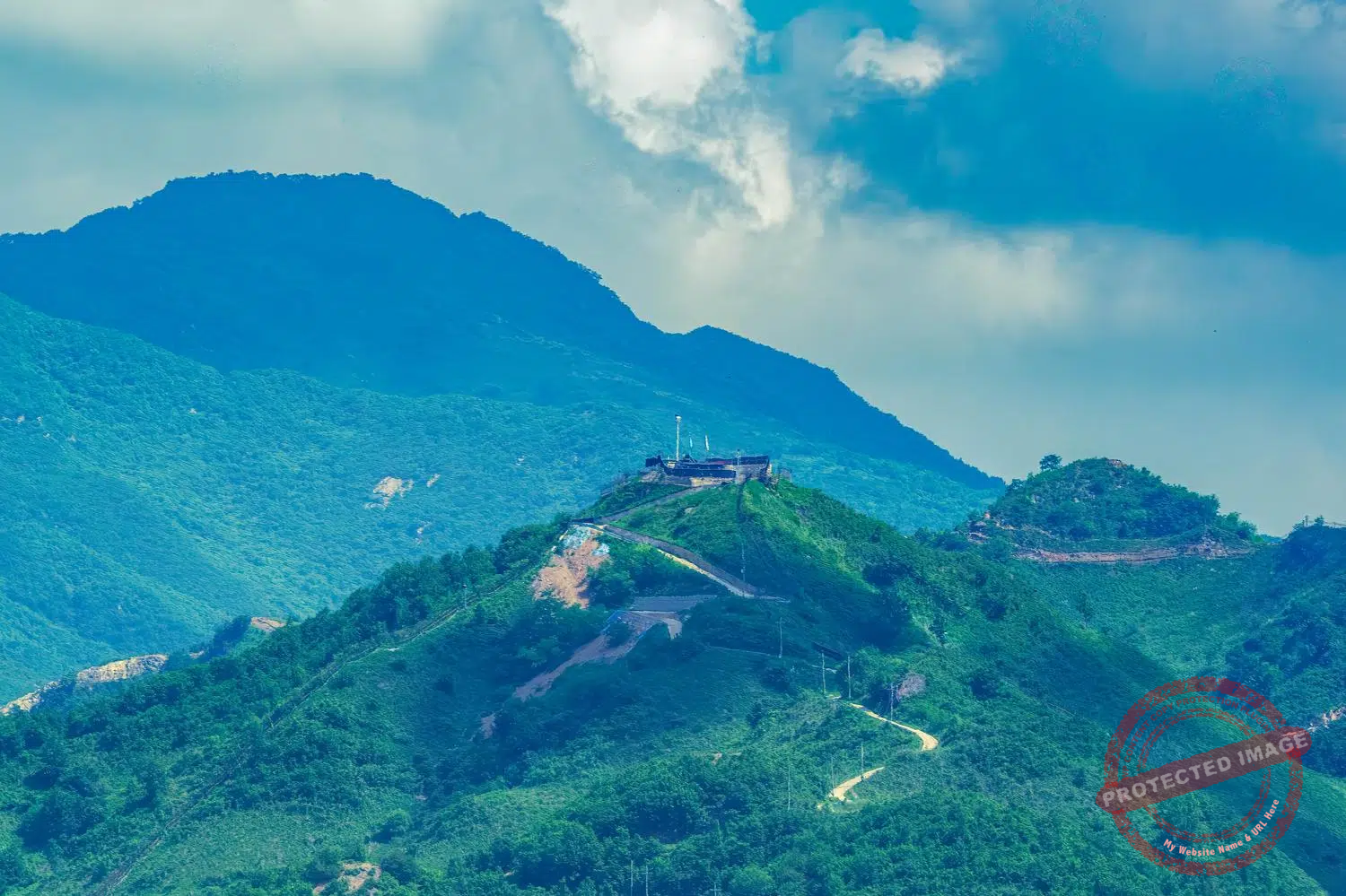
Inside the DMZ, a South Korean guard post at the top of one ridge faces a North Korean guard post at the top of another: a vision repeated all along the border in rugged central Korea (June 2025).
In addition to the antenna and radar station, the mountain is reportedly the starting point of the so-called “Underground Great Wall of China”, a huge network of tunnels dug by Chinese forces during the war and said to stretch nearly 200 kilometers along the frontline, and that is still in use today.
The mountain itself is said to be a gigantic fortress, criss-crossed by hundreds of underground galleries and bunkers that are said to hide four divisions, or at least 28,000 soldiers. Telescopic observation reveals dozens of loopholes and artillery emplacements in the mountainside.

A remote North Korean guard post on the top of a mountain in the Central Front (May 2026).
Driving from Cheorwon to Hwacheon along National Route 5 gives you a close-up view of the isolation and tension of this border region. The winding road runs right along the southern edge of the DMZ, inside the Civilian Control Zone. It is therefore forbidden to drive there at night. During the day, every car entering and leaving the CCZ is checked at a military checkpoint. Stopping along the way is strictly forbidden, and you have a maximum of 30 minutes to complete the 25 kilometer journey.
The forest and mid-mountain landscape is beautiful, but apart from a succession of barracks, shooting ranges, anti-tank obstacles, military vehicles and surveillance cameras, there is not much to see.

A monument to peace in the garrison village of Sanyang-ri, adjacent to the Civilian Control Zone (May 2026).
At the edge of the Civilian Control Zone, the road passes through Sanyang-ri, a village that lives according to the rhythm of the garrison stationed there—in this case, the 7th Infantry Division, nicknamed Chilsung (“Seven Stars”)—which is responsible for defending this mountainous section of the front. To pass the time on their evenings off in this godforsaken place, the conscripts have a fairly wide selection of restaurants to choose from, and even a “DMZ Cinema.”
The 7th division operates the Chilseong observation post, about 10 kms north of the village and at the edge of the DMZ, which usuallly welcomes a maximum of 25 civilian visitors twice a day under military escort and with no photography allowed. Although little known, this observatory provides a rare, direct view across the border and on the Geumseongcheon stream flowing from South to North Korea, an atypical hydrological feature in the Peninsula.
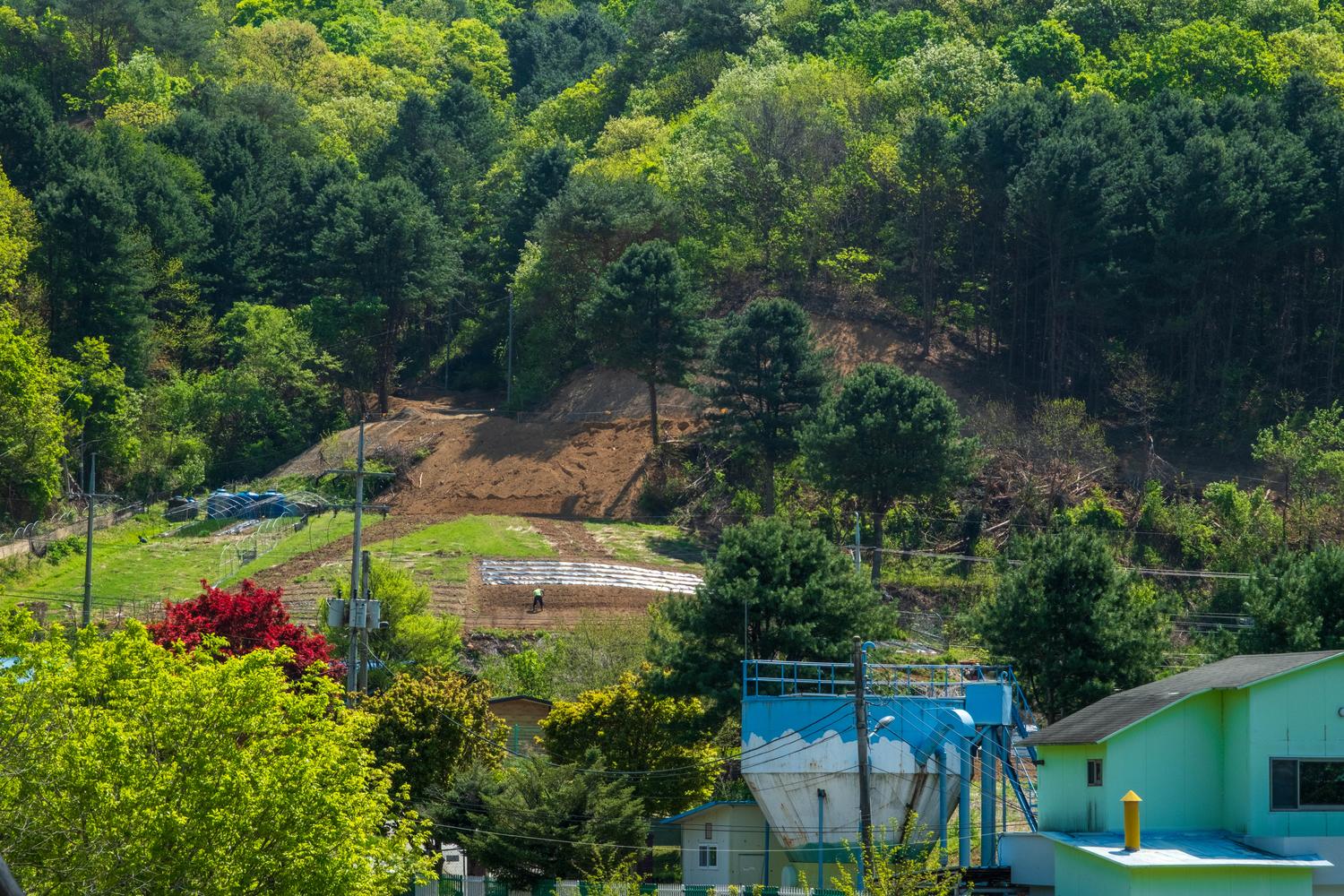
A farmer works in his field in the village of Sanyang (May 2026).
In the middle of this rather eerie no-man’s-land stands another tourist attraction as grandiose as it is well-hidden. The Baegamsan Cable Car, which in 15 minutes takes you to the top of a mountain 1,178 meters above sea level.
Here, a military observation post has a section open to the public from which, on a clear day, you can see the mountains of North Korea and the huge reservoir of the Imnam Dam, the source of many scares in the South, as we’ll see in the next story. The cable car also serves to supply the military stationed up there.
It took eight years of titanic work to build this cable car, which opened in 2022 and climbs over two kilometers of almost vertical slopes. And yet, as is often the case in South Korea, where the desire to develop tourism near the DMZ and the security measures imposed by the army don’t always mix, everything seems to be done to dissuade the public from finding it. Daily visitors are limited to 500 people and you can’t get there directly by yourself.
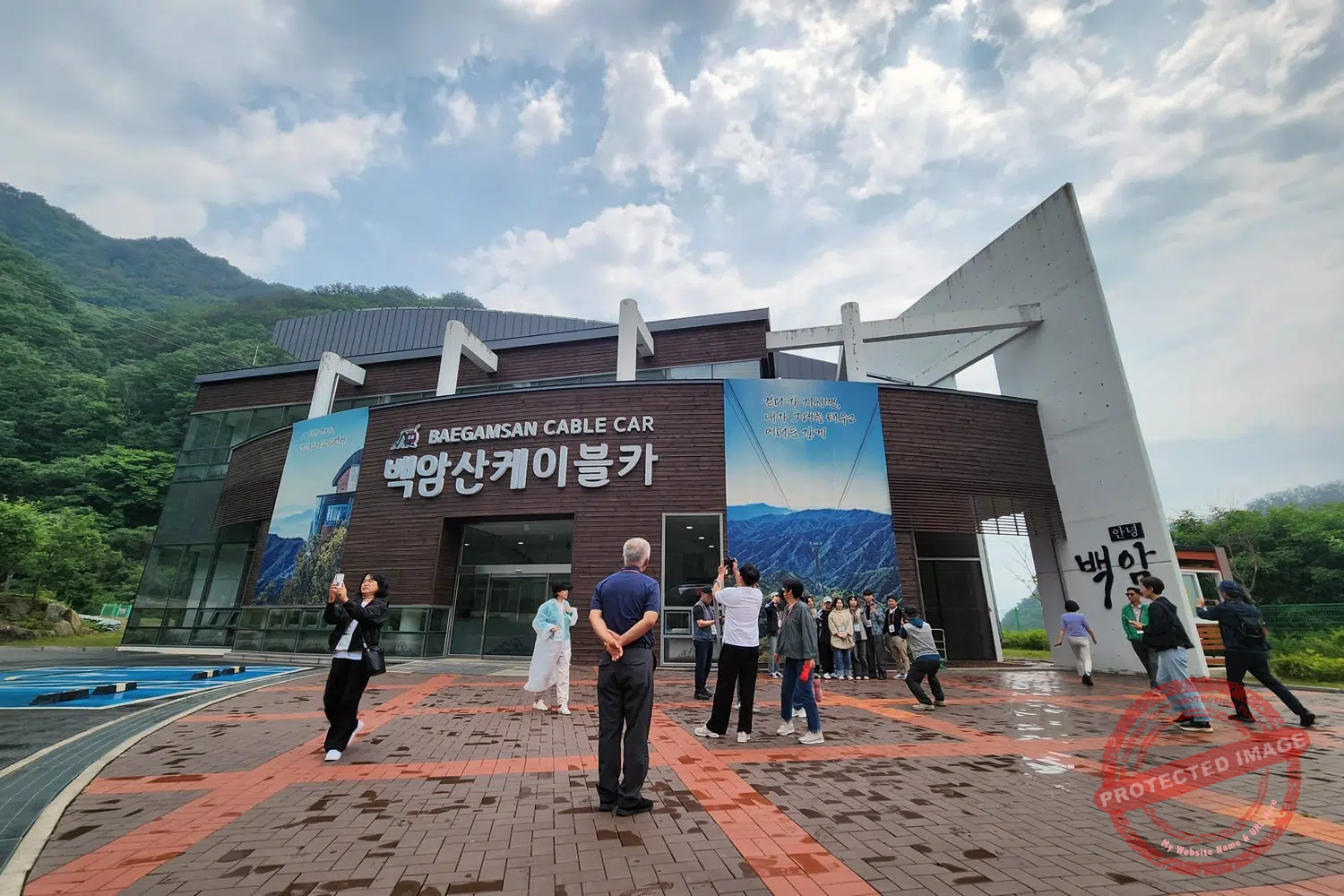
Visitors take pictures at the lower boarding station of the Baegamsan Cable Car (June 2025).
Access is only allowed via designated shuttle buses from Hwacheon, which pass through two military checkpoints to reach the boarding station. And once you are there, photography of the breathtaking mountain scenery before your eyes is strictly forbidden and enforced by military guards (a few selfies and family photos near the bottom station of the cableway are tolerated, however). This makes the overall experience rather frustrating.
Like virtually every mountain in the region, Mount Baegam has a bloody past. It was here that the Geumsong battle, the last major one of the Korean War, took place in July 1953, just a few days before the armistice was signed. In a bid to gain territory before the cessation of hostilities, the Chinese army launched a gigantic offensive against the South Korean troops holding this part of the front. It is estimated that tens of thousands perished within a week, although estimates vary. The Chinese could not change the broader outcome, but successfully captured portions of the salient and improved their defensive lines just before the ceasefire.


A rock riddled with bullet holes and dummy soldiers used by the South Korean military as targets for shooting practices: the Sergeant Kim Soo-hyun Memorial, located on a mountain road between Cheorwon and Hwacheon, bears witness to a deadly infiltration by North Korean soldiers in 1964. A nearby sign reads: “With the belief of sure victory, we shall achieve unification by annihilating communism!” (May 2026).
The remote Central Front region holds a few more surprises, such as the anti-tank obstacle transformed into a row of colorful robots by an imaginative artist in Sangyang-ri (top photo), and a completely forgotten roadside monument commemorating a soldier killed by North Korean infiltrators in November 1964.
It is a memorial to Sergeant Kim Soo-hyun, who was fatally wounded by a bullet to the abdomen while pursuing two armed North Korean agents who had infiltrated South Korea. Before falling, the soldier had time to shoot down one of the two enemies. The other was captured in a nearby village nine days later upon a local resident’s report. A rock riddled with dozens of bullet holes still bears witness, apparently, to the violence of that skirmish (even though I’m not sure whether these impacts are really due to the incident in question, or whether they are the result of unrelated live-fire exercises).
Erected by the 50th Regiment of the 15th Infantry Division, to which the fallen soldier belonged, the memorial also features an altar and a sign proclaiming: “With the belief of sure victory, we shall achieve unification by annihilating communism!”
Dummy soldiers wearing uniforms reminiscent of those of the North Korean army have been placed here and there for decorative purposes. These metal figures were commonly used, at least until recently, as targets for shooting exercises by the South Korean armed forces.

An anti-tank obstacle celebrates the ROK 7th Infantry Division on a road north of Hwacheon (May 2026).
This post was last updated on : May 18, 2026.