Imjingak
임진각
The border is 7 kilometres away. You cannot see North Korea from here. That has never stopped anyone from coming.


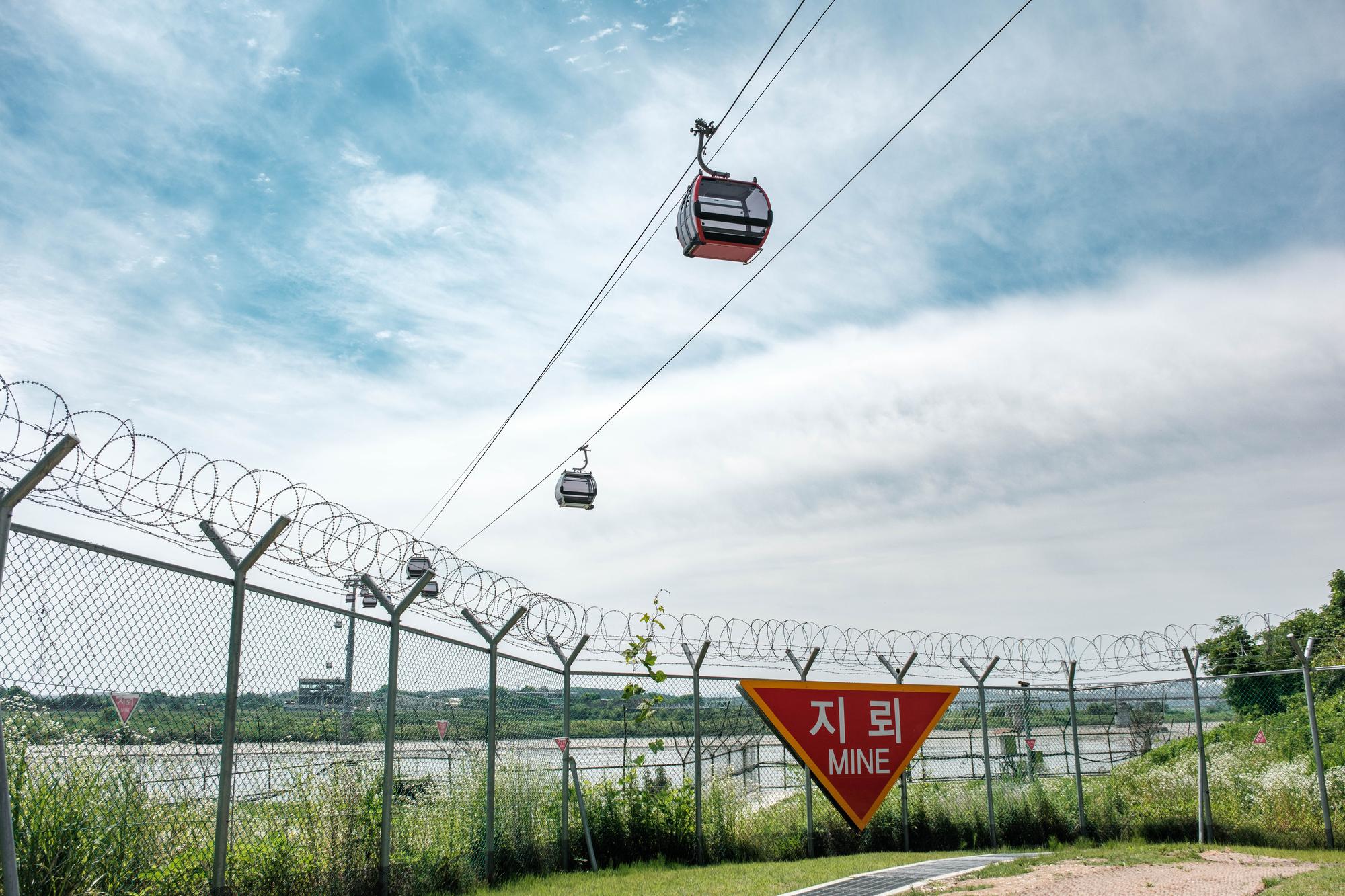
The ‘Paju Imjingak Peace Gondola’, sometimes wrongly nicknamed ‘DMZ Gondola’, crosses the Imjin River into the Civilian Control Zone (June 2026).
Anyone who has ever taken an organized DMZ tour from Seoul has passed through Imjingak. Open-air museum, creepy amusement park, last stop before the real warzone, place of remembrance, tourist trap, total rip-off… they all apply to this place, which sums up all the contrasts and all the weirdness of the Korean border area.
Everything at Imjingak is done to give visitors the thrills they have paid for, by making them believe that the evil North Korean enemy is lurking nearby. You might come across one or two western vloggers here, barely off their tour buses, streamcam running, narrating their journey to camera as if they were filing dispatches from the front in 1951.
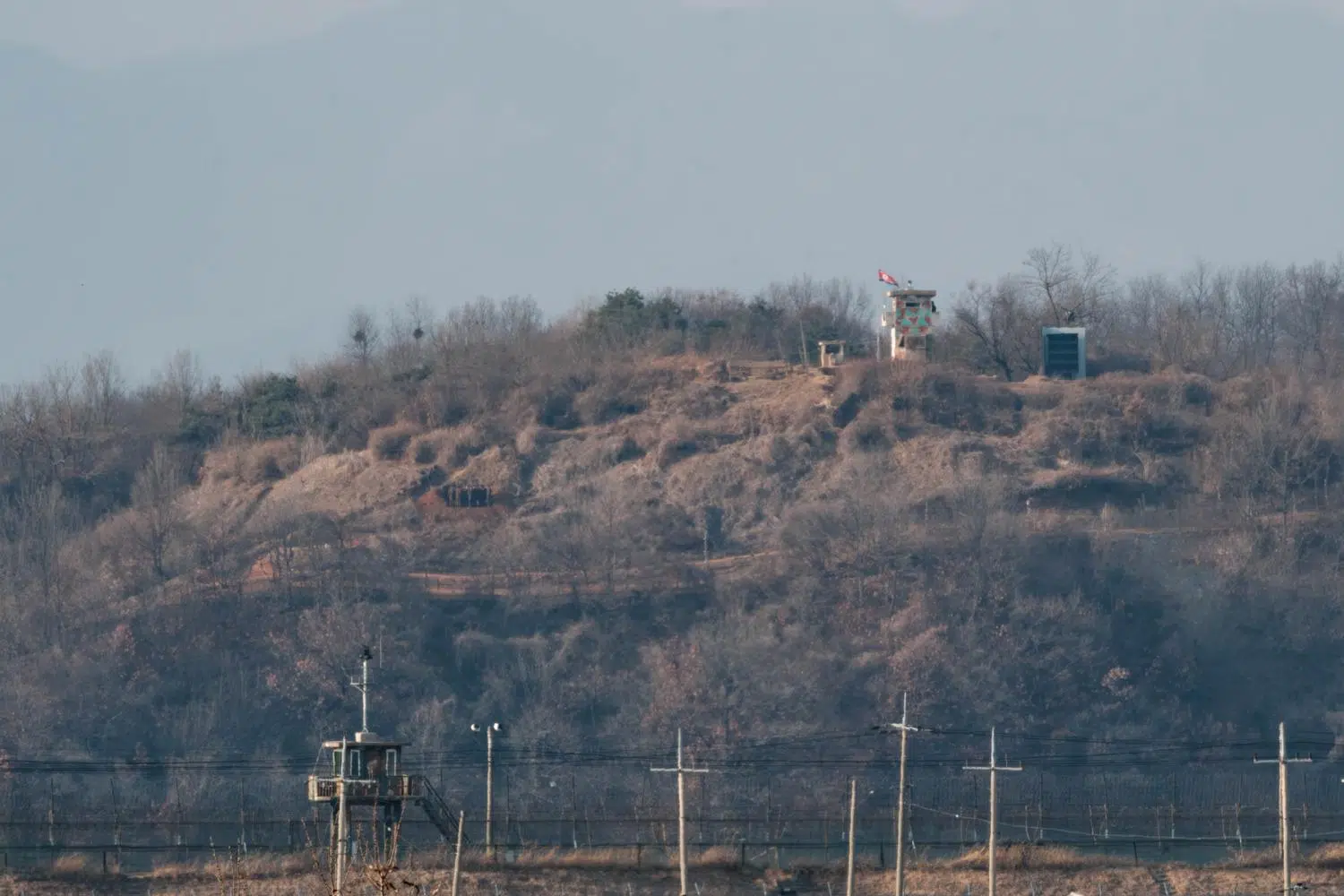
The border is 7 kilometres away and, from Imjingak itself, it is almost impossible to see North Korea. The Peace Gondola that takes you to the other side of the Imjin river gets you marginally closer to the truth: at the top of its highest pylon, on a clear day and with some luck, a sliver of North Korean mountain ridge is just about visible on the horizon for a few seconds. You can also sometimes catch a glimpse of a few North Korean peaks from the rooftop of one of the buildings housing cafés and souvenir shops. But the immediate proximity of the North Korea-originated Imjin River, with its barbed-wire-lined banks and border-like appearance, and the railway bridge which crosses it, reinforce the impression of having arrived at the edge of the free World.
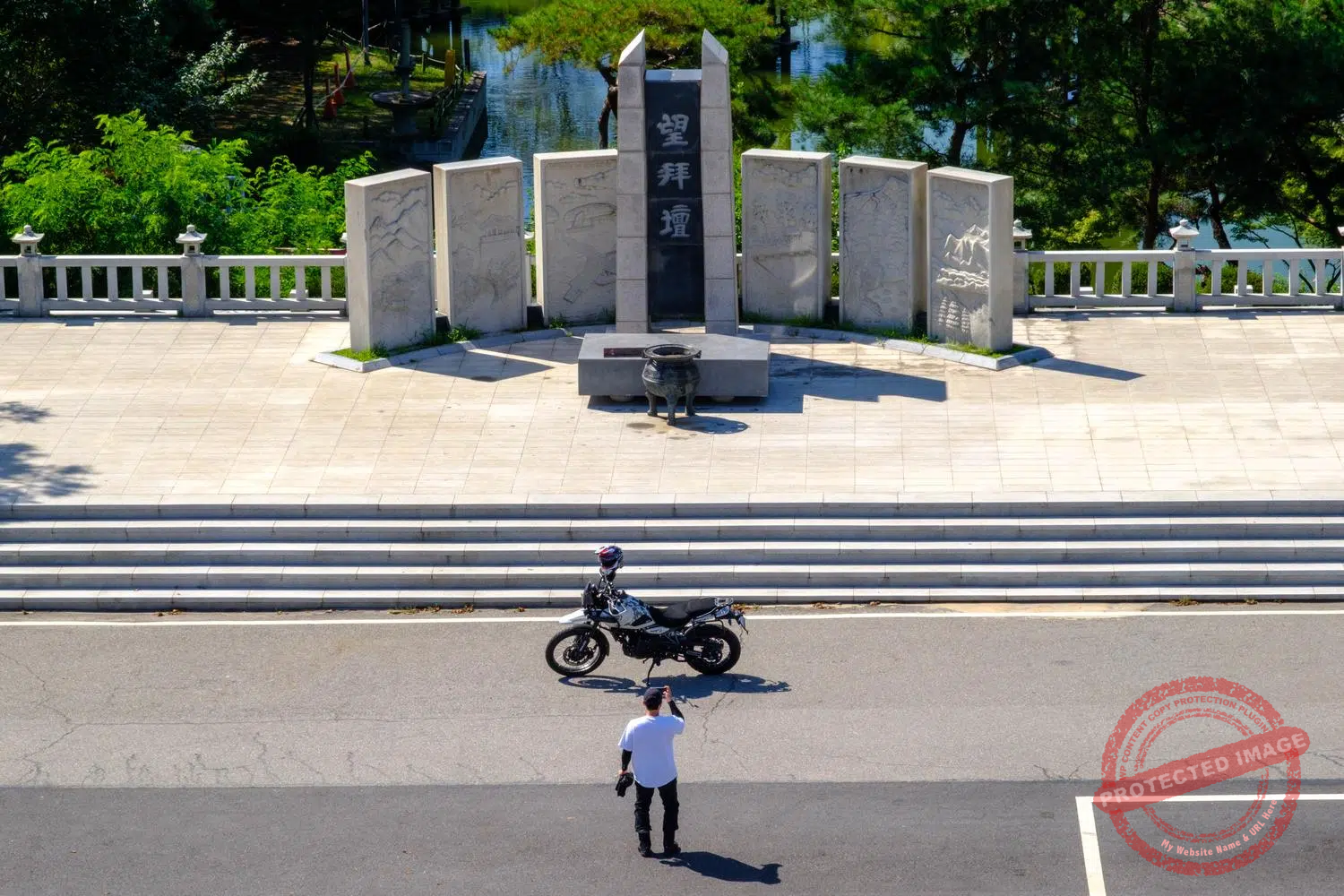
A biker takes a photo of his machine in front of the Mangbaedan, an altar in Imjingak where separated Korean families come to perform ancestral rites during major holidays (September 2025).
At dawn, the huge car park fills up with coaches carrying foreign tourists eager for access to the DMZ. In the afternoon, Korean cars take over the area. Most of the locals come here to relax at the nearby and spacious Pyeonghwa Nuri Park, or to enjoy the “Peace Land” amusement park and its pendulum ride in the shape of a pirate ship. The presence of this fairground attraction just a few kilometers from the North Korean border may seem puzzling. But it reflects the local authorities’ desire to make Imjingak not only a place of remembrance, but also a family-friendly destination.
Imjingak is the mecca of “DMZ tourism”. More than 1.2 million people pass through here every year, a figure comparable to the annual visitor numbers at sites such as the Mont Saint-Michel Abbey in France, Stonehenge in the United Kingdom, Alcatraz in the United States or Pompeii in Italy.
Organised trips must stop here while the guides queue up at the ticket office where permits are issued to enter the Civilian Control Zone (CCZ), on the other side of the Imjin River, and continue to the Dora Observatory and the ‘Third Tunnel of Aggression’ tourist sites inside the DMZ.
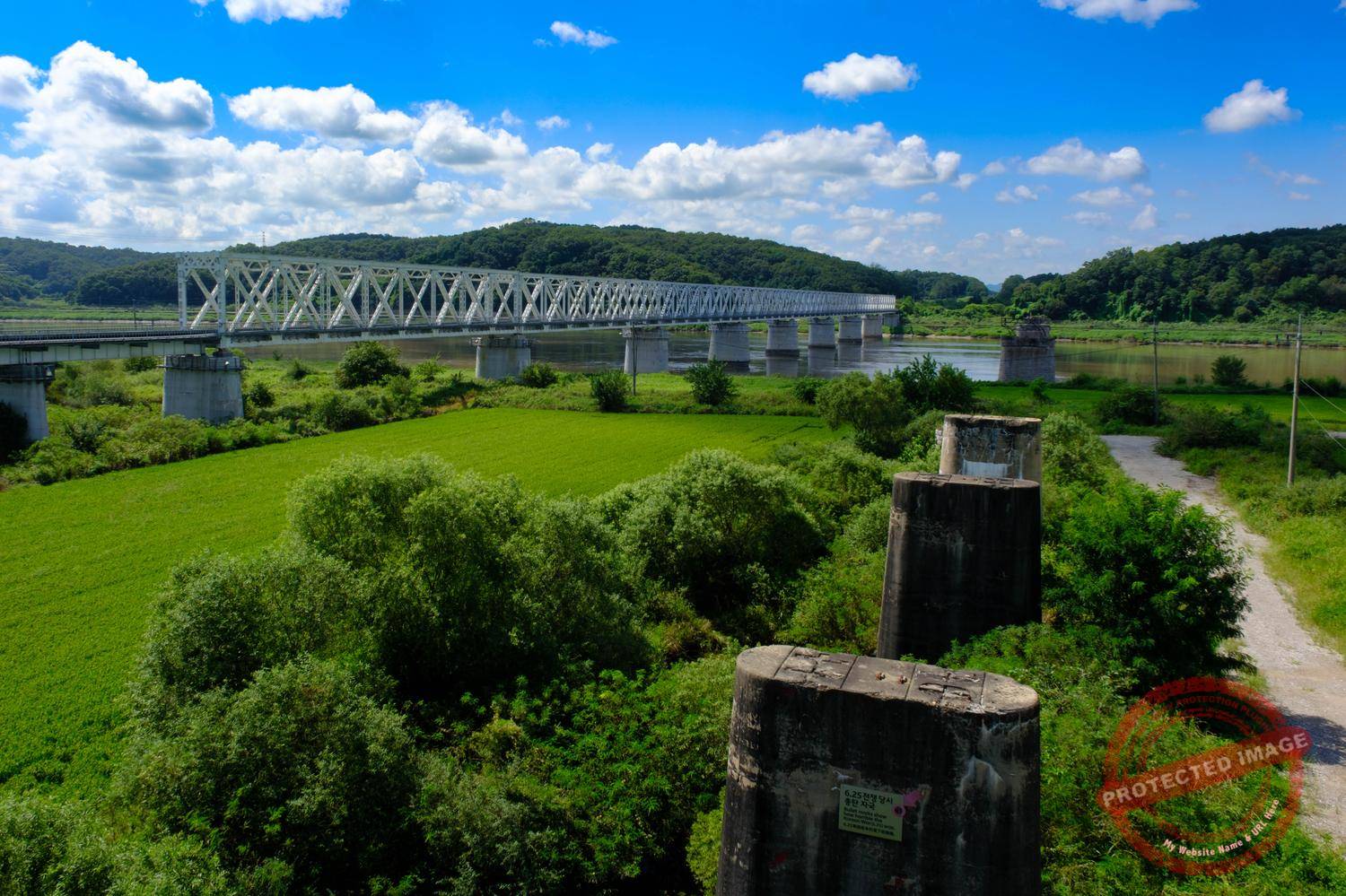
The railway bridge across the Imjin River at Imjingak. On the right, the bullet-riddled pillars of the old bridge, destroyed during the Korean War (September 2025).
The wait at Imjingak can be long, as permits to enter the CCZ are issued on a first-come, first-served basis and for a specific time slot. At weekends during the high season, it is not uncommon for groups to arrive here before six in the morning and only be able to continue their journey in the early afternoon.
This is good business for the many fast-food outlets, cafés and souvenir shops.
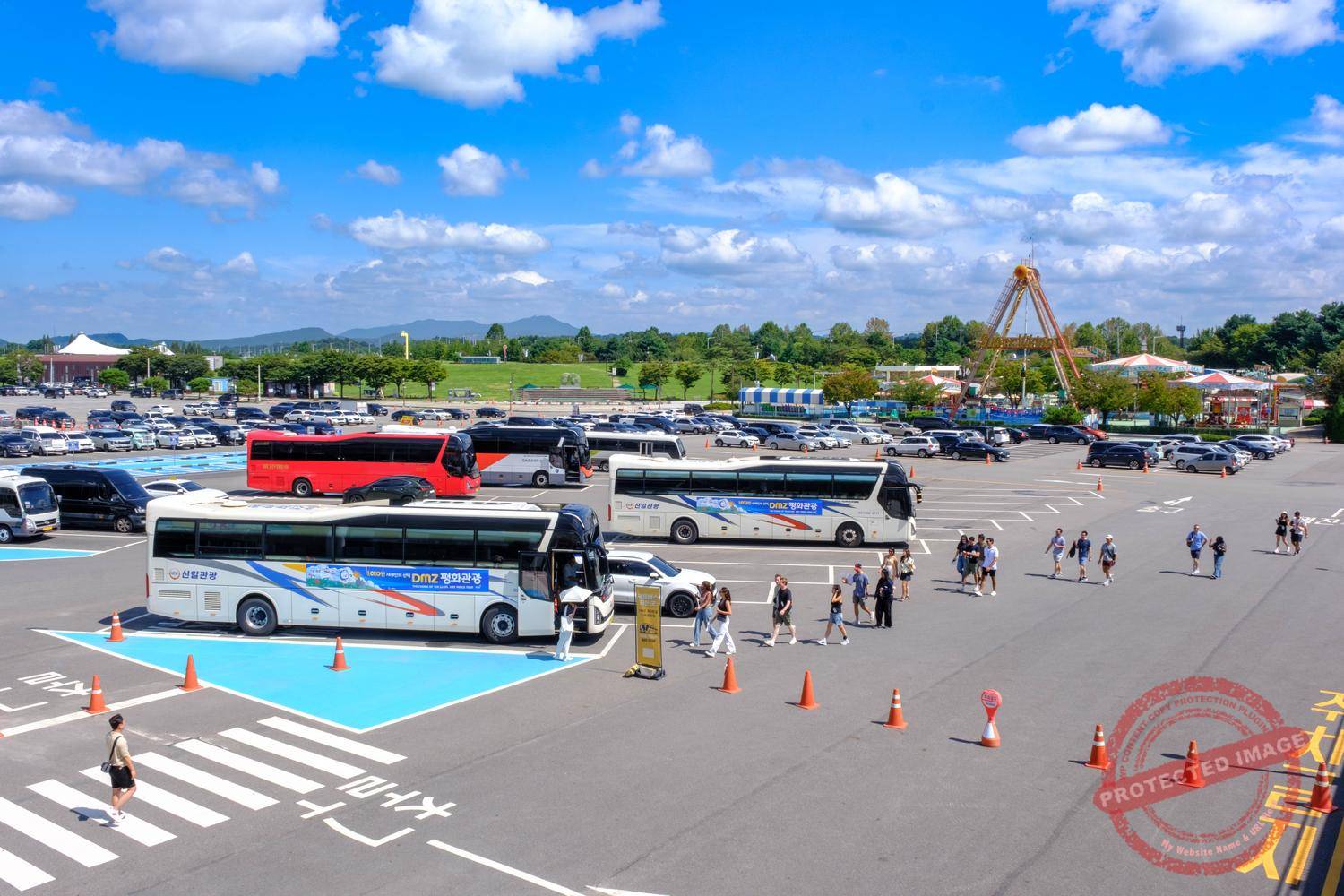
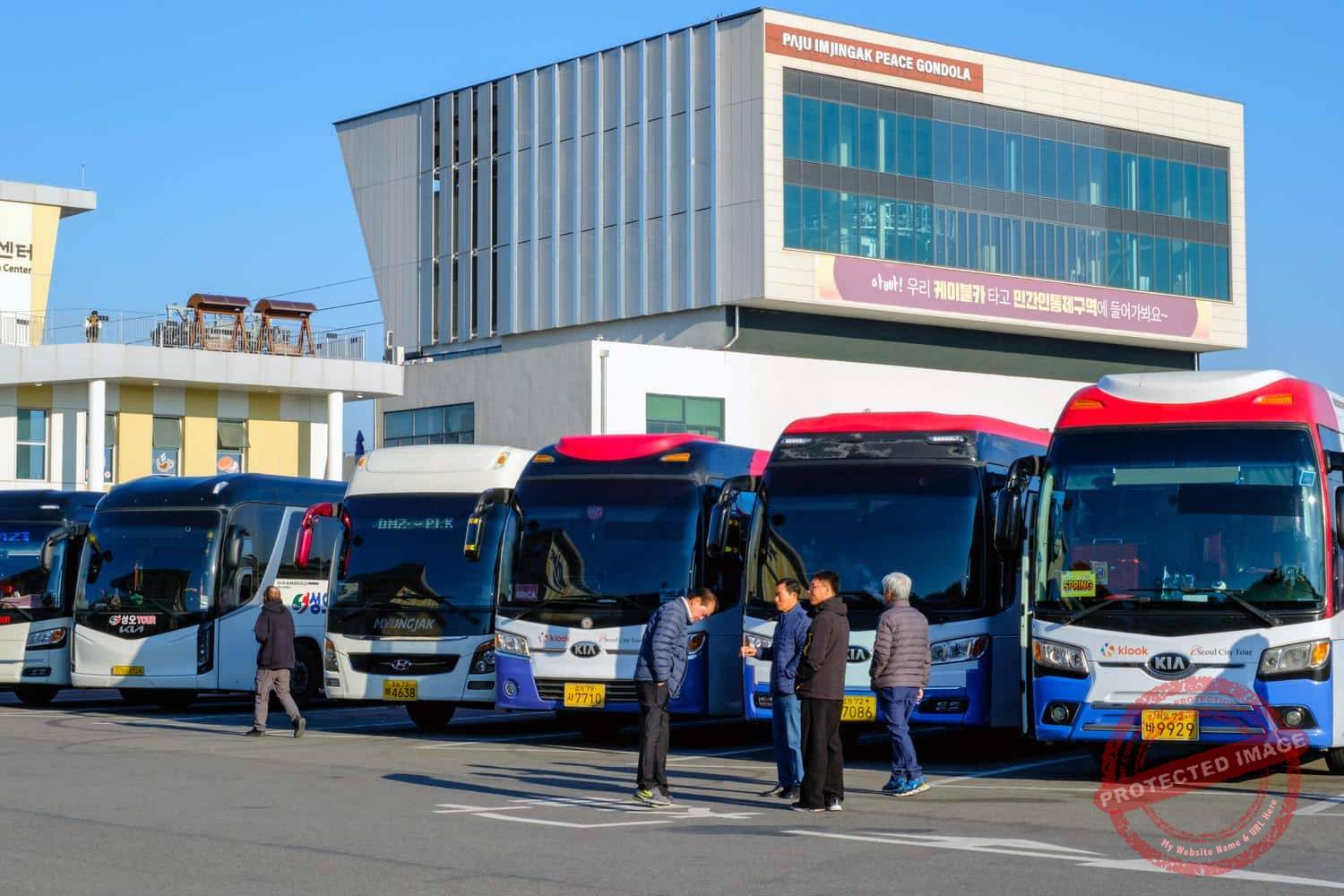
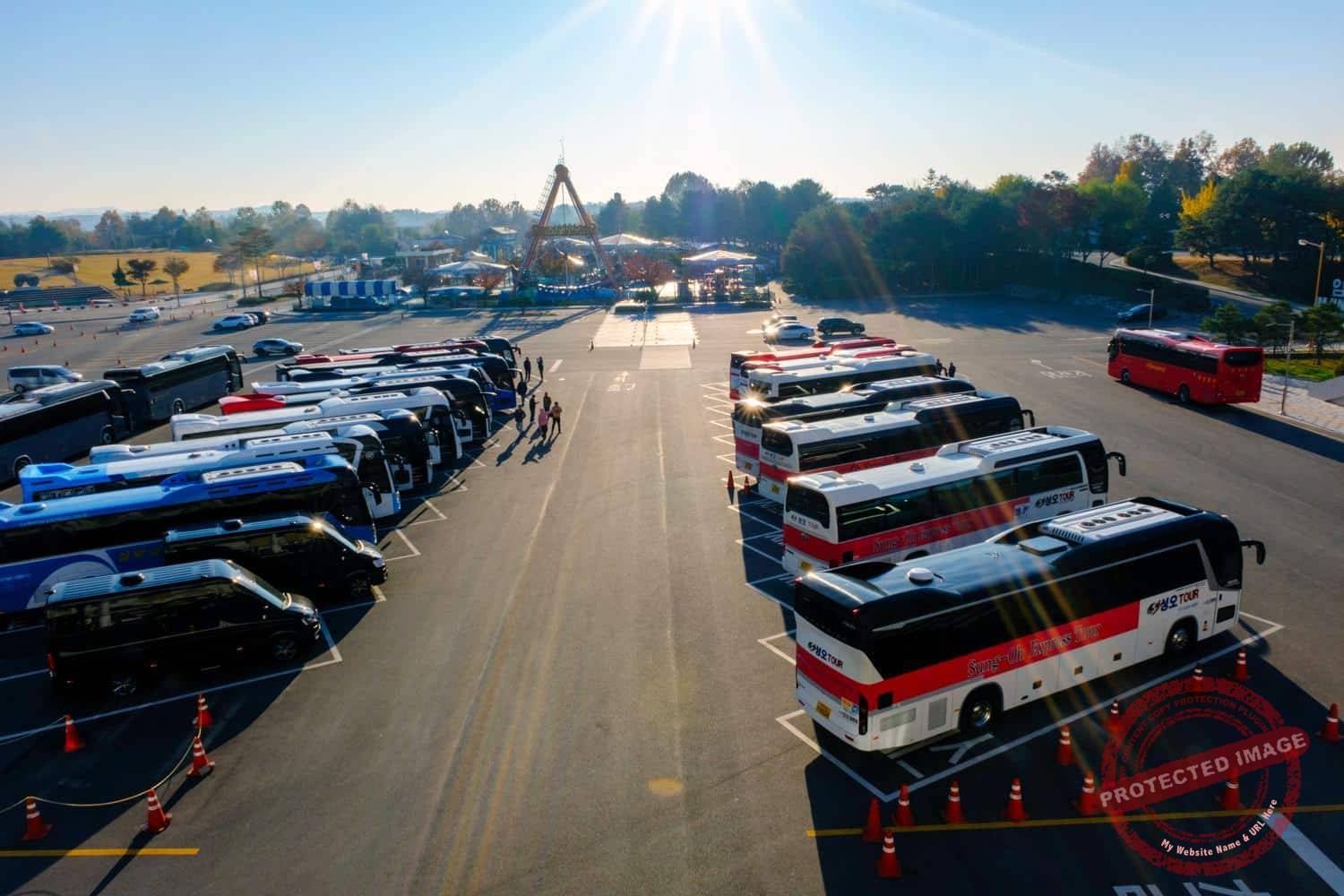
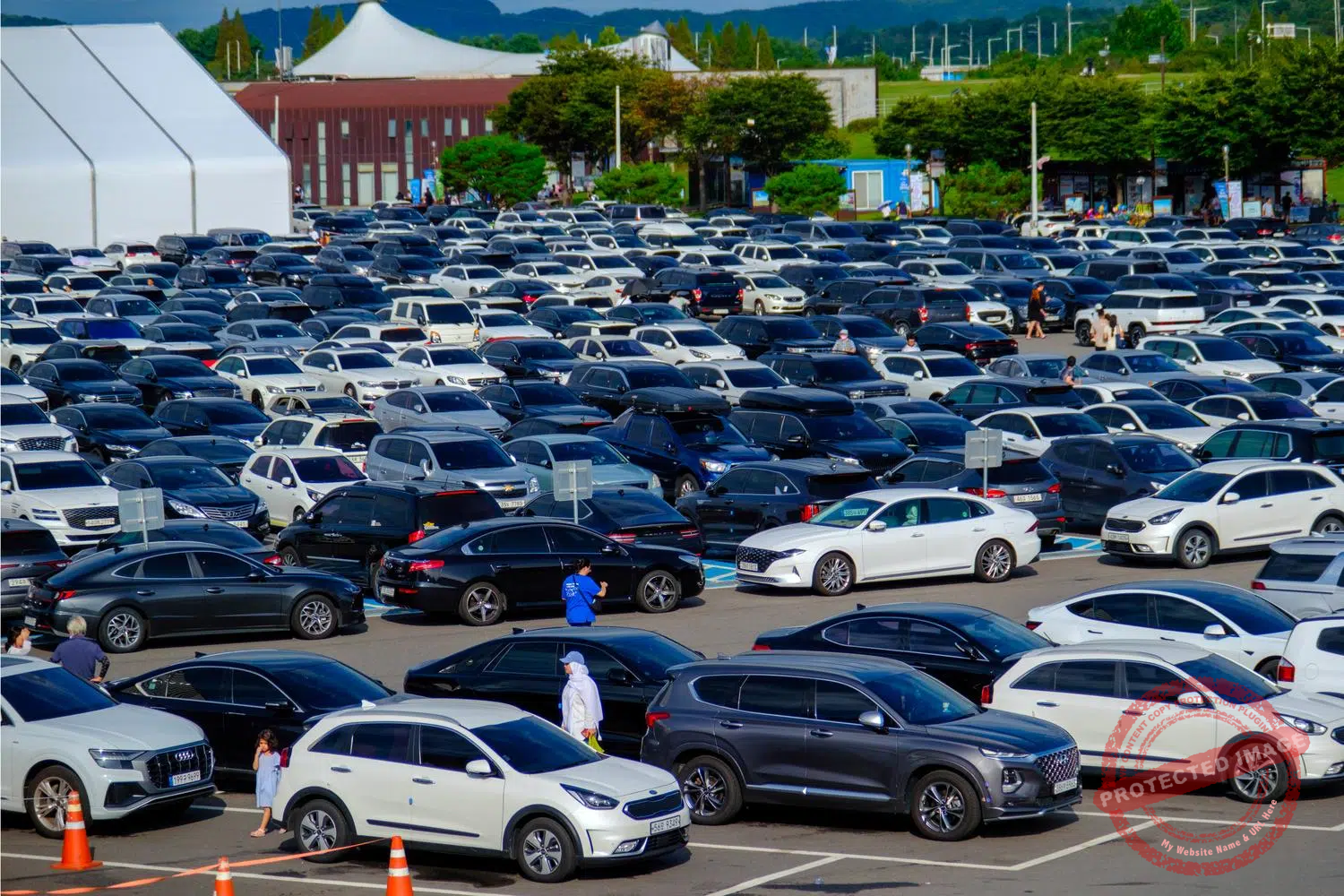
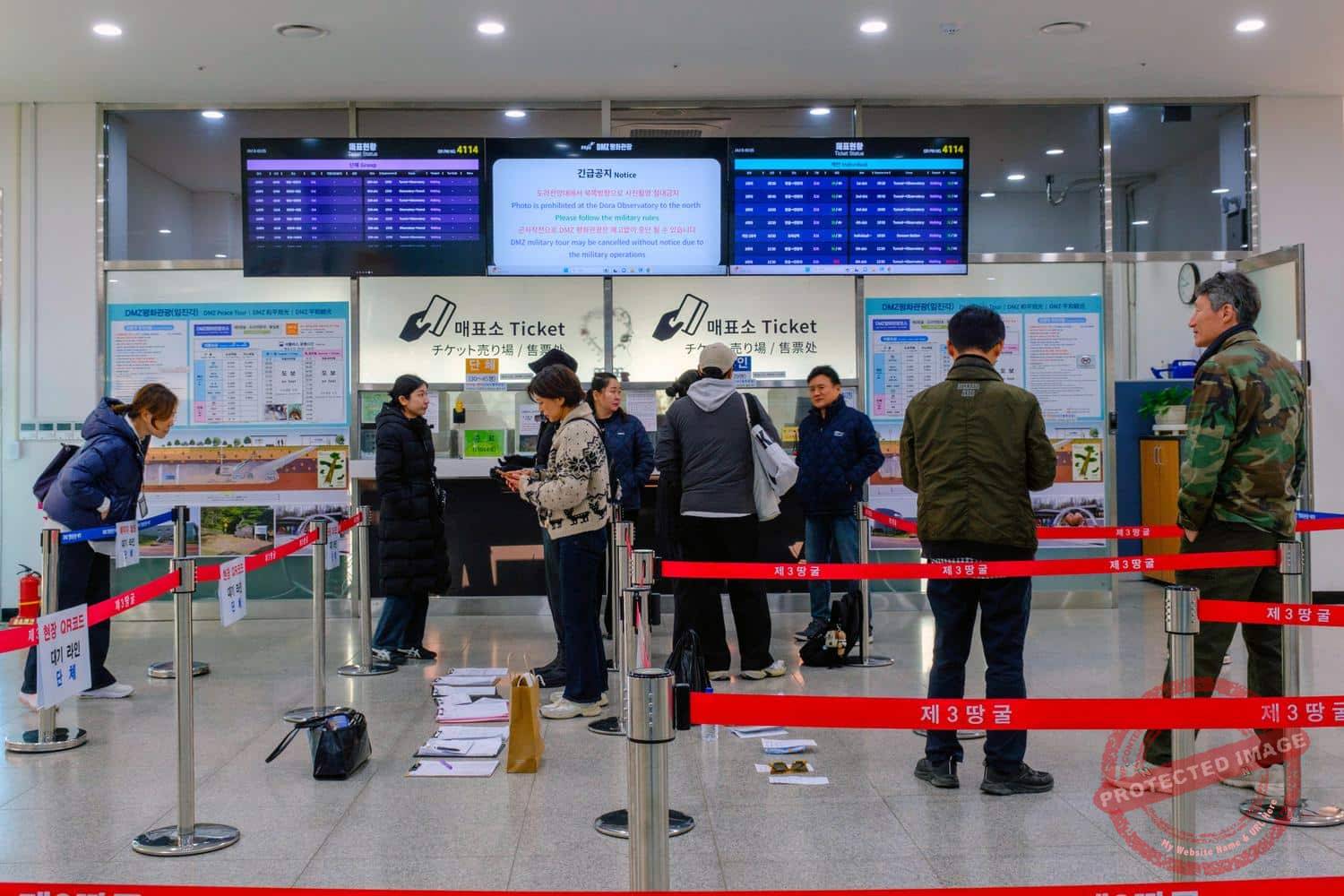
Tour buses and private vehicles fill the Imjingak complex parking lot, and tour guides queuing for tickets to enter the Civilian Control Zone and continue to the DMZ area main tourist attractions (September and November 2024, September 2025).
Fortunately, Imjingak is a bit more than just a gaudy dark tourist trap and there are a few things to see here. The history of the site is also interesting.
Imjingak was built by the South Korean government shortly after the historic July 4th 1972 North-South Joint Statement, which briefly raised hopes for reunification.
The joint statement was the first time the two sides acknowledged each other officially, and the first formal agreement between Seoul and Pyongyang since the Korean War. Also, for the first time, the two Koreas acknowledged that reunification must be pursued through peaceful dialogue, not by force or armed conflict. Despite the initial optimism, the agreement did not lead to substantive change. But Imjingak was there.
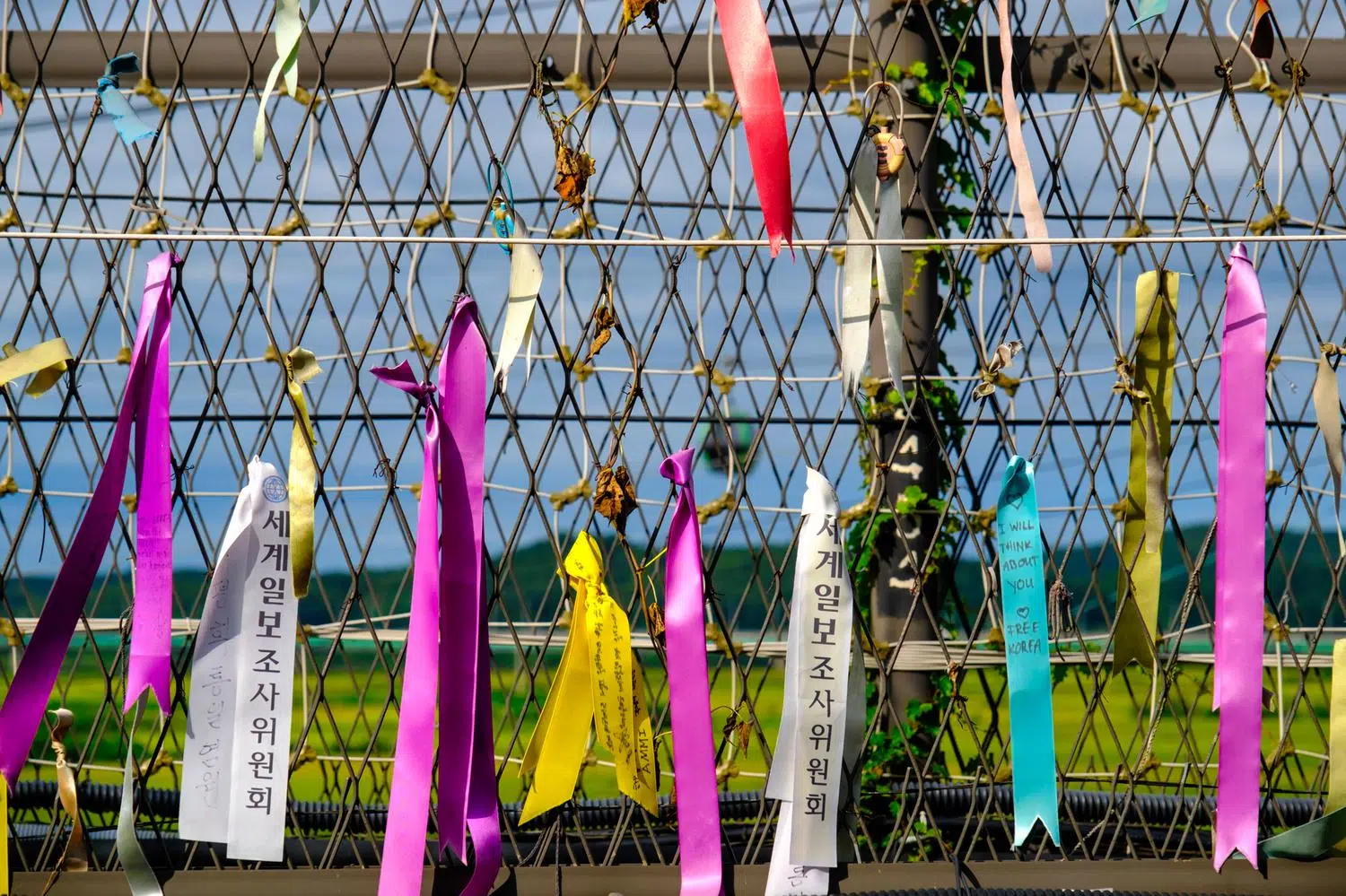
‘Peace Ribbons’ attached to the Civilian Control Line fence at Imjingak (September 2024).
The foundation of Imjingak was a symbolic act to provide a space where refugees and defectors could symbolically reconnect with their lost homes.
The resort was established just outside the Civilian Control Line (see the glossary to understand this term and many others), making it accessible to ordinary citizens without any security checkpoint. It became a public-facing counterpart to the heavily fortified front lines. It sits at the northern terminus of National Road No. 1, the old arterial road that once ran all the way from Seoul to Sinuiju on the Chinese border.
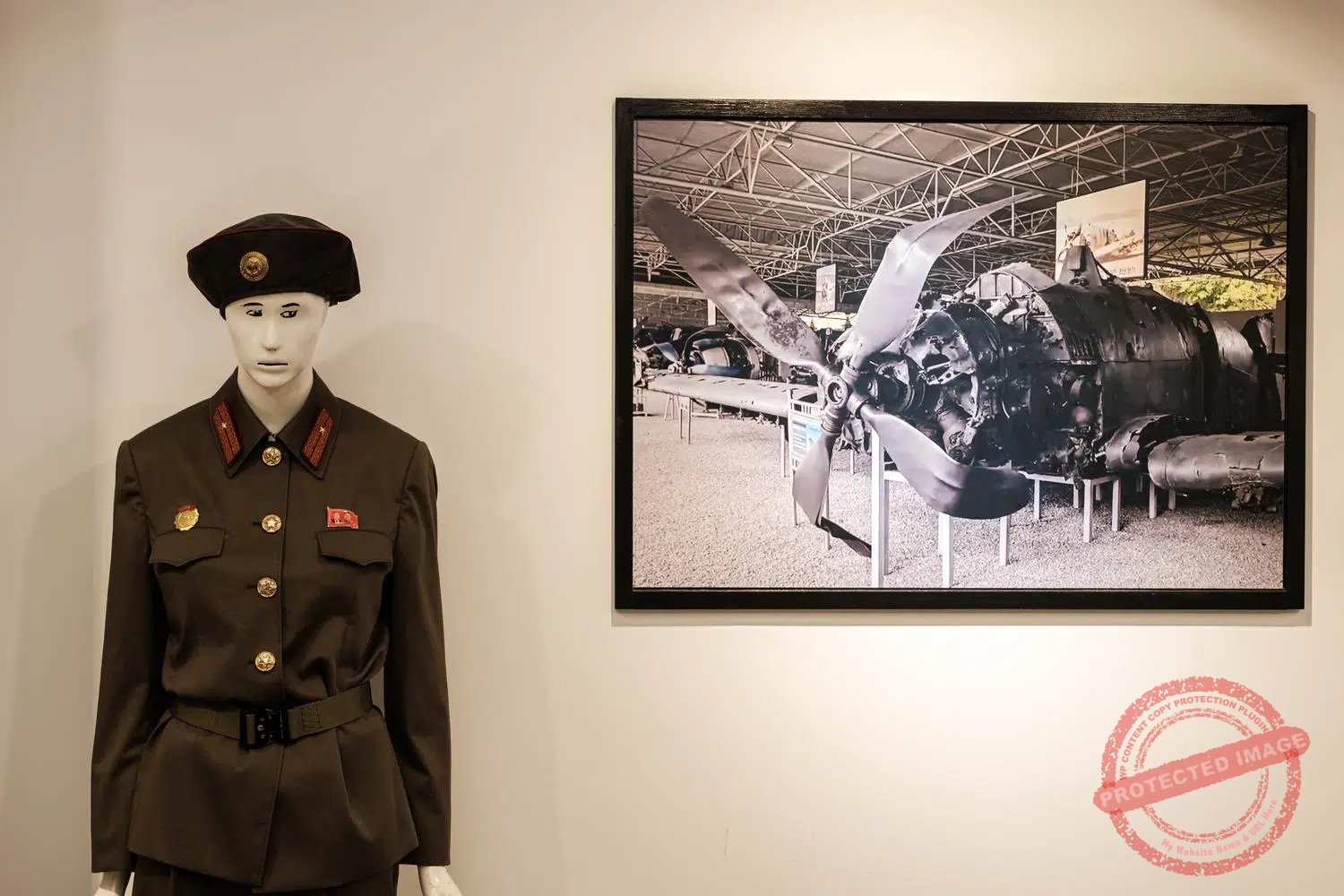
The North Korea Experience Center exhibition at Imjingak (September 2025).
As in many places close to the border, here we find a Mangbaedan, an altar where separated families perform rituals facing the North, especially during traditional holidays like Chuseok (the autumn harvest festival) or Seollal (the Lunar New Year), times traditionally devoted to family visits.
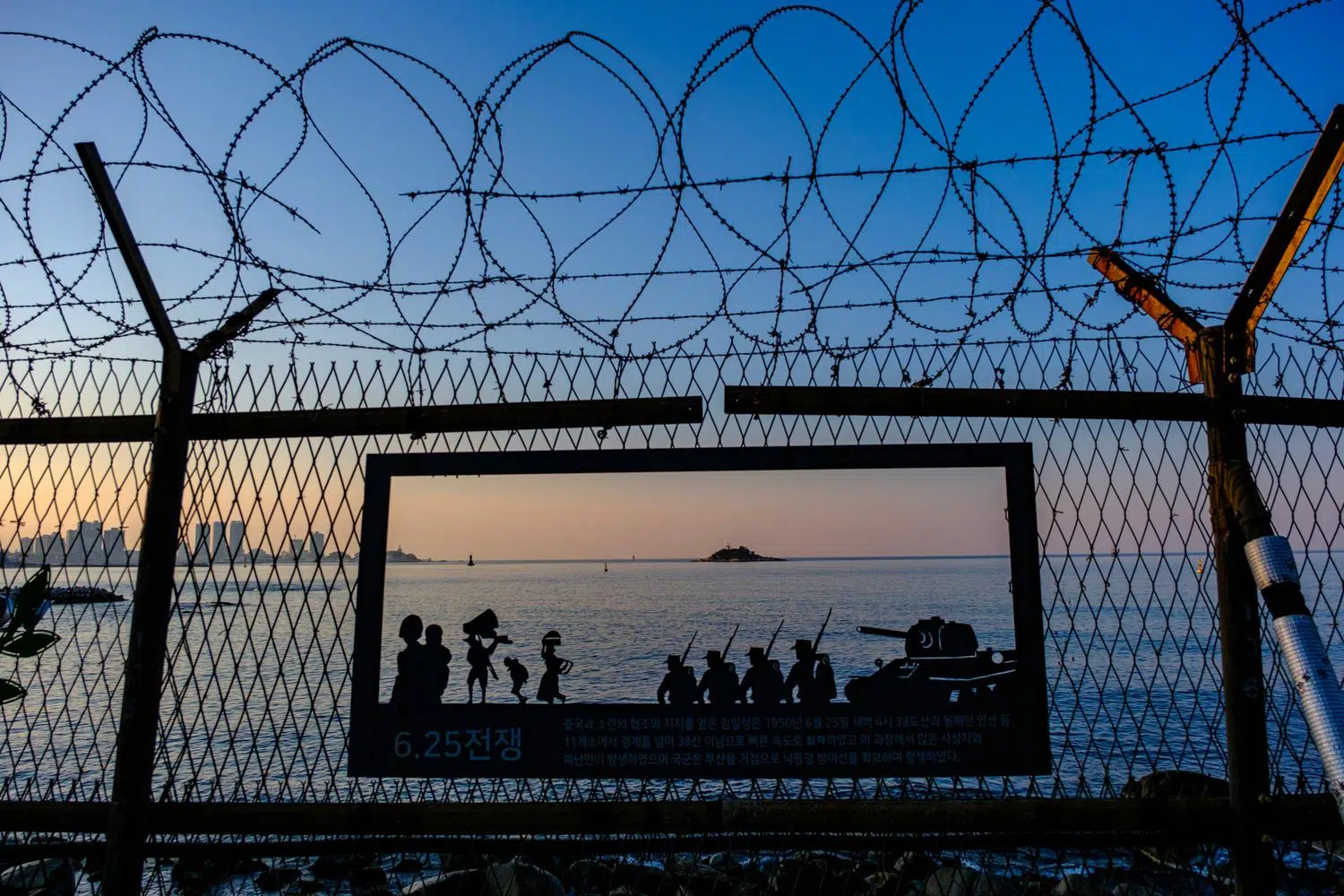
The pain of separation is also expressed in the thousands of multicoloured “peace ribbons” hanging from the barbed wire fence marking the boundary of the Civilian Control Zone (though many tourist pictures will try to make you believe this is the fence of the DMZ, or even the border with North Korea).
Since spring 2025, Imjingak has been home to a new attraction run by a private tour operator: the North Korea Experience Center. For a few thousand won, visitors can watch a film about life on the other side of the DMZ. At the end of the screening, a North Korean defector spends around 15 minutes answering questions from visitors.
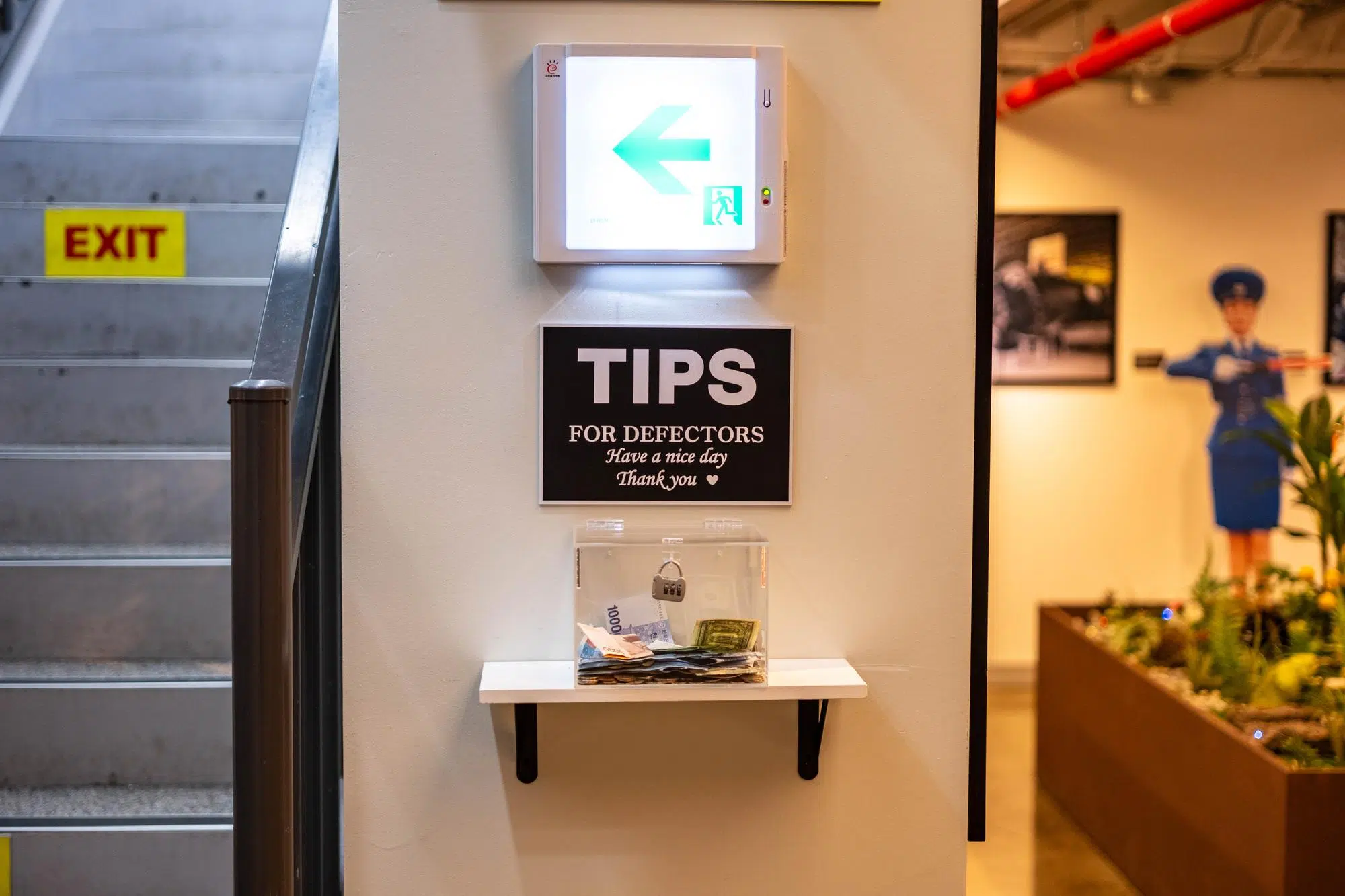
Tip a defector at the North Korea Experience Center at Imjingak (June 2026).
I was a little reluctant at first, finding that the initiative had a slight “human zoo” feel to it. But in the end, the exchange proved to be very interesting (it must be said that, having arrived at a quiet time, I was the only visitor there). The person I was talking to —a lady who fled the North Korean city of Hyesan in 2014 and reached South Korea via China, Laos, and Thailand— taught me a great deal in just a few minutes about her escape, her interrogations by South Korean secret services seeking to confirm that she was indeed North Korean, and her adaptation to life in the South.
A few months later, I returned, this time out of curiosity about the questions tourists of all nationalities would ask the defector. Almost all of them were intelligent and thoughtful, focusing on the reasons for her defection, her adjustment to life in the South, and the prospects for reunification. In the end, I am certain that this exchange was the highlight of the day for the visitors.
Despite its obviously commercial nature, and even though—like so many things in South Korea—the meeting is rushed through at breakneck speed, for the vast majority of foreign visitors, this is likely the only opportunity in their lives to hear a firsthand account of life in North Korea. In any case, the North Korea Experience Center stands in stark contrast to the rest of Imjingak. Perhaps the only thing that lacks a bit of dignity is the donation box for leaving tips for the defectors.
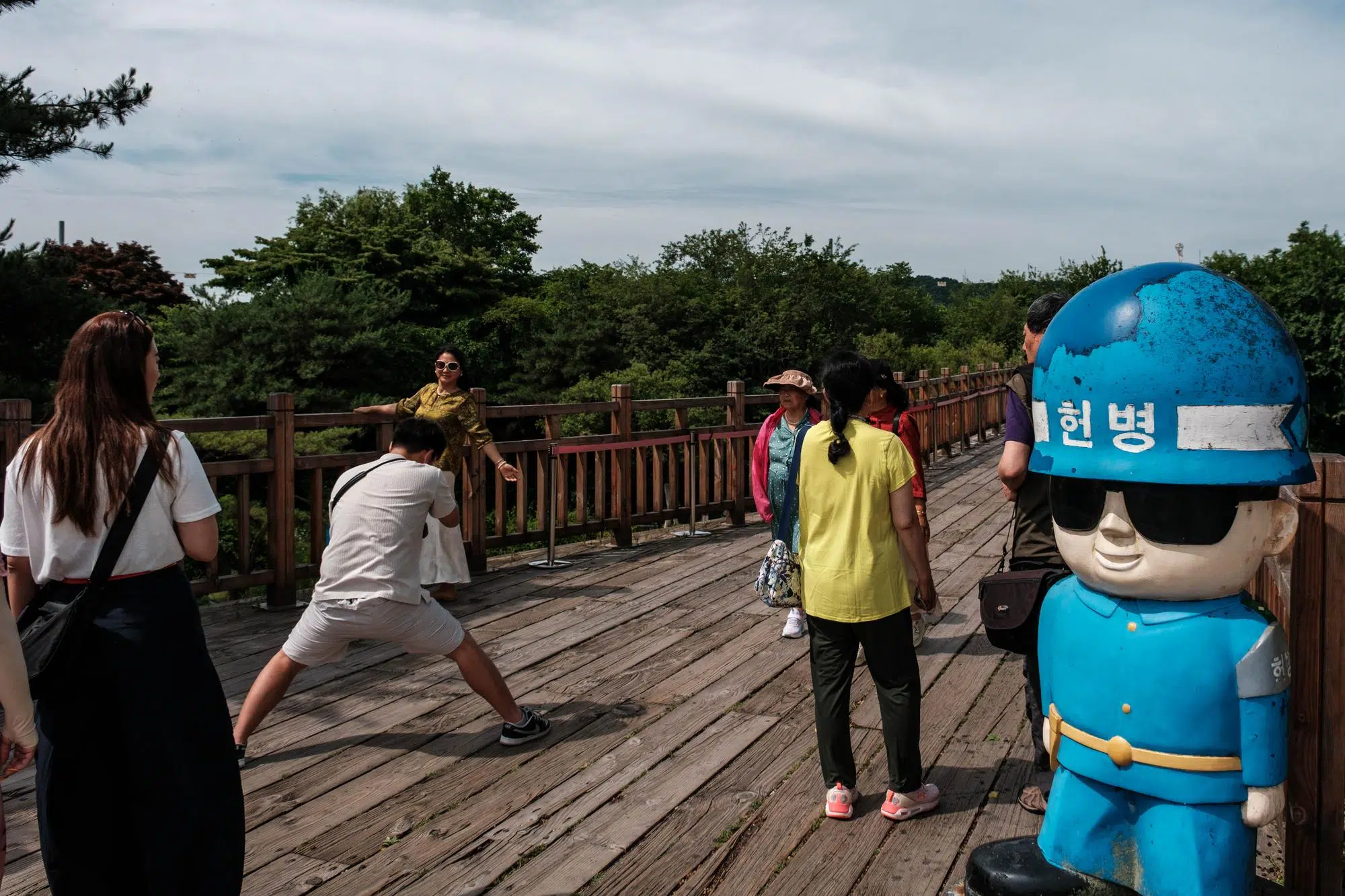
A wooden platform at Imjingak evokes the original “Bridge of Freedom,” across which prisoners of war returned from North Korea (June 2026).
Behind the Mangbaedan altar stands what visitors most commonly photograph as the “Freedom Bridge”. It is, strictly speaking, not a bridge anymore. The original pair of railway bridges on the Seoul-Sinuiju line, which once crossed the Imjin here, were destroyed during the Korean War. After the Armistice was signed on July 27, 1953, a temporary wooden structure was hastily erected on the remaining piers to facilitate the exchange of prisoners of war. 12,773 South Korean and UN POWs were brought to the bridge by truck, crossed it on foot, and shouted “Long live freedom!” as they stepped back onto South Korean soil. That is how the bridge got its name.
The temporary wooden span was later demolished (a wooden platform, reminiscent of the original bridge, was built for tourists and is guarded by a mannequin dressed as a UN soldier). What remains today is the rebuilt Imjin Railroad Bridge, now part of the Gyeongui Line track between Munsan and Dorasan stations, plus the bombed piers of the original northbound bridge. The bullet-riddled steel is visible from Imjingak’s observation platform.
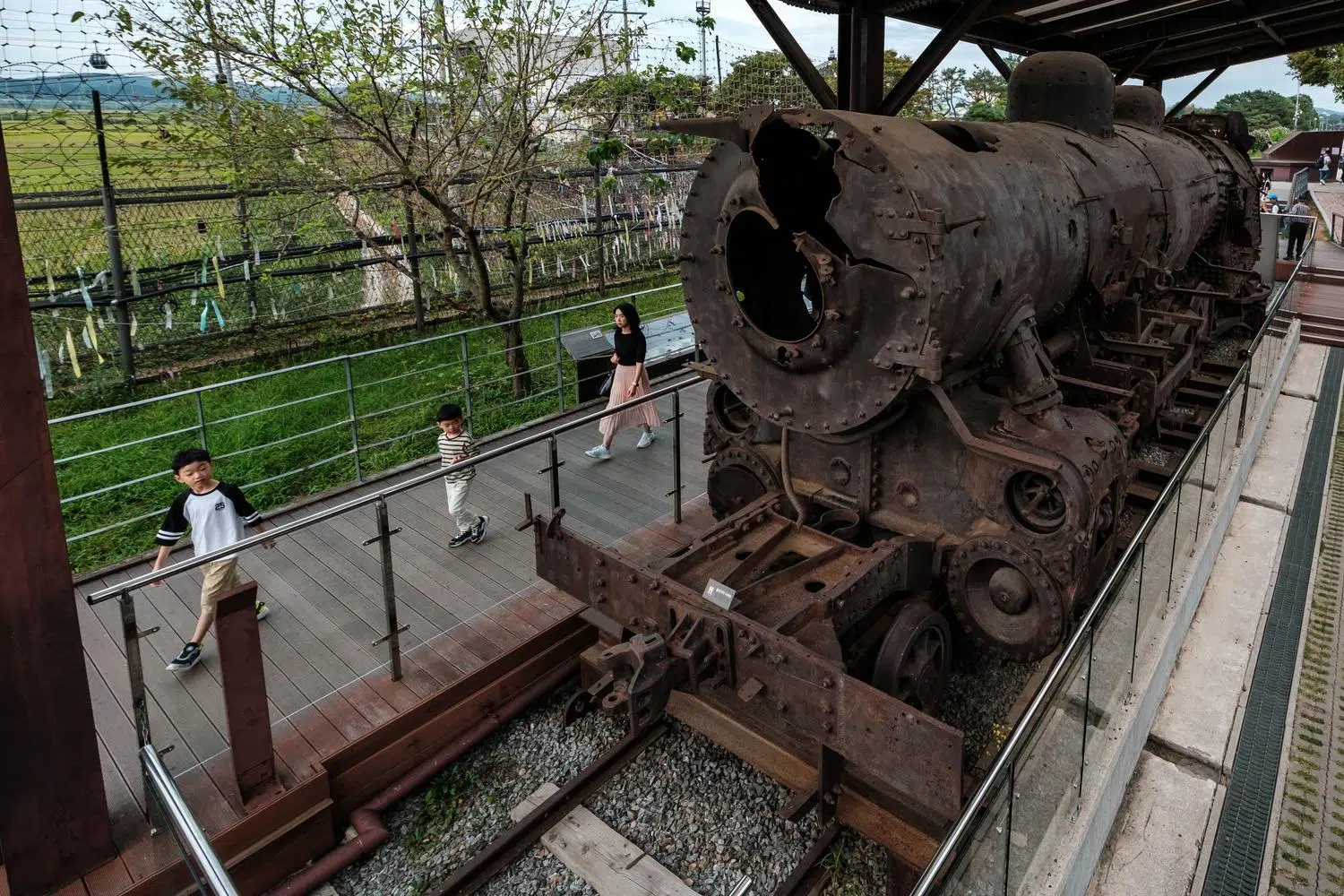
The Sensetsu steam locomotive, riddled with shell holes and bullets (September 2026).
Another famous relic is the steam locomotive rusting nearby, riddled with shell holes and bullets, which pulled the last South Korean train to cross the border during the Korean War.
The locomotive is a KNR Mateo Class, built by Kawasaki Heavy Industries during the Japanese colonial period and originally used between Kaeseong and Pyongyang. It was carrying supplies for United Nations forces when it found itself blocked at Hanpo station, in what is now North Korea, on 31 December 1950, because of the presence of Chinese troops just ahead of it.
The driver, Han Joon-ki, desperately tried to reverse the train to Munsan station in South Korea. But he was stopped on the way by American soldiers who riddled the locomotive with more than 1,000 machine-gun bullet holes. The aim was to prevent the Japanese-made machine, which had already been taken from North Korea earlier in the war, from falling back into the hands of its former owners.
For more than half a century, the rusting hulk lay abandoned in what was once Jangdan station, in the southern portion of the DMZ. In 2004, it was officially registered as Registered Cultural Heritage No. 78. After two years of restoration work, it was installed under a protective canopy at Imjingak, where it has stood ever since.
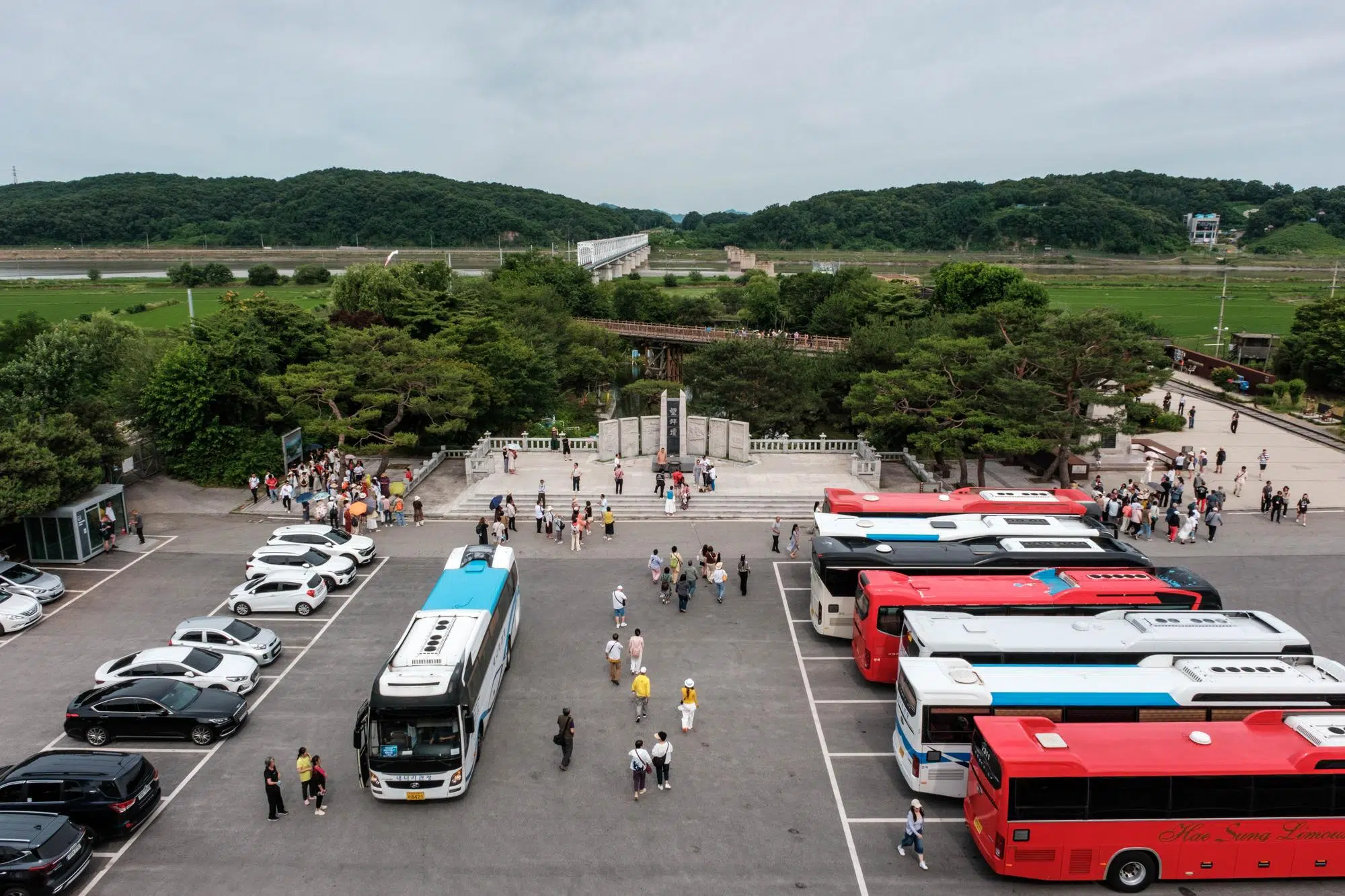
Peak hour at Imjingak (June 2026).
Right next to the locomotive and a little less popular with visitors, Beat 131 is a Korean War-era underground military bunker converted into an exhibition space. The descent is narrow. Capacity is around 20 people at a time. At the bottom: a reproduction of a wartime command room, military materiel from the period (rifles, canteens, helmets with bullet holes, field radios), and video screens showing real-time footage of the DMZ and documentary clips on the conflict.
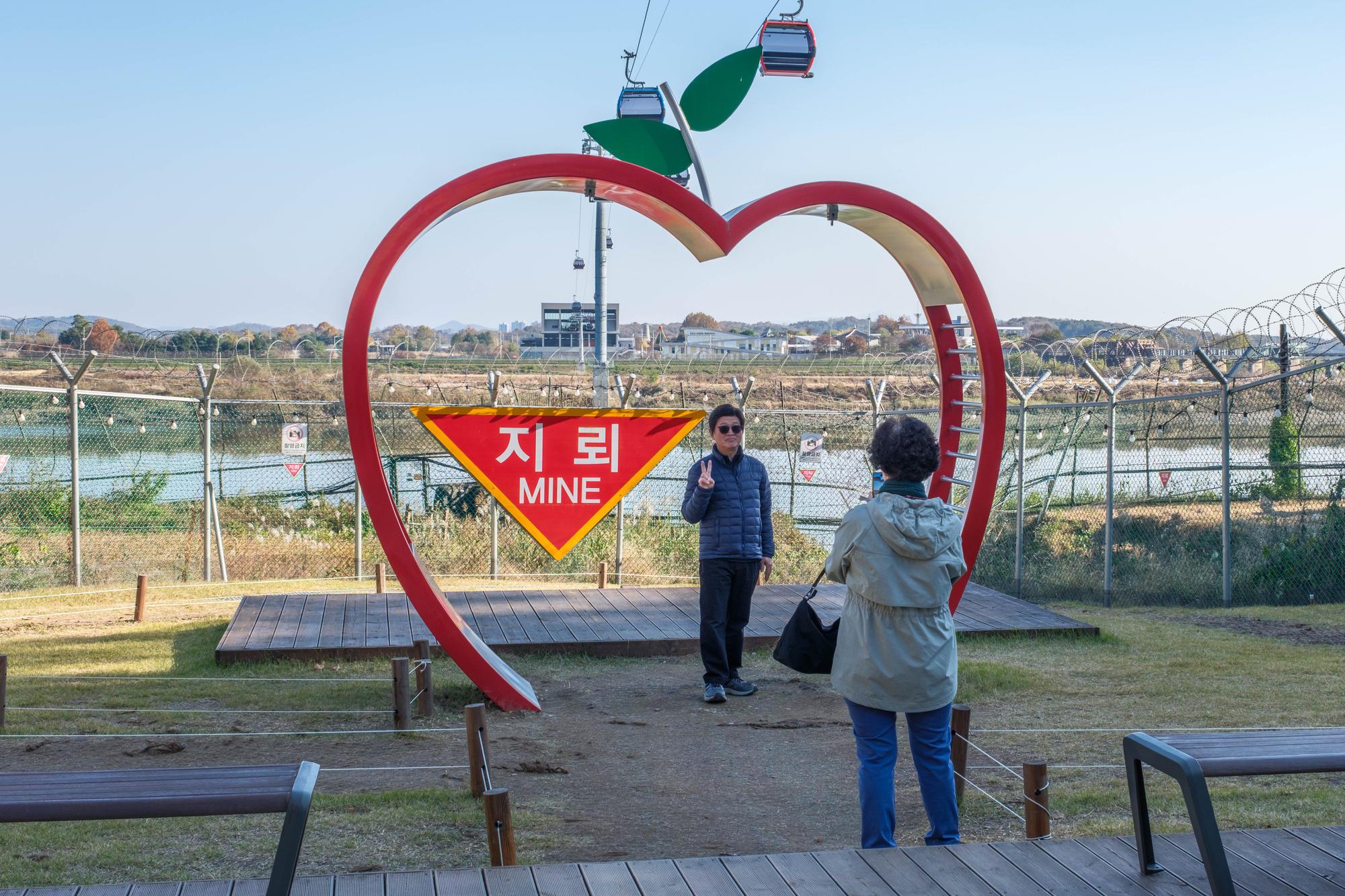
World’s weirdest Instagram spot in November 2024. The apple has since been removed and replaced with a tank with its cannon pointing north, and the “no photography” signs have disappeared from the fence. The minefield behind is still real.
Other attractions designed to keep tourists waiting before their hurried incursion to the Dora Observatory and the ‘Third Tunnel of Aggression’ include the ‘Peace Gondola’, sometimes wrongly nicknamed the ‘DMZ Gondola’.
This gondola doesn’t take you into the DMZ, but only across the Imjin River, into the Civilian Control Zone. That’s why, before climbing into the gondola, you have to show your ID and sign a form promising not to do anything foolish once on the other side.
The section of the CCZ you will land in after the 850-meter ride is hermetically sealed, but it’s enough to give you a few extra thrills. Even more so when, as you approach the north shore, you see from the gondola the huge ‘mine’ sign, specially designed for Instagram pictures. For a long time, absurd “no photography” signs posted by the military hung on the fence right in front of this highly Instagrammable spot. They were finally removed. Perhaps as a form of compensation, a decommissioned tank, its gun barrel pointed toward North Korea, has now replaced the apple-shaped (or heart-shaped) structure in front of which visitors used to take photos against the backdrop of the minefield (which is a very real one).
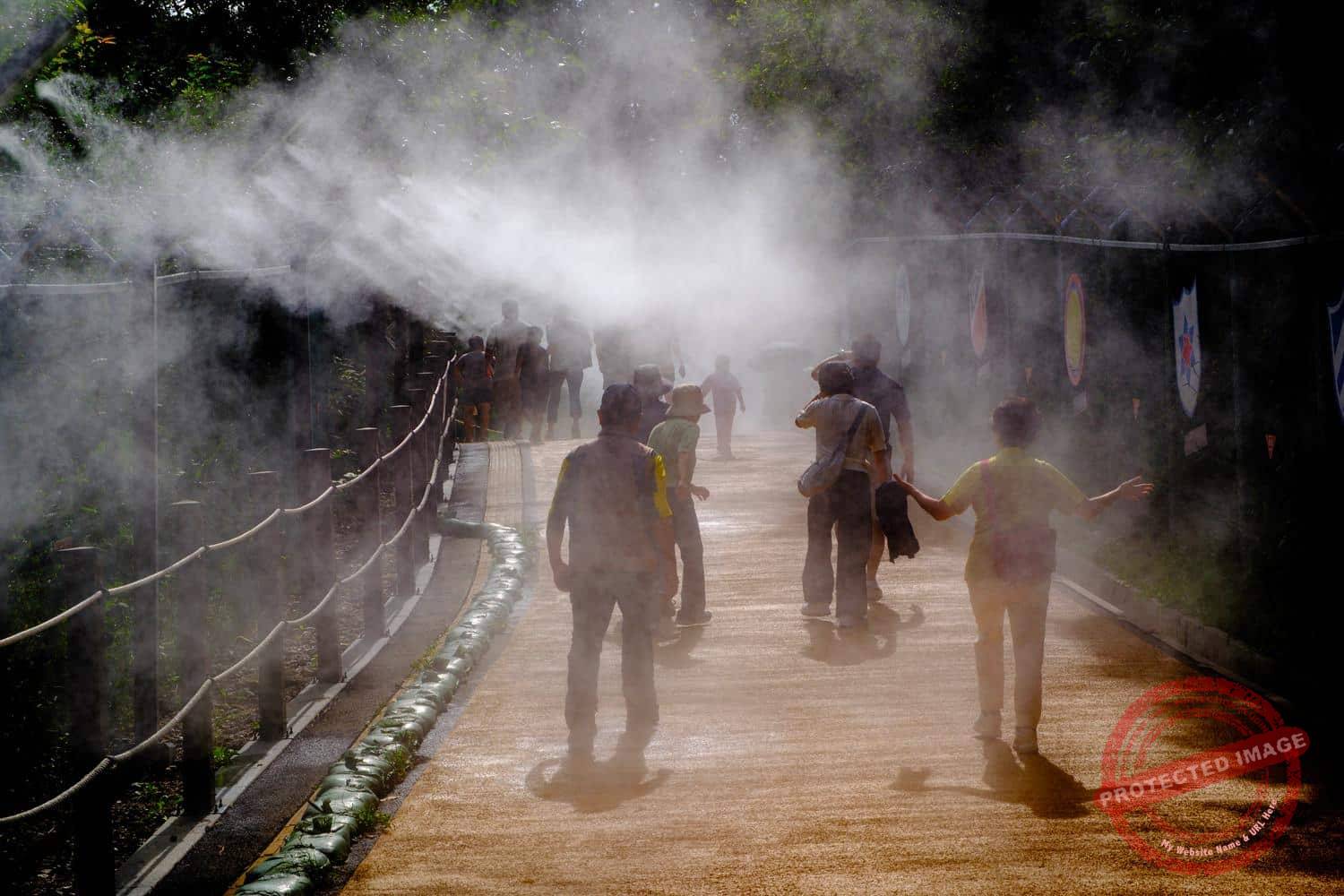
Water sprays along “Military Street”, Imjingak, during a hot late summer day (September 2024).
Also on the north bank of the Imjin River, one can walk along “Military Street”, lined with high fences displaying the coats of arms of units that fought in the Korean War, to a pleasant observatory overlooking the river and from which you can see Bukhansan, the mountain overlooking Seoul. In summer, water sprays protect you from the heat.
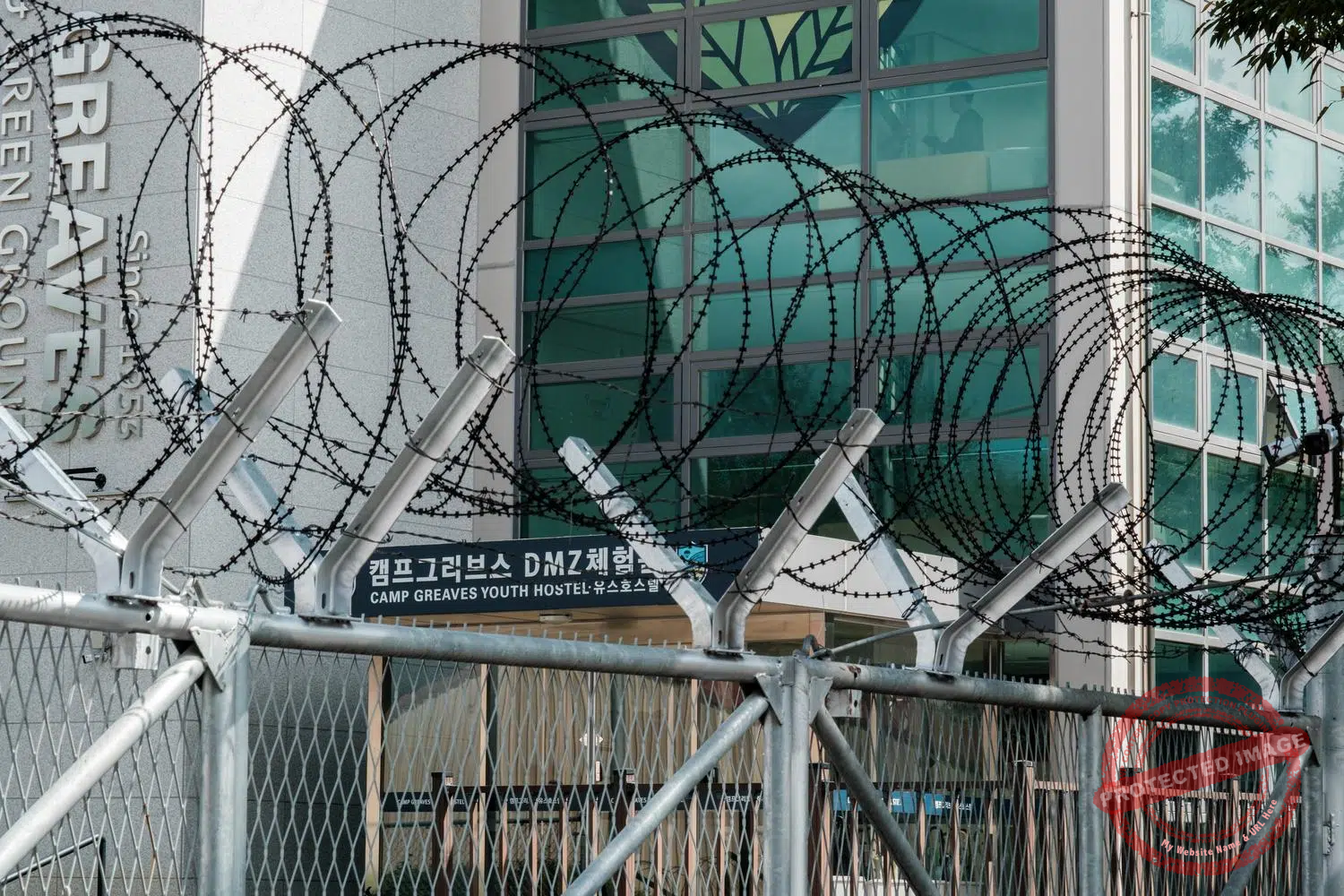
This is also the entry gate for Camp Greaves, a former U.S. military camp transformed into a cultural space.
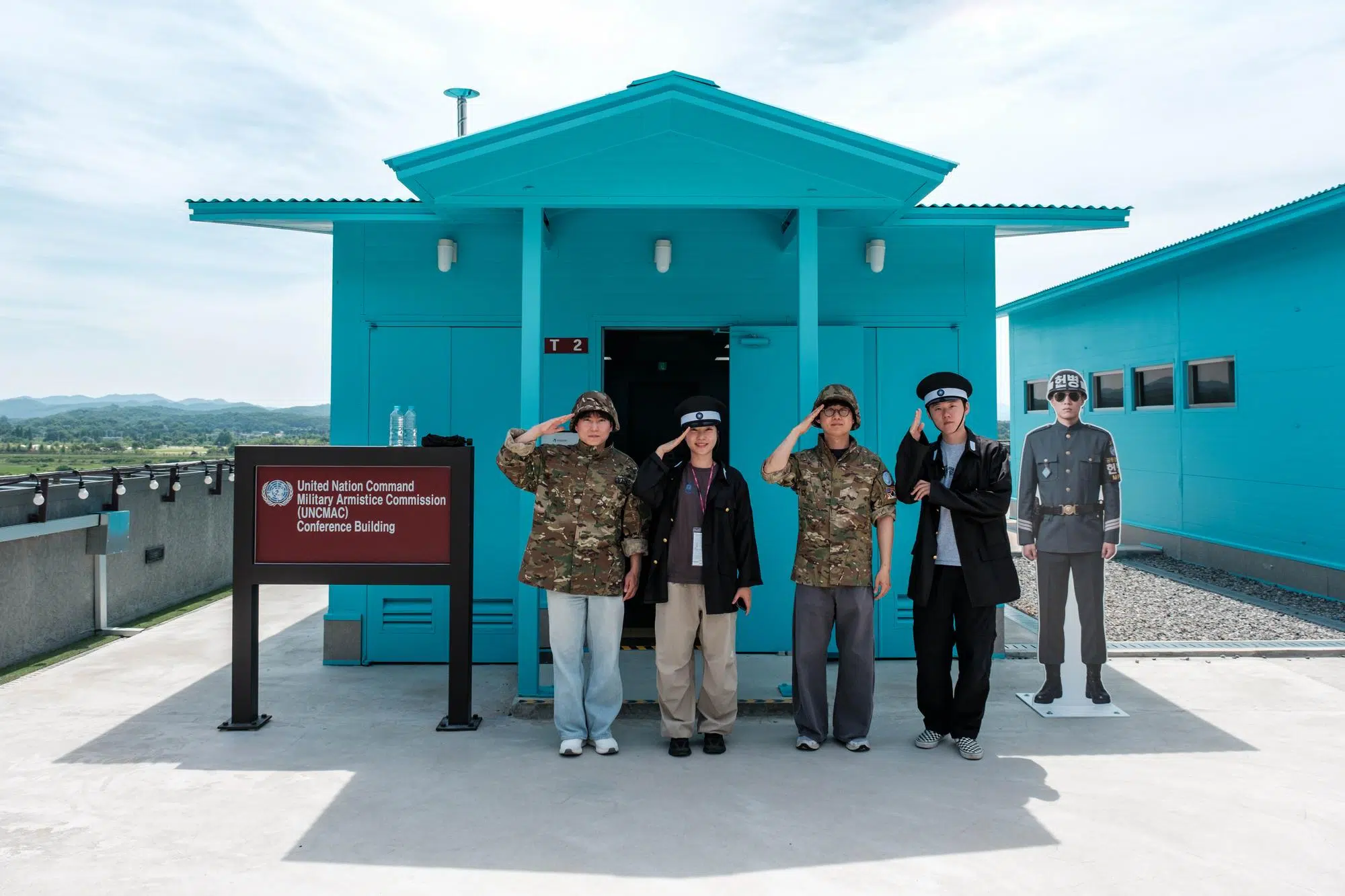
In front of them all: visitors pose in front of a scale model of the conference huts in the Joint Security Area at Imjingak (June 2026).
On the rooftop of the gondola’s northern terminal is another attraction at this strange border-side “Disneyland”: a scale model of two of the famous blue conference huts from the Joint Security Area at Panmunjeom. Whimsical military uniforms are available for visitors to wear for selfies.
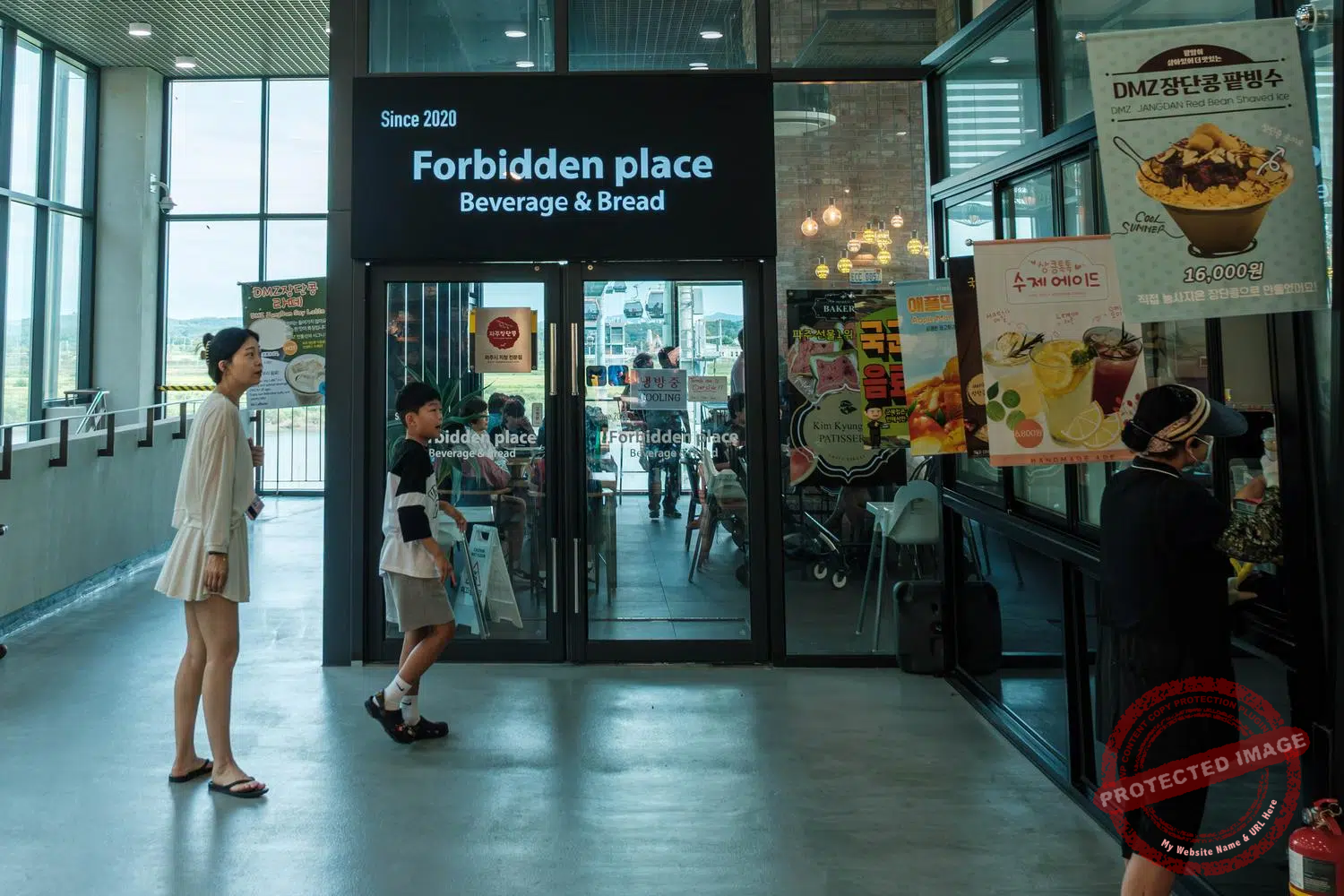
Welcome to the Forbidden Place, offering DMZ Jangdan Red Bean Shaved Ice and other DMZ delicacies (September 2024).
Before taking the gondola back to the other side, visitors can enjoy a coffee or a ‘DMZ Red Bean Shaved Ice’ at the ‘Forbidden Place’ cafe, or buy a bullet-shaped key ring or other souvenirs of their expedition “at the DMZ”.
DMZ rice, DMZ cookies, DMZ ice-cream, DMZ T-shirts, DMZ caps, DMZ magnets, DMZ booze: there’s a DMZ-something for everyone in the souvenir shops near the border. I fell for a keyring in the shape of an offensive grenade (I’ll try not to forget to leave it at home next time I go through airport security), and a magnet shaped like a minefield sign (hoping it will discourage me from opening my fridge so often).
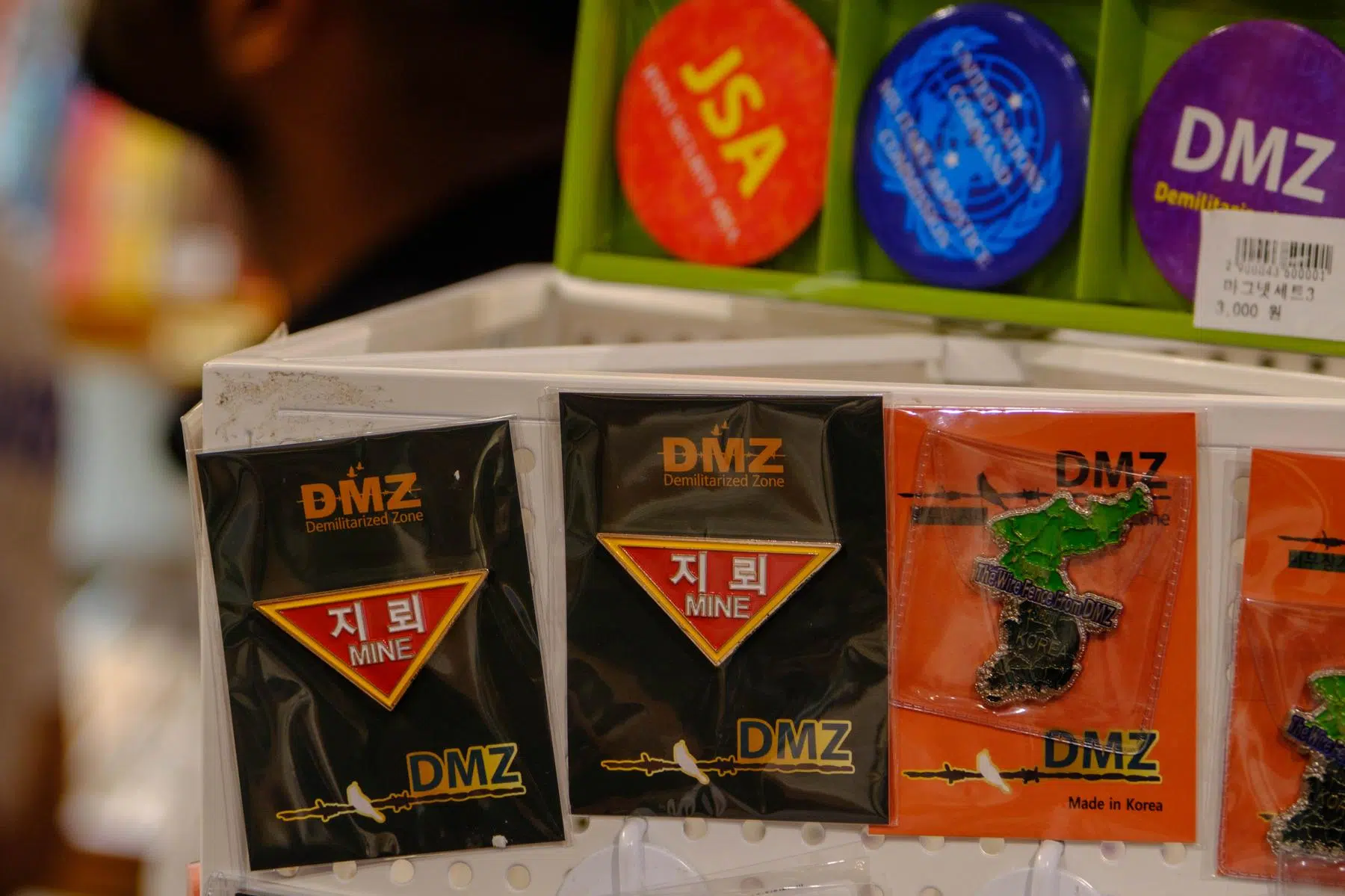
DMZ souvenirs on sale at Imjingak (September 2024).
Tourists who come to Imjingak on organised trips generally continue on to the Third Tunnel of Aggression and the Dora Observatory. Their bus crosses the Unification Bridge and, after a stop at the South Korean army checkpoint, enters the Civilian Control Zone.
This 900-meter-long bridge opened on June 15, 1998, during a period of détente that saw the reopening of a cross-border road linking South Korea to Kaesong in North Korea.
The founder of Hyundai Group, Chung Ju-yung, born in a region that is now part of North Korea and who worked hard to normalize the relations between the two enemies, used the bridge to drive a herd of 1,001 “Unification cows” as a gift to the North during the historic inter-Korean summit in 2000.
Like all major bridges near the DMZ, the Unification Bridge is considered a structure designed for prepared demolition in the event of a North Korean invasion. Although the details are not public, it was likely built with demolition chambers or locations where explosives could be quickly installed to blow up the structure and prevent the enemy from advancing.
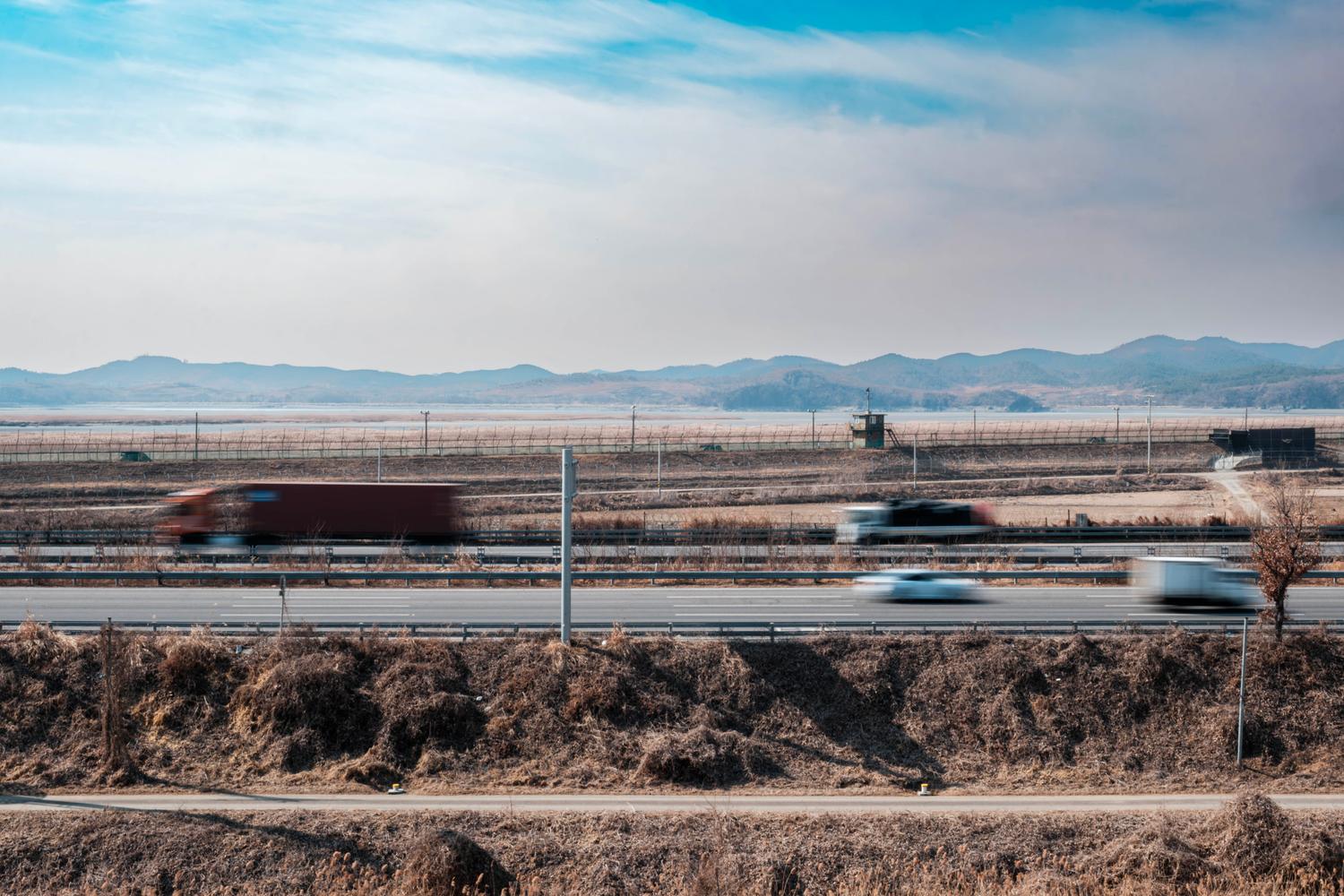
The Unification Highway, which crosses the bridge, once led to the North Korean city of Kaesong, just about 15 kilometers away. It now ends a few kilometers north of the bridge, at the fence marking the southern boundary of the DMZ.
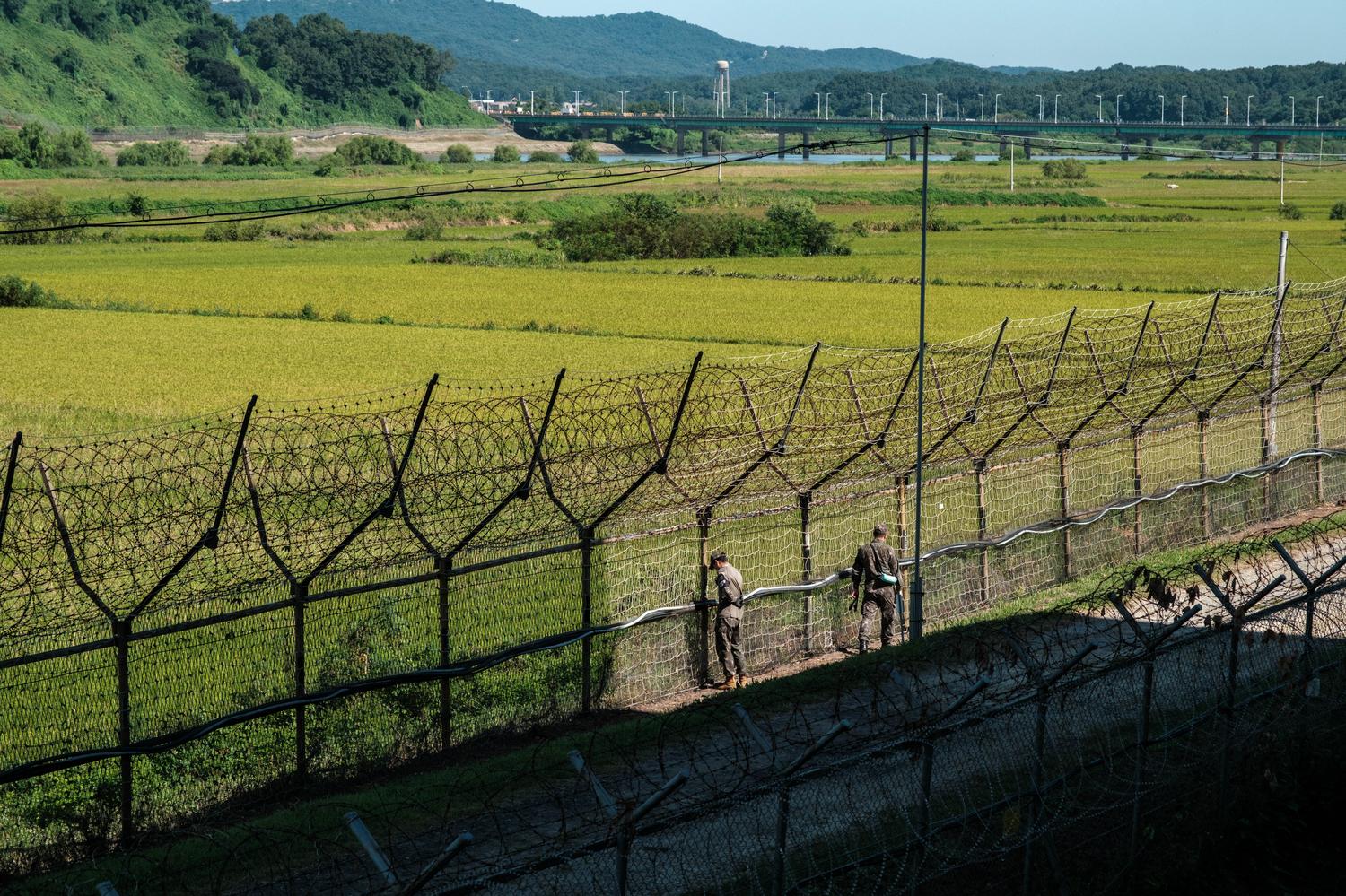
South Korean soldiers inspect the Civilian Control Line (CCL) fence in Imjingak, with the Unification Bridge over the Imjin River in the background (September 2026).
Most visitors arrive and depart from Imjingak by coach or by private car. But it is also possible to get there by the regular commuter train from Seoul, about an hour and a half away with a connexion in Munsan. Only a handful of regular local trains serve Imjingang Station each day.
Imjingang Station is the last stop before the tightly restricted Civilian Control Zone, and the usual terminus of the Gyeongui-Jungang railway line, which once connected Seoul to the Chinese border but was cut in two by the Military Demarcation Line at the end of the Korean War. On the platform, a sign indicates the distance to Seoul (52 km) and Pyongyang (209 km). To the north, the single-track railroad crosses the bridge over the Imjin River and continues toward the last stop before North Korea, Dorasan Station, whose platforms are just 650 meters from the southern fence of the DMZ.
In the spring of 2026, Korail resurrected a tourist train service, the “DMZ Peace Link”, directly connecting Seoul to Dorasan Station at least twice a month. It’s a strange and fascinating rail trip. But without a special reservation and a passport, no travelers can go beyond Imjingang.
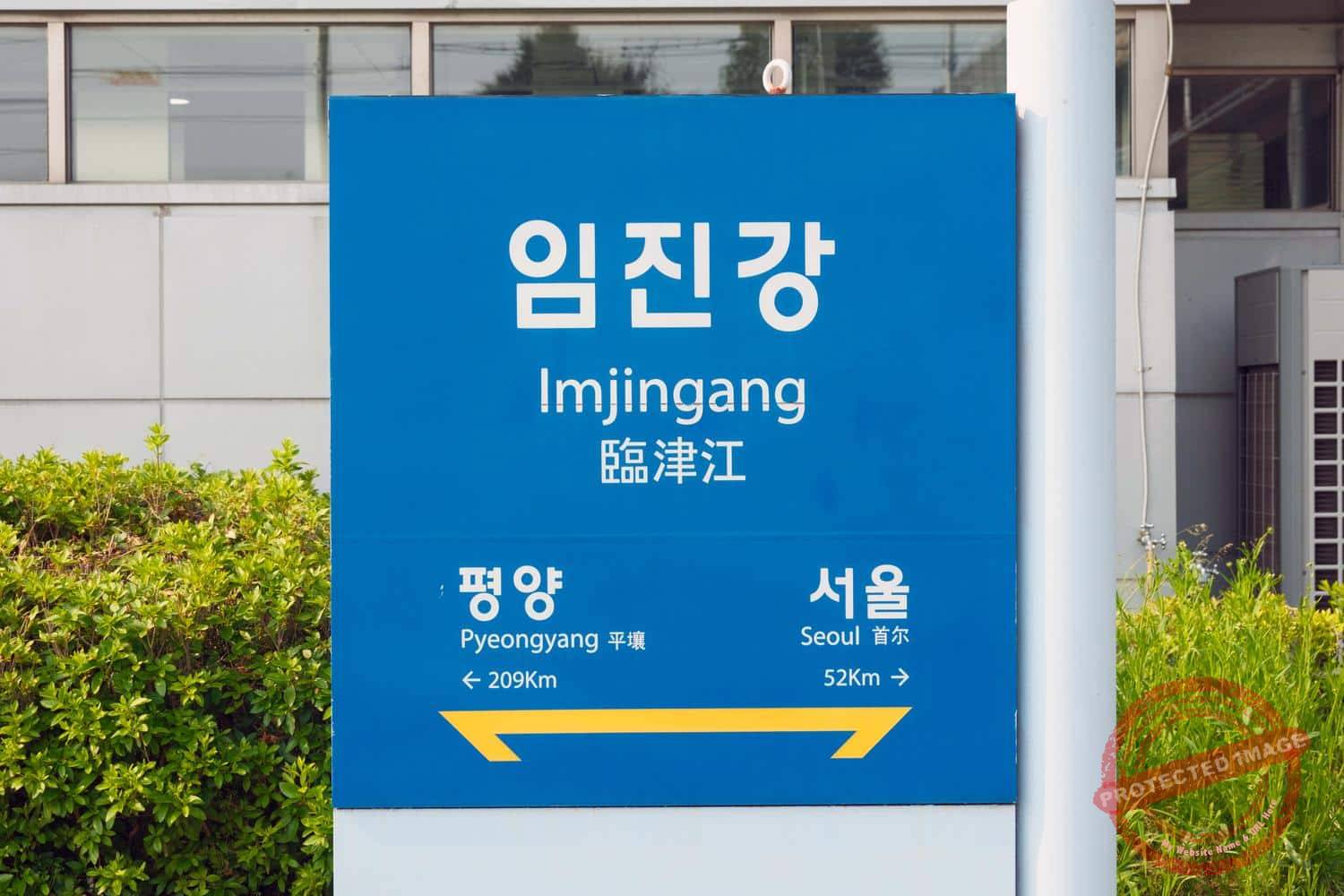
Imjingang Station, last stop outside the Civilian Control Zone (May 2025).
Bypassed by organized tours for foreigners but popular among locals, the spacious Pyeonghwa Nuri Park was inaugurated in 2005 on the occasion of a World Peace Festival organized by Gyeonggi Province, an attempt to transform Imjingak from a symbol of the Cold War into something more resembling a symbol of hope.
Its main feature is a vast grass-covered hillside with an open-air performance stage capable of accommodating around 20,000 spectators. Forests of colourful windmills calling for reunification, works of art, and a well-maintained lawn serve as the backdrop for outdoor film screenings and music performances in fine weather.
Every December 31st since 2006, MBC TV has broadcast its New Year’s countdown show live from here, complete with K-pop idol performances in temperatures well below zero, against a backdrop of CCZ fences. Local fans have coined a term for the performers assigned to this outdoor slot in the freezing dark: Imjingak Exile. Idols who survive it are considered seasoned.
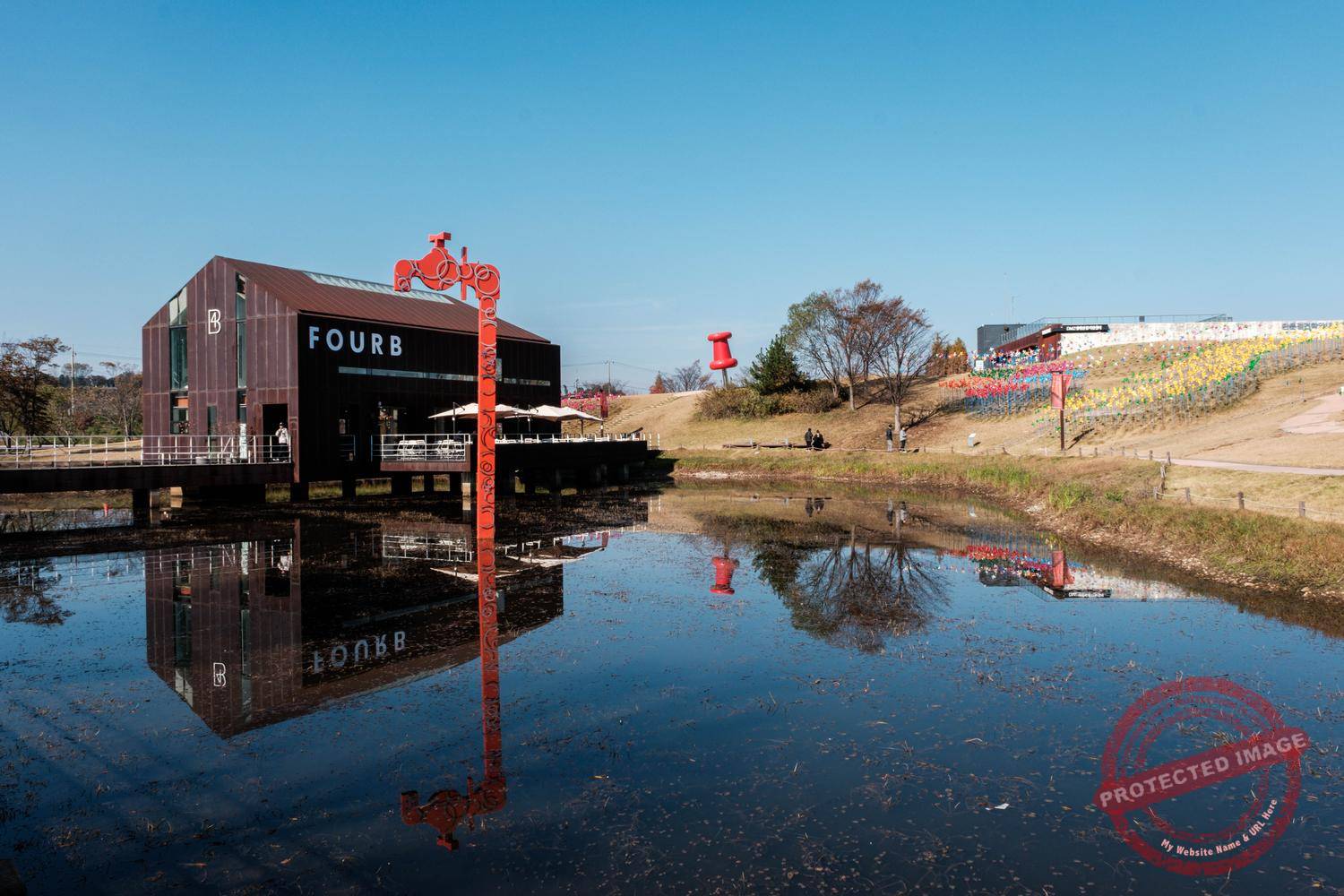
The Imjingak Pyeonghwa Nuri Park (November 2024).
Imjingak is also home to the Abductees Memorial and of many massive, sometimes brutalist monuments. Very few people visit them, even though each revives memories of the many tragic episodes that have shaped Korea’s recent history
Among many others, you will find here the Monument to US Forces in the Korean War (with a bronze statue of president Harry S. Truman), the Chamorros of Guam Memorial (a thousand of them served with the US military during the war), certainly not the most beautiful but nonetheless moving and keeping alive the memory of a tragic episode from the past, the Burma Aung San Martyrdom Memorial Tower.
This monument is dedicated to the 21 people -among them 17 South Koreans including the Foreign minister, other members of the government, high-ranking officials, diplomats and journalists- who were killed by a North Korean bomb attack in Yangon, Myanmar, in October 1983.
President Chun Doo-hwan, who was paying an official visit to Myanmar, had insisted to visit the Martyrs’ Mausoleum commemorating Aung San, one of the founders of independent Myanmar (and father of pro-democracy leader and Nobel Peace Prize Aung San Suu Kyi).
Chun was miraculously spared because he arrived a few minutes late, his motorcade being stuck in traffic jams. The mausoleum was completely destroyed.
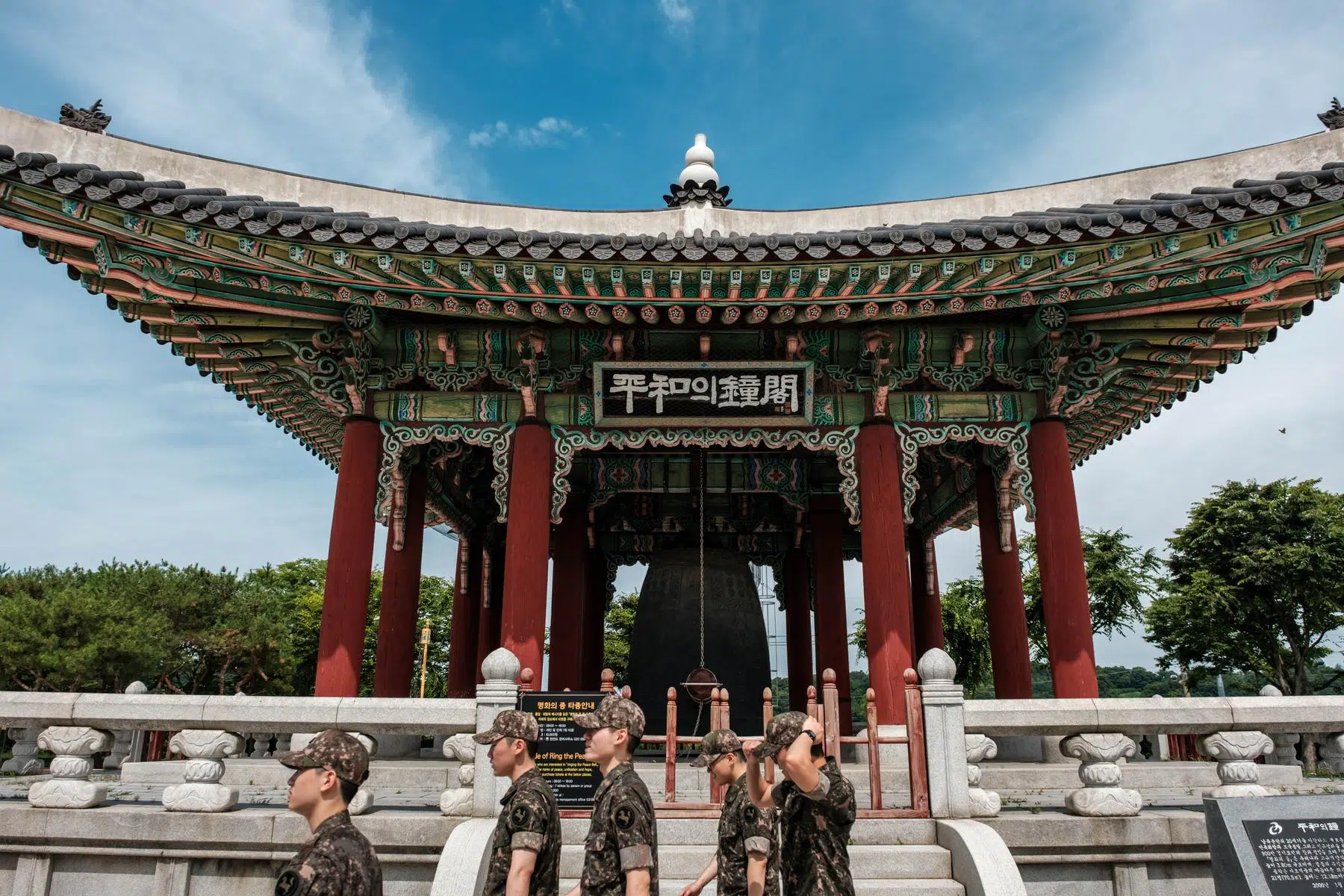
The Peace Bell pavilion (Pyeonghwa Jonggak) at Imjigak. The bell, weighing 21 metric tons, was installed there in 2000 to mark the transition to the 21st century (June 2026).
This post was last updated on : September 13, 2026.