Border Subversion
경계를 뒤집는 예술의 힘
Anti-tank barriers transformed into sculptures. Bunkers converted into art galleries. Barbed wire from the DMZ reforged into a piano. Culture along the world’s most fortified border.


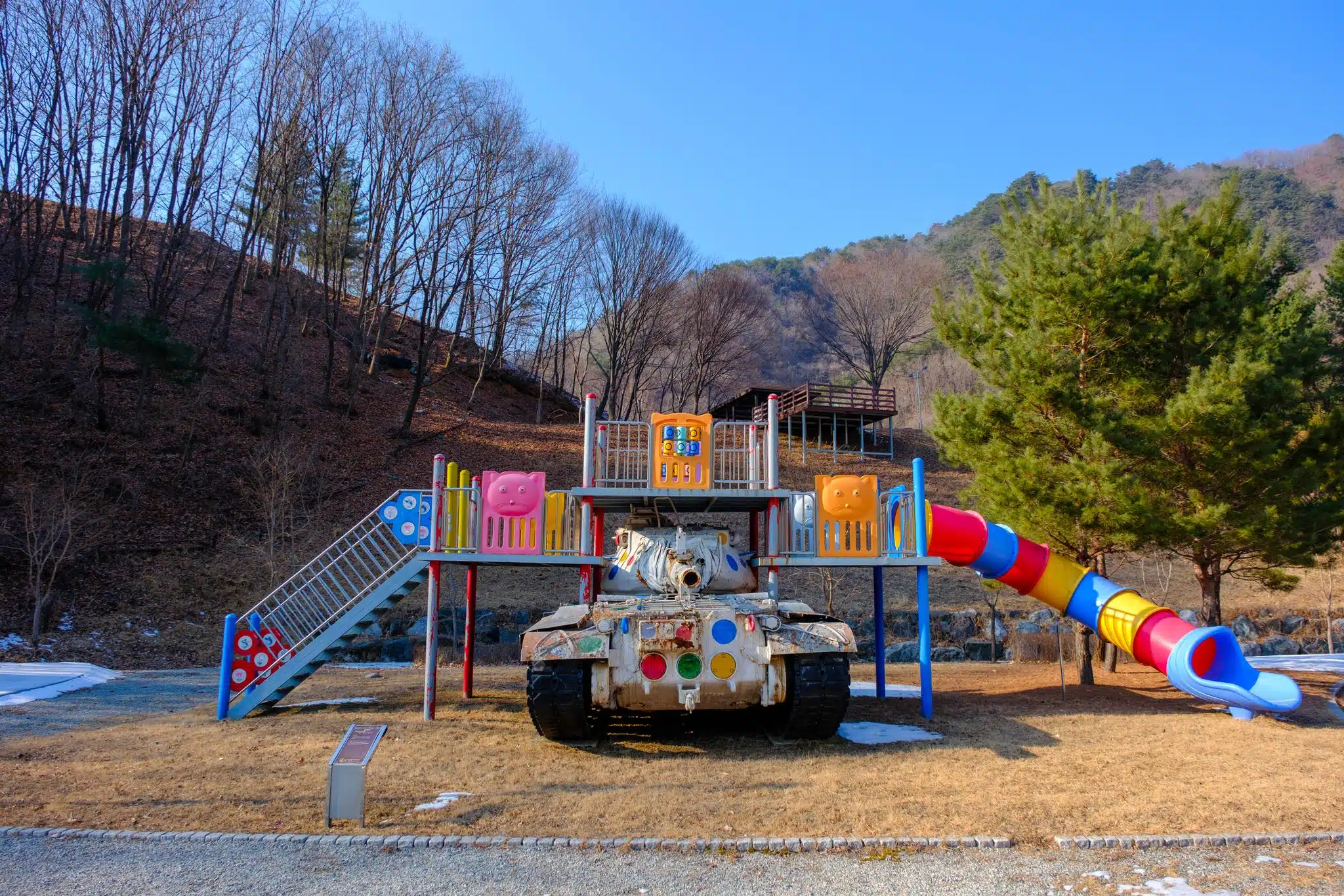
An old tank transformed into a work of art and children’s playground at the Hwacheon Peace Art Park (February 2025).
Since the Berlin Wall, walls of shame have doubled as surfaces of expression. The western face of the Wall accumulated graffiti until it came down in 1989. The US-Mexico border, the Israeli-Palestinian separation barrier, the Peace Walls separating Catholic and Protestant communities in Belfast: all have been claimed at one point or another by street art, sometimes by names like Banksy or JR. The medium is always the same: the infrastructure of division repurposed as a canvas. Academics have called this “border transgression”, or “border subversion.”
The Korean DMZ does the same. But with one significant difference.
Along most contested borders in the world, art tends to challenge the wall itself, its legitimacy, its violence, its permanence.
Here, no one does that. The fence is not questioned. Almost 75 years of infiltration attempts, shellings, abductions and threats of nuclear annihilation by the rogue state of the North have settled that point. What happens instead is something more oblique: the apparatus of division is acknowledged, domesticated, and then, methodically, repainted.
The result is an aesthetic peculiar to South Korea’s northern edge: somewhere between open-air museum, patriotic or pacifist theme park and collective act of wishful thinking.
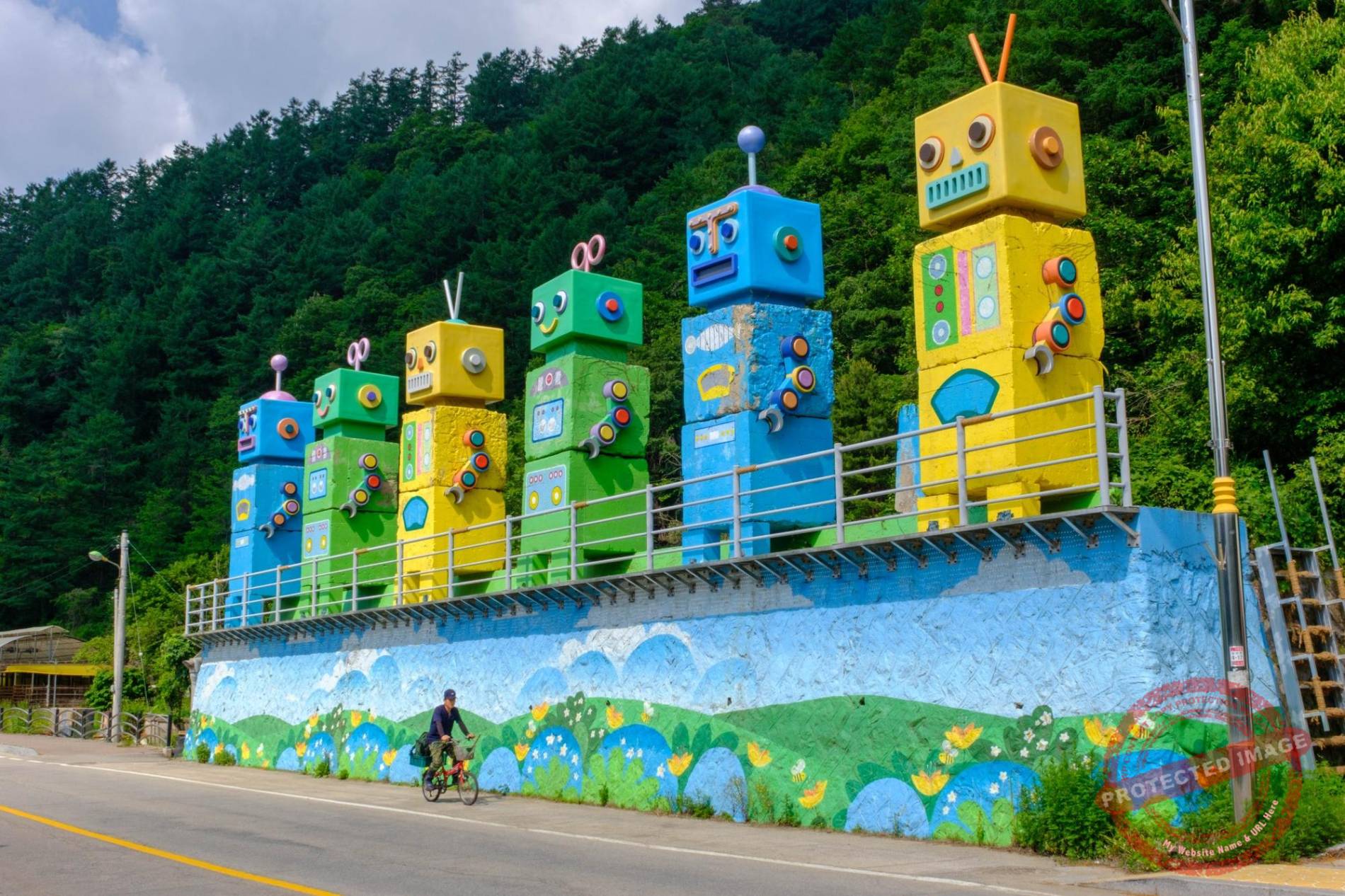
A cyclist passes by an imaginatively decorated anti-tank obstacle in a village near Hwacheon (June 2025).
The most basic form is also the most widespread: ribbons.
Visitors to observation posts and other sites along the DMZ are invited to write messages on small strips of fabric, then tie them to the barbed wire fences. Thousands of them flutter along the border, accumulating through the years, bleaching and shredding in the wind. Up close, the effect is less decorative than melancholic.
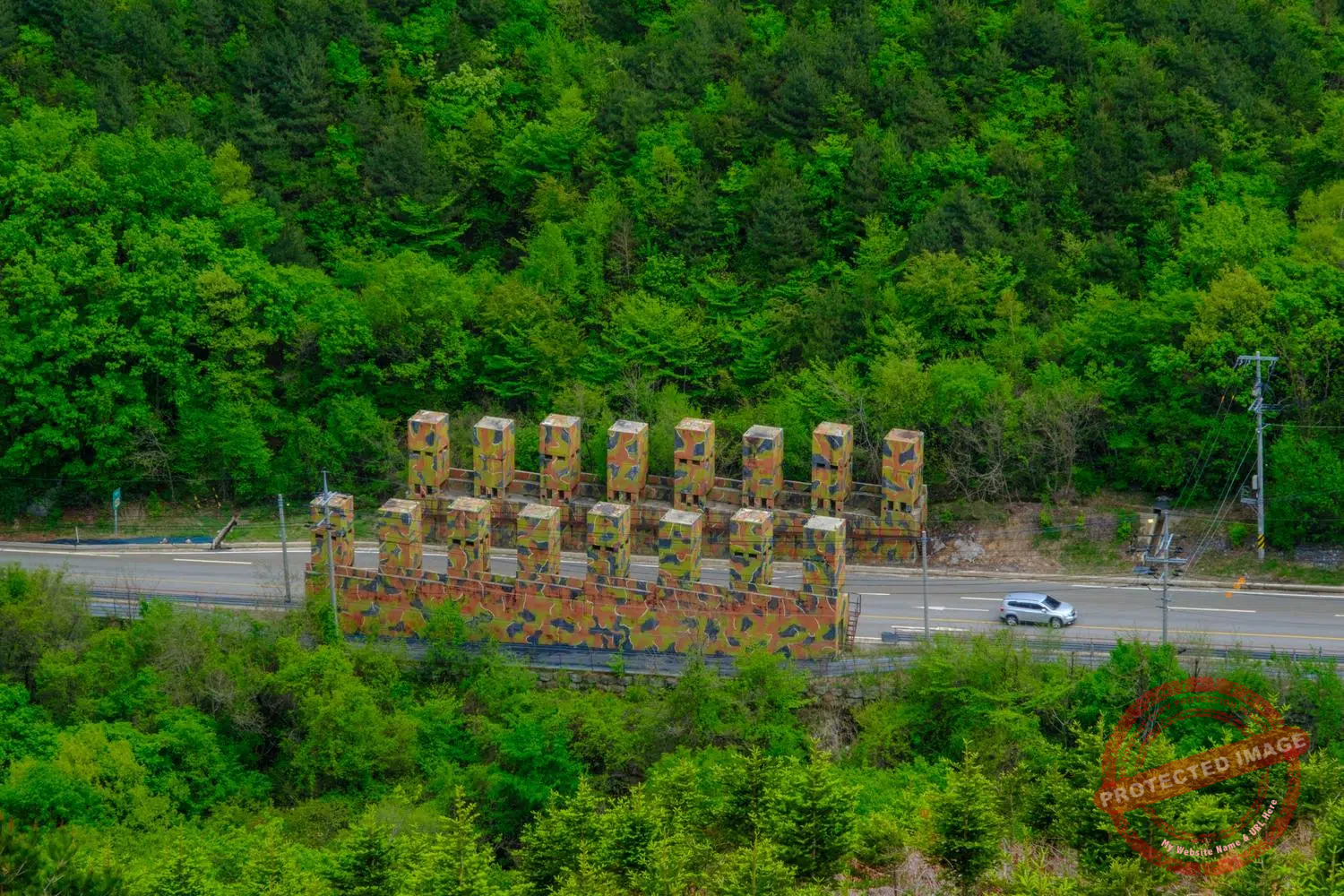
A more durable intervention is the treatment of anti-tank obstacles. The concrete and steel tetrahedra and “rock drop” structures that line many roads in the border area have become targets for municipal beautification projects. Villages near the DMZ have painted their obstacles with flowers or Korean folk patterns. In a village north of Hwacheon, the concrete blocks of one of these barriers have been transformed into colorful robots. Most obstacles remain structurally operational.

A poem celebrating Mount Osong, located in North Korea, hung on the fence of a minefield in Cheorwon (May 2026).
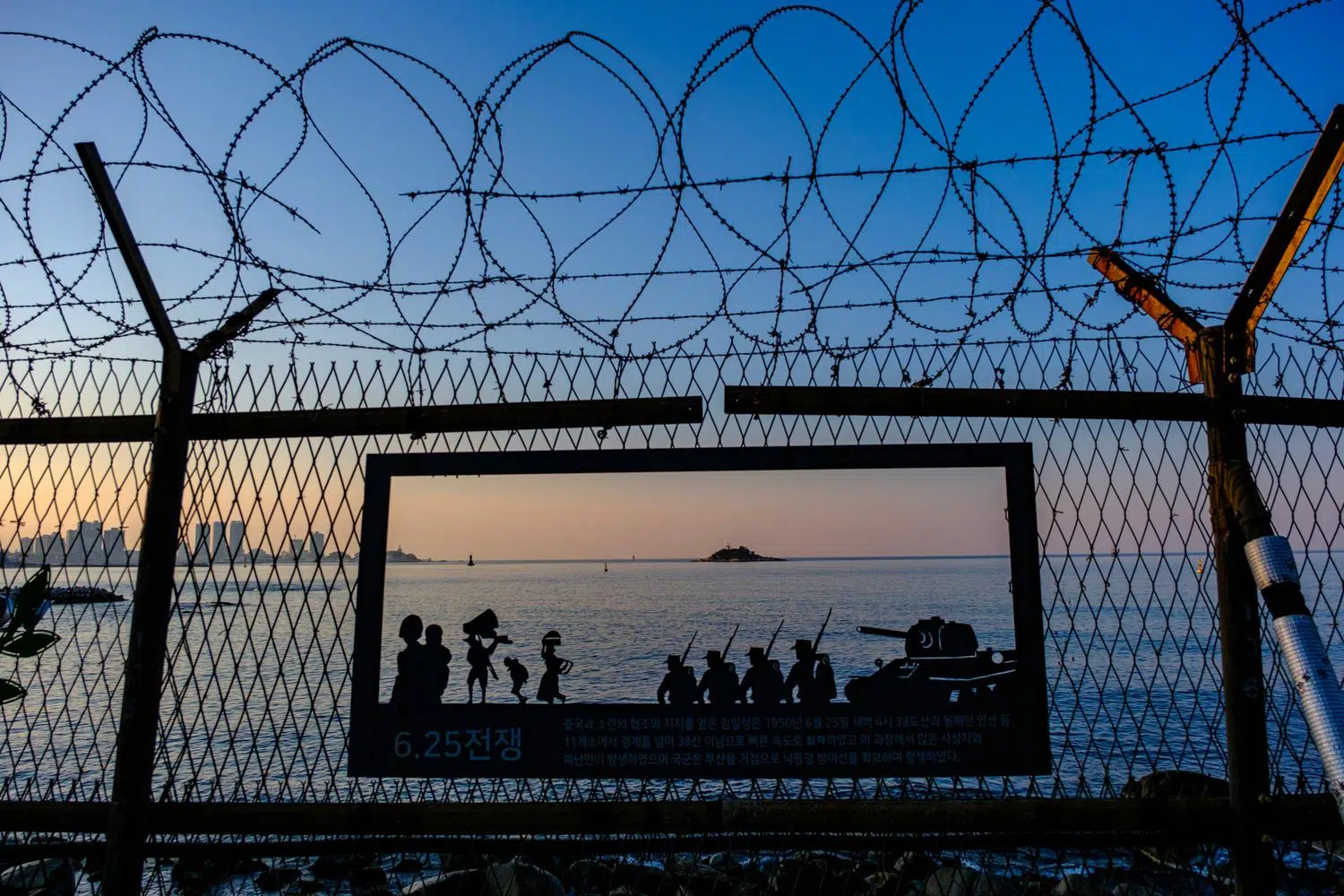
Anti-infiltration fences along the east coast have been subject to the same logic. In Sokcho, where the coastal path follows a string of wire and CCTV cameras planted to detect any approach from the sea, the fence itself has been repainted, sections decorated, a viewing corridor manicured.

A decorative anti-infiltration fence on the Sokcho waterfront (May 2025).
Since the early 2000s, several permanent institutional spaces have anchored the border art scene.
Camp Greaves, a former US Army forward base inside the Civilian Control Zone near Paju, was decommissioned after American troops withdrew from the area in 2004 and handed over to Gyeonggi Province. It now hosts a regular program of exhibitions and performances, and functions as an experience facility where visitors, mostly South Korean students and young adults, can spend a night in former barracks converted into a youth hostel.
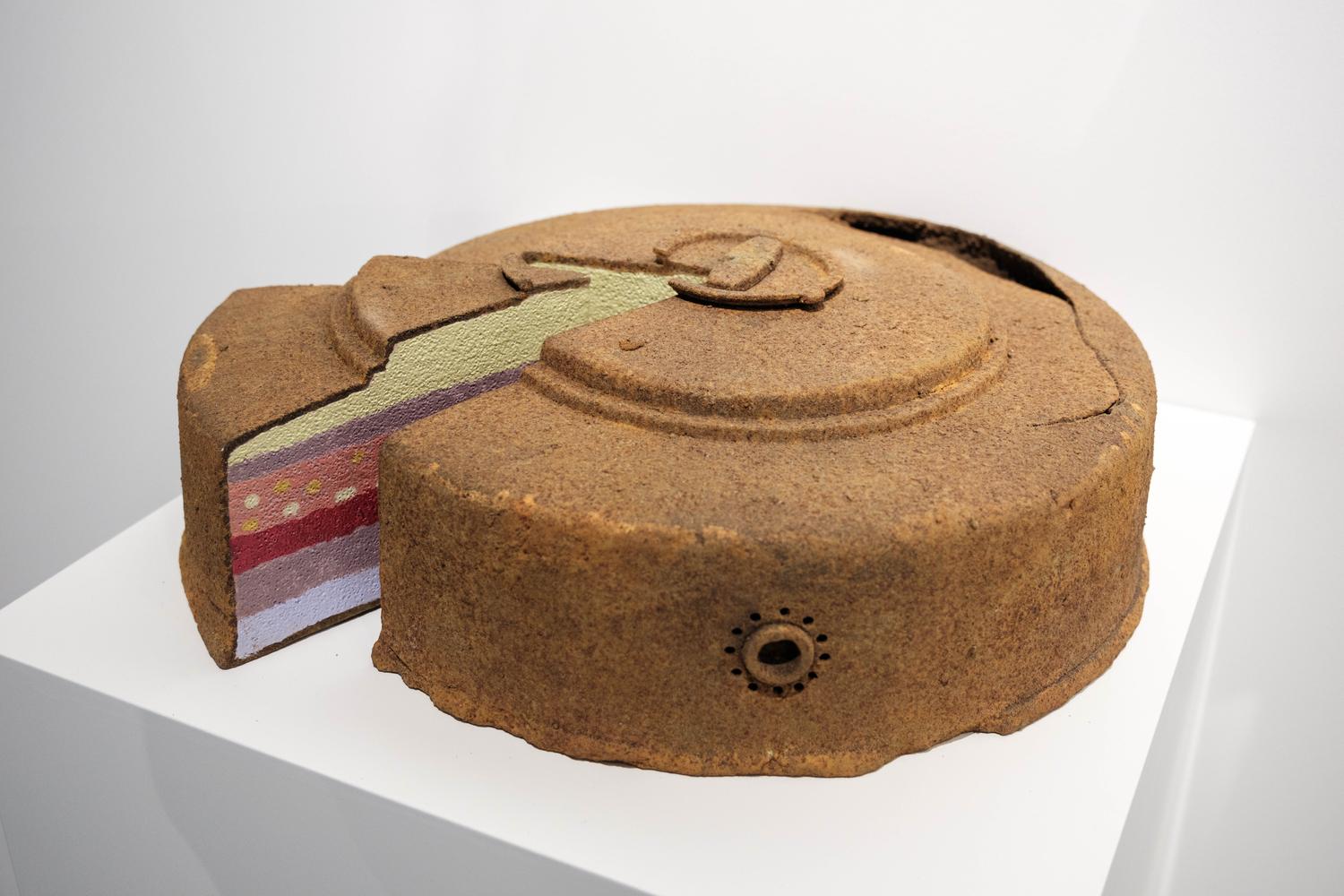
Peace, an artwork by Lee Sang-gu, on display at the Pyeonghwa Museum S827, located in a former U.S. Army warehouse in the border city of Paju (April 2026).
Opened in 2026 on the grounds of Camp Howze, another former US Army installation, in Paju, the Pyeonghwa Museum S827 is a newer project. It occupies former US Army warehouses, functional structures of no aesthetic distinction, and fills them with rotating art exhibitions. Its name is taken from the building’s numeric designation. Strangely enough, the place isn’t advertised at all, has no website and no social media accounts, and is therefore extremely difficult to find.
On the northern outskirts of Seoul, a fortress disguised as an apartment block, built to anchor the capital’s inner defensive perimeter along a likely invasion route, operates today as the Peace Culture Bunker, a cultural center managed by Dobong-gu district. The conversion was completed in 2016. The site houses three authentic sections of the Berlin Wall covered in original graffiti, a gift from the German capital.
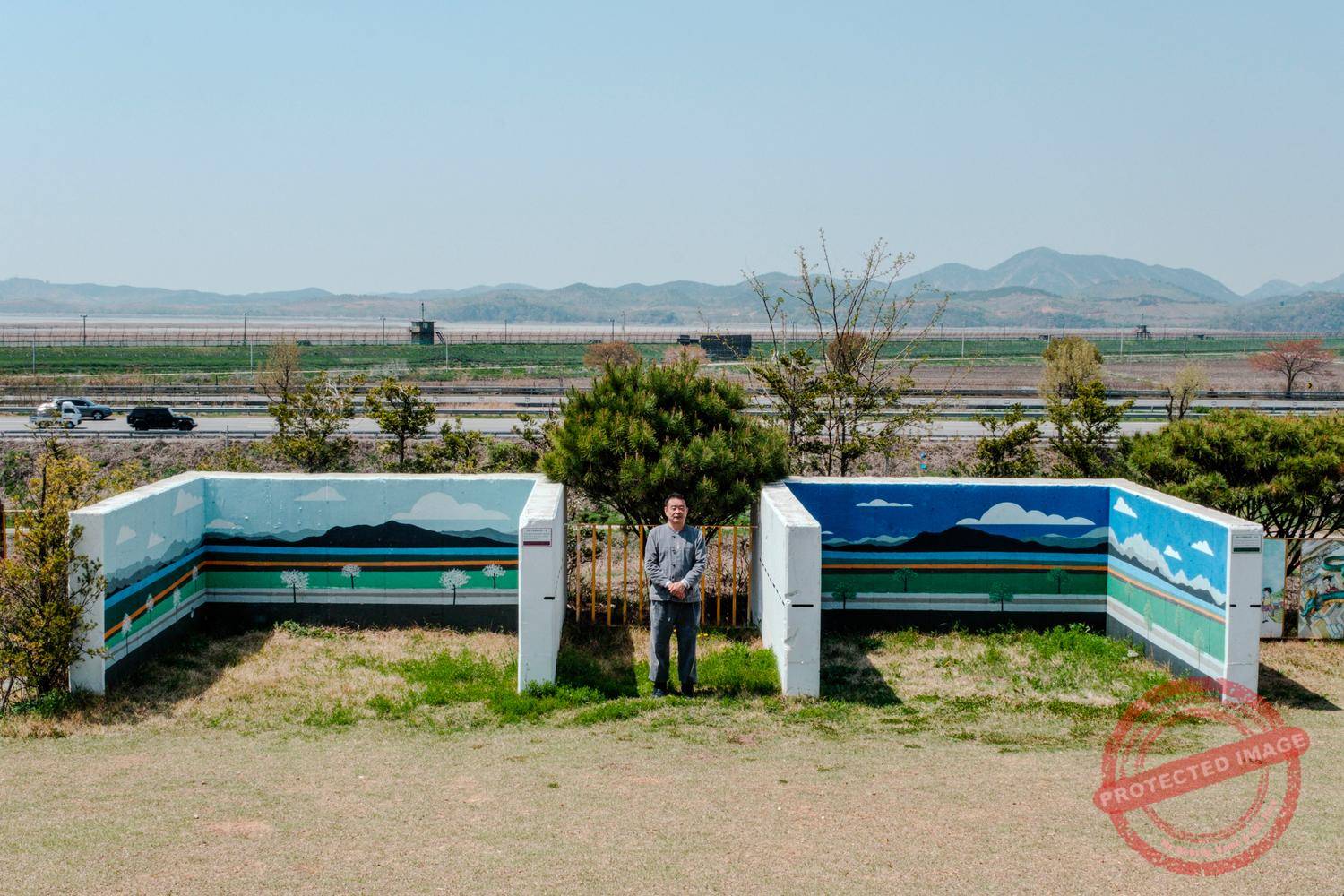
Artist Kim Dae-nyeon, aka Danny Kim, poses in front of two fortified tank emplacements he has decorated above his gallery-bunker located just across the border (April 2025).
On Jayu-ro, the highway running north of Seoul toward the demarcation line, artist Kim Dae-nyeon, known as Danny Kim, has taken up residence in an operational military bunker whose gun ports overlook North Korea, and which he has transformed into a gallery space. Above the bunker are four emplacements for tanks or artillery pieces, which he has repainted in the colors of the four seasons.
Danny Kim lives and works in the nearby village, a few hundred meters from North Korea. Recurring themes in his drawings are division and unification. Once or twice a year, the army takes over his gallery for military exercises, then returns it to its artistic purpose.
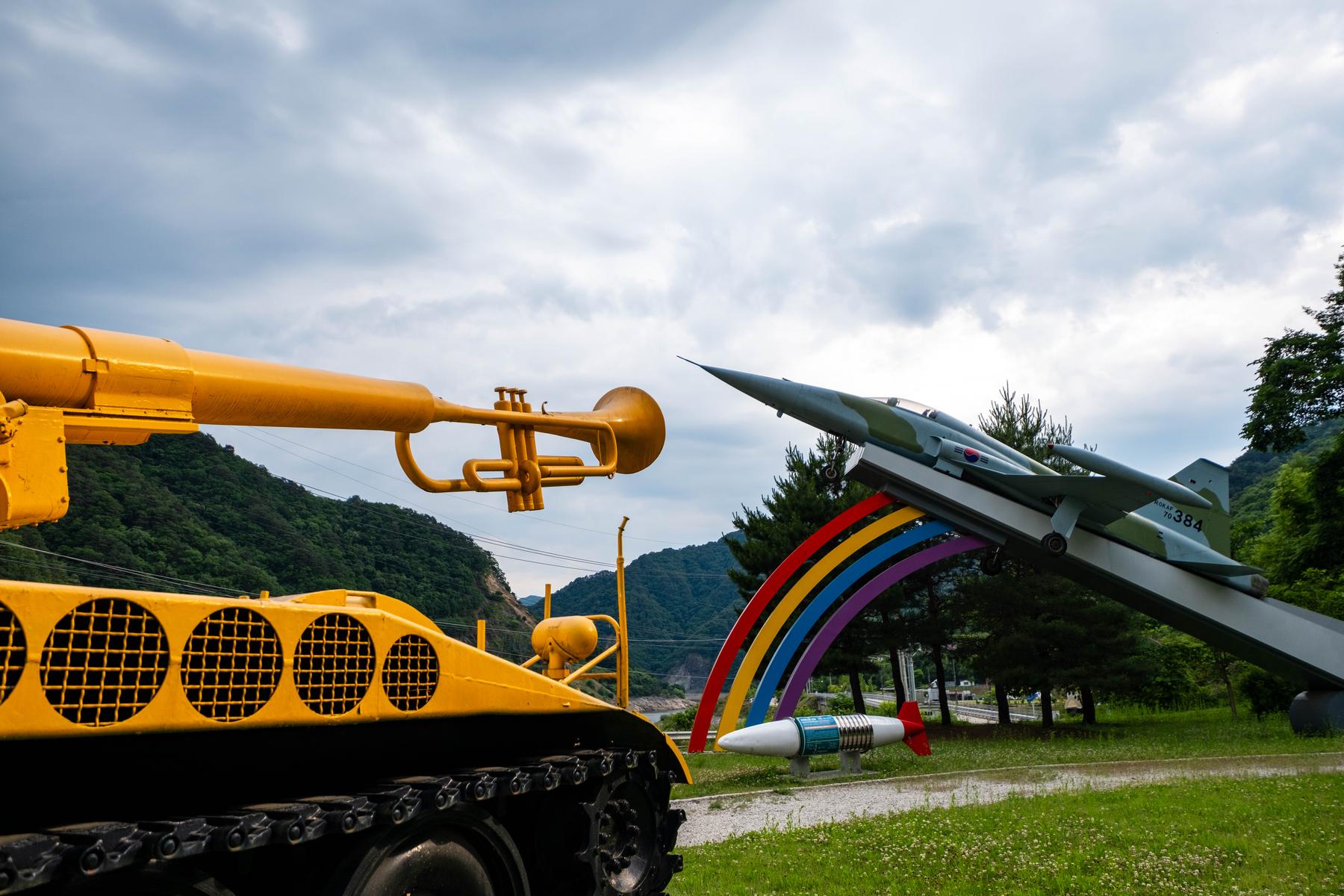
Decommissioned military equipment transformed into whimsical works of art at the International Peace Art Park near Peace Dam (June 2026).
The most literal form of subversion involves military objects: not the infrastructure around a weapon, but the weapon directly.
Just below the Peace Dam, a massive structure built to contain potentially devastating water releases from North Korea a few kilometers upstream, lies the so-called International Peace Art Park. There, old tanks, machine guns, cannons, and even a fighter jet have been repurposed into colorful works of art, some with their barrels turned into trumpets, others converted into slides for children.
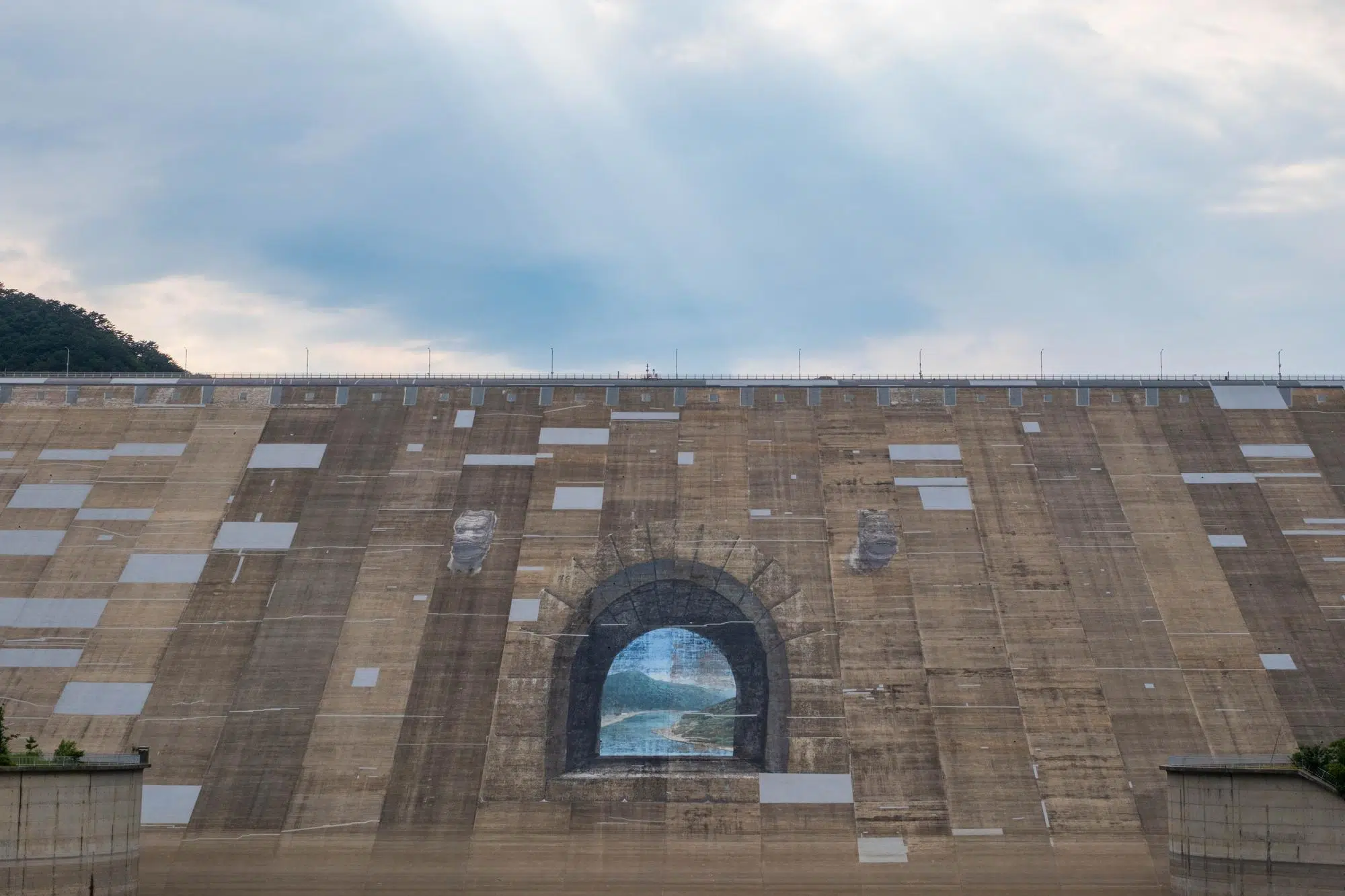
“Door to Unification”, the world’s largest anamorphic painting, on the southern slope of Peace Dam, designed to contain a hypothetical catastrophic and deliberate flooding of Seoul by North Korea. The painting gives the impression of a door opening toward the north side of the dam—that is, toward North Korea (June 2026).
On the southern face of Peace Dam itself, the largest anamorphic painting in the world, Door to Unification, covers part of the slope. Viewed from the correct angle, it gives the visual impression of a door opening northward, toward the North Korean side of the dam.
On the top of the Peace Dam and at several other points along the border, huge metal “Peace Bells” have been installed, made from shell casings from the Korean War or barbed wire from the DMZ. They are part of a much older Korean tradition in which bells hold strong religious, symbolic, and political significance.
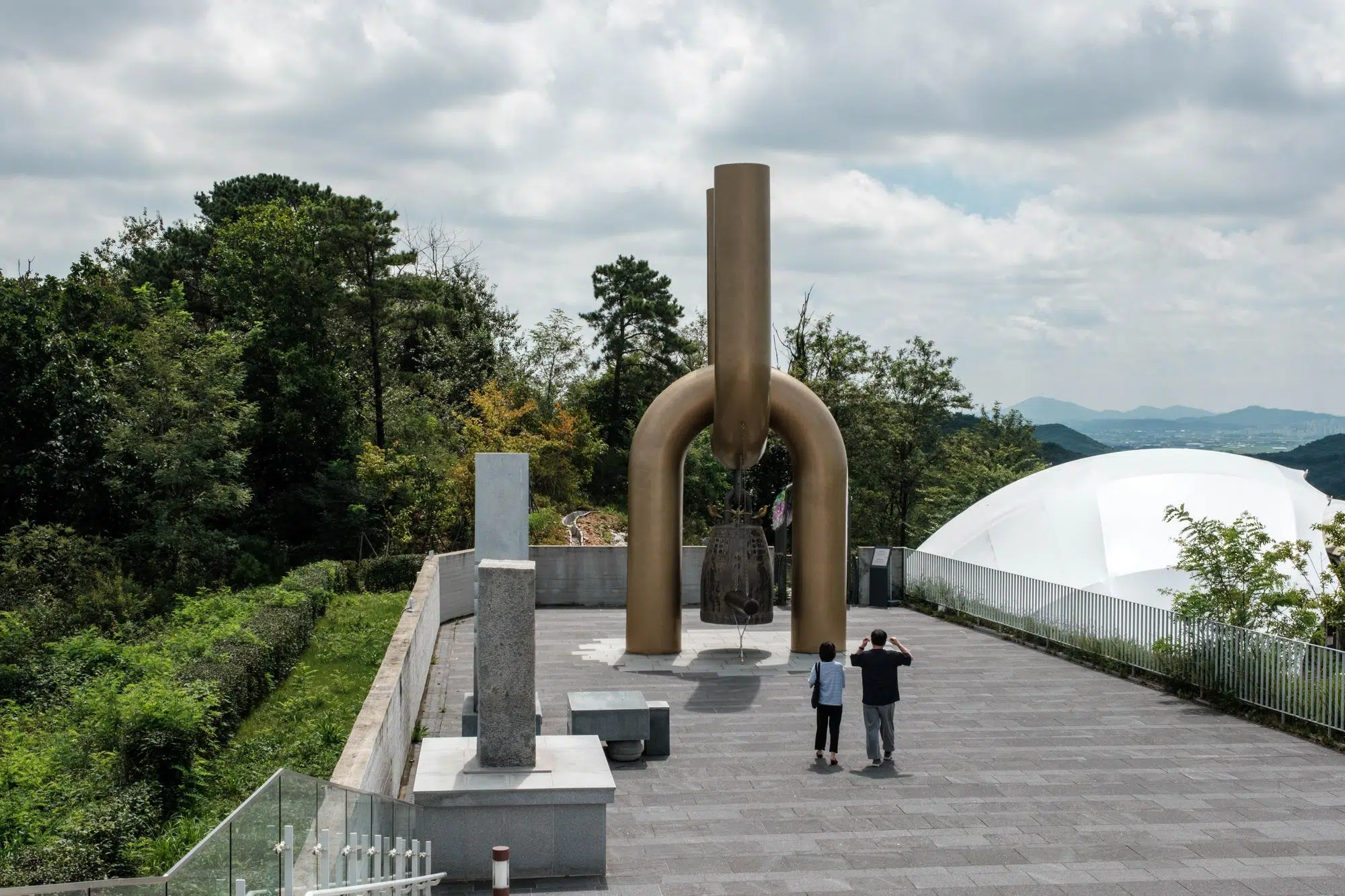
The Peace Bell at Aegibong Peace Ecopark, facing North Korea on the Han River Estuary, made with rusty wire fence and empty cartridges from the Korean War (August 2026).
The sound of a bell is perceived as carrying far through space and time. In the Korean imagination, it often connects the living, the ancestors, and the spiritual world. In Buddhist thought, it represents compassion spreading in all directions. It is meant to symbolically cross barbed wire, minefields, and the Military Demarcation Line. The idea is that what people cannot physically cross, the sound can.
In a similar vein, the Piano of Unification is on permanent display at the Odusan Observatory, north of Seoul. The instrument was constructed from barbed wire recovered from the DMZ fence. Instrument specialists spent six months processing the wire before it produced a recognizable tone. On August 15, 2016, Korea’s National Liberation Day, the piano was played publicly in Seoul, performing the Song of Unification.
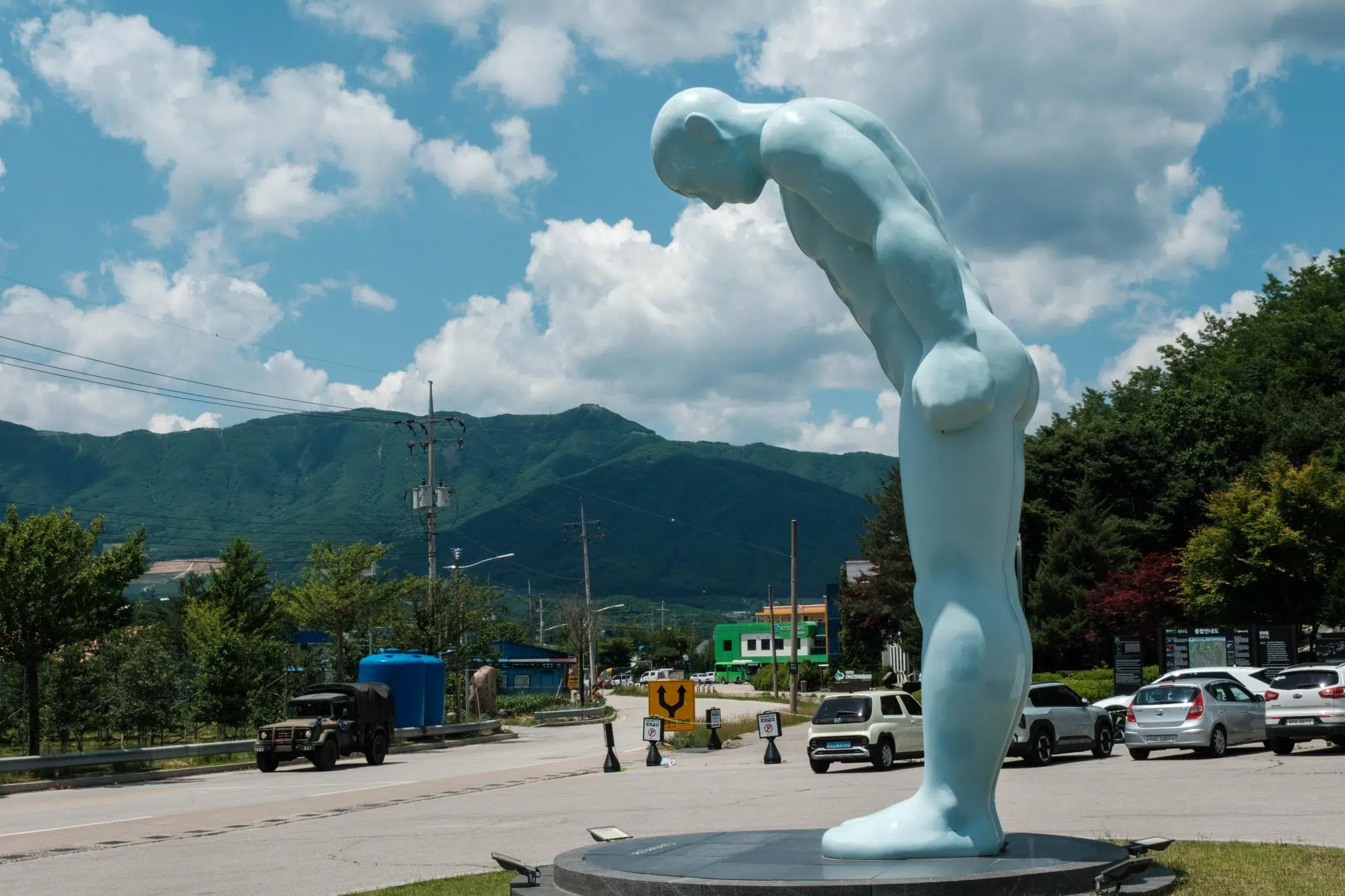
The Greetingman, a 6-meter tall sculpture by Yoo Young-ho, at the foot of Heartbreak Ridge in the Punchbowl Basin. There is a taller version of the sculpture facing the North Korean border in Yeoncheon (June 2026).
The Greetingman, a recurring sculptural motif by artist Yoo Young-ho, marks several points along the border. A six-meter version stands at the foot of Heartbreak Ridge in the Punchbowl basin. A taller version faces directly toward North Korea in Yeoncheon. The sculpture depicts a figure bowing, the Korean gesture of greeting. It has been reproduced and installed at enough locations that it functions less as a site-specific work than as a recurring emblem.
Unlike other borders, where artists have taken it upon themselves to transform the dividing walls, artistic subversion of the Korean Division is most often orchestrated by the local authorities themselves, through calls for proposals and the construction of arts and culture centers. But there are also many unofficial initiatives, such as the one by cartoonist Danny Kim mentioned above.
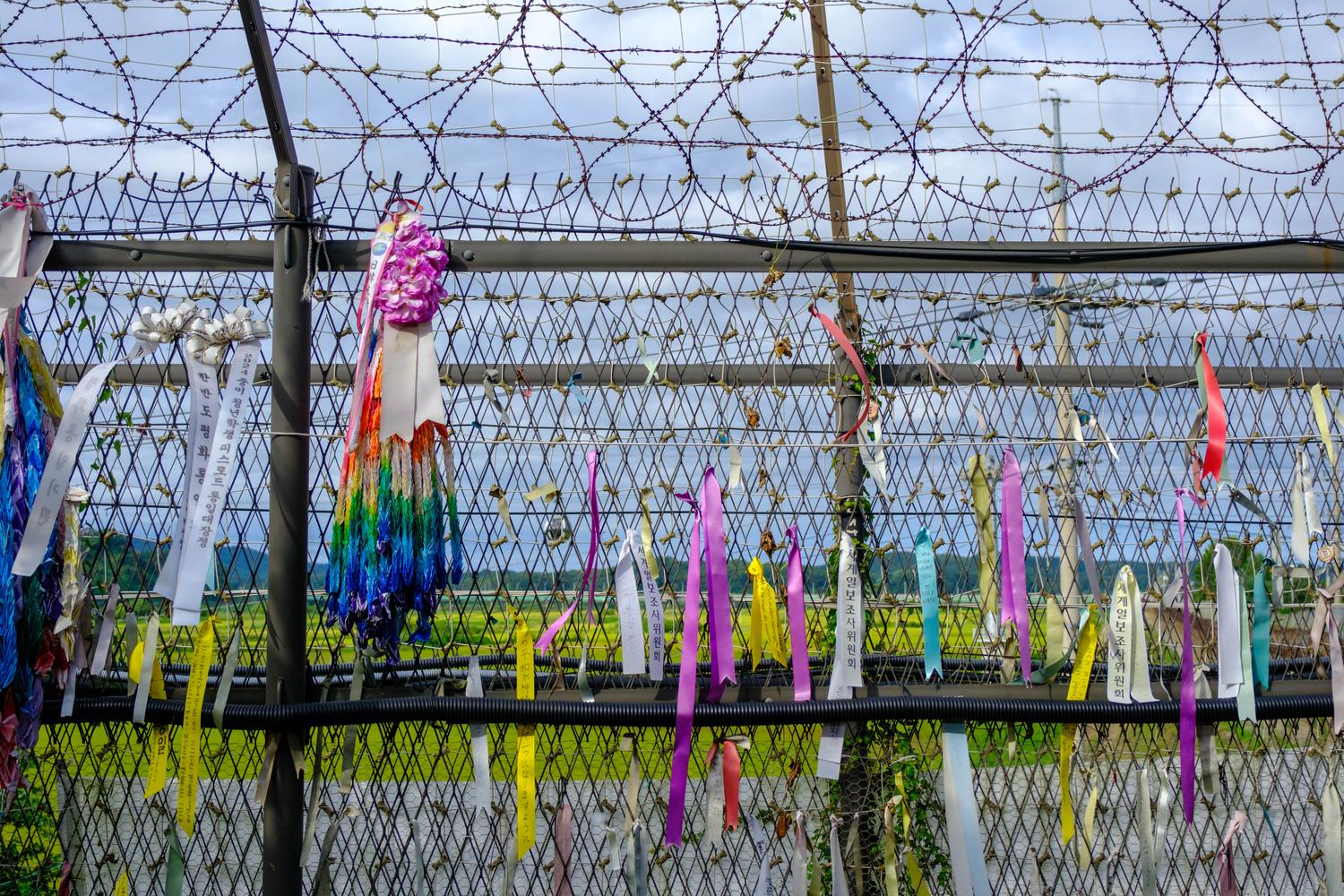
“Peace ribbons” hung on the fence of the Civilian Control Line at Imjingak (September 2024).
The Real DMZ Project, launched in 2011, is the most conceptually ambitious initiative in the field. It operates as a platform for contemporary art that engages with the DMZ and the border region not as a tourist destination, but as a space of political, psychological, and environmental consequence.
Over its years of programming, it has expanded to examine boundaries within South Korean society itself: between regions, between generations, between those who remember division and those for whom it is an abstraction. Its exhibitions have appeared in galleries in Seoul and in the border counties.
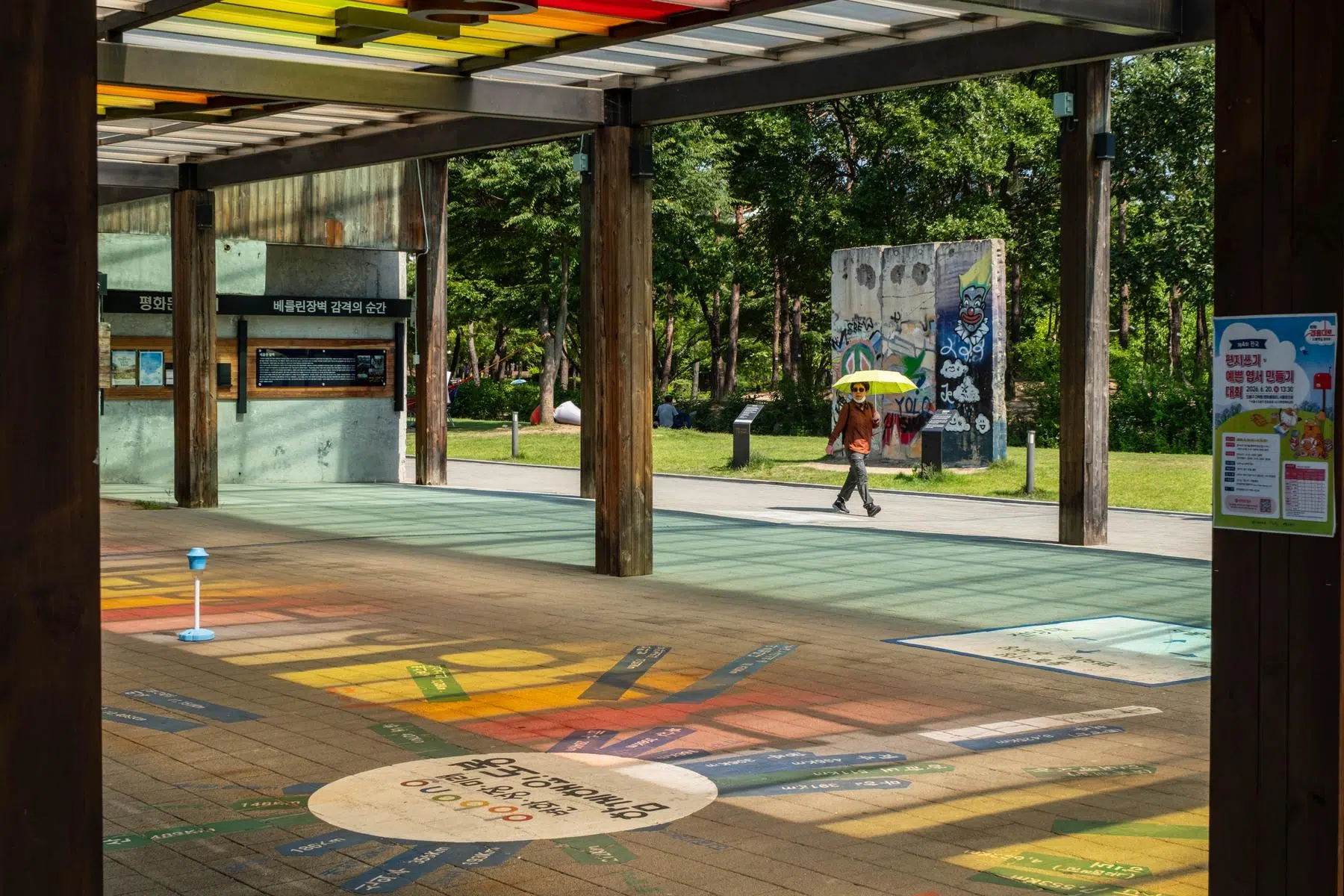
The Peace Culture Bunker, a former secret fortress built to protect the northern approach to Seoul from North Korean tanks, transformed into an art and culture venue and decorated with an authentic slice of the Berlin Wall (June 2026).
The DMZ Peace Train Music Festival, launched in 2018, emerged directly from the brief diplomatic thaw that followed the inter-Korean summits of that year. It is held annually in early summer near the border in Cheorwon, using sites connected to the Korean War and the division.
The inaugural edition, in September 2018, used the courtyard of the Workers’ Party Headquarters, a roofless ruin bombed out during the war, as one of its stages. The lineup included John Cale, founding member of the Velvet Underground; Glen Matlock, founding bassist of the Sex Pistols; and Danish post-punk band Iceage. Three days of concerts. North Korean authorities were reportedly briefed in advance so that the sound would not be interpreted as a hostile act.
The festival has continued each year since. The atmosphere of 2018 has not.
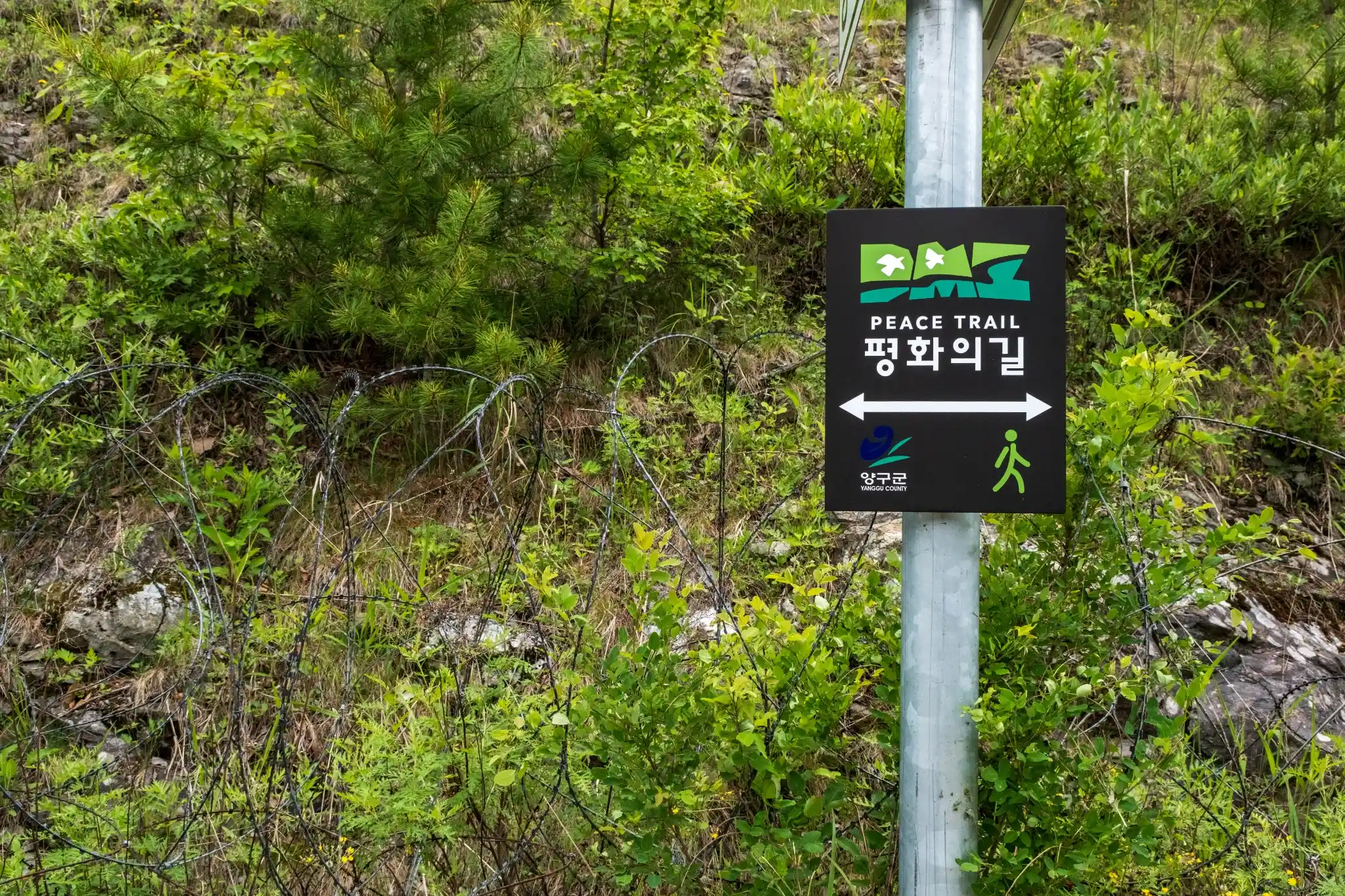
The DMZ Peace Trail, a 510 km-long network of government-managed trekking routes stretching from coast to coast along the southern boundary of the Demilitarized Zone (June 2026).
The sporting annexation of the border follows the same logic as the artistic one.
Every year, a string of competitions routes itself through the Civilian Control Zone, along minefields, past fortifications, through villages that have not changed much since the 1980s. The DMZ Hwacheon Cycling Rally covers the mountainous terrain around the Peace Dam. The DMZ Open Peace Marathon in Paju crosses the Unification Bridge into the CCZ. The DMZ International Peace Marathon in Cheorwon routes participants past Korean War battle sites and along military-controlled rural roads that are otherwise closed to public traffic.
The DMZ Peace Trail, inaugurated in 2019, formalizes the hiking dimension. It comprises twelve sections of trail running the length of the border from the east coast to the west. Several sections in the Civilian Control Zone require military escort and must be completed in organized groups. Some are, for reasons that are not publicly explained, closed to non-Korean nationals. The trail covers terrain that was, in many places, a battlefield within living memory.
It should be noted that none of these competitions or trails labeled “DMZ” actually pass through the Demilitarized Zone, which is strictly off-limits for this type of activity. Here, as in many other areas, the “DMZ” label helps promote regions near the border in general.
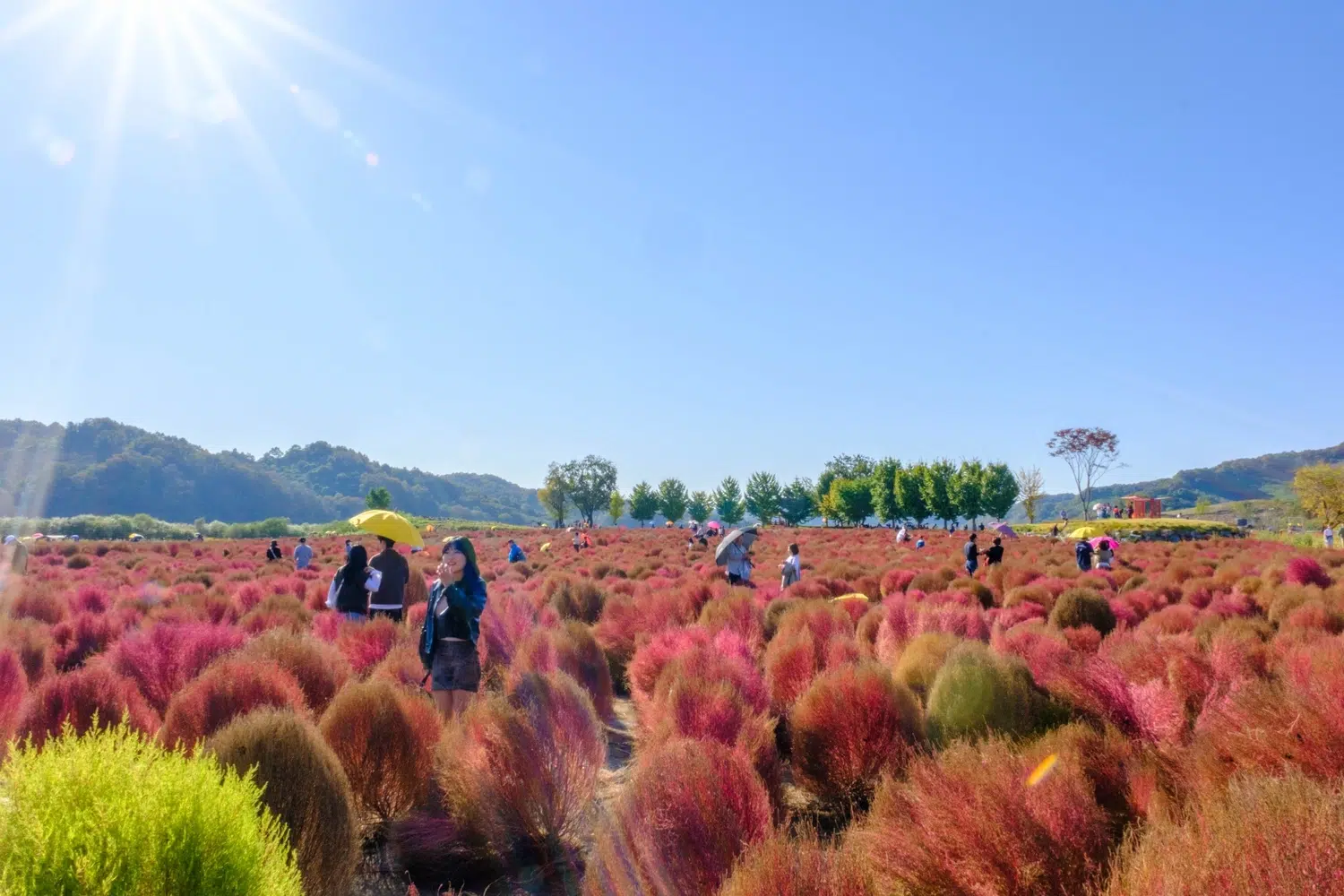
Imjin River Daepssari Park in Yeoncheon. The barbed-wire fence of the Civilian Control Line is just behind the trees in the background, and the Military Demarcation Line with North Korea is less than 5 kilometers away (October 2024).
The vibrant flower gardens planted right behind the barbed wire in Yeoncheon or on Gyodong Island. The poems hung on the fence of a minefield in Cheorwon. The anti-invasion fortresses converted into art and culture spaces: each of these is, in its own way, a statement about what South Korea has chosen to do with the wounds of its unresolved division. Not ignore them, not remove them, cover them in flowers, run races past them, invite musicians to play beside them, commission murals on top of them.
Elsewhere, a scar is something to hide. In Korea, it has become something to visit.
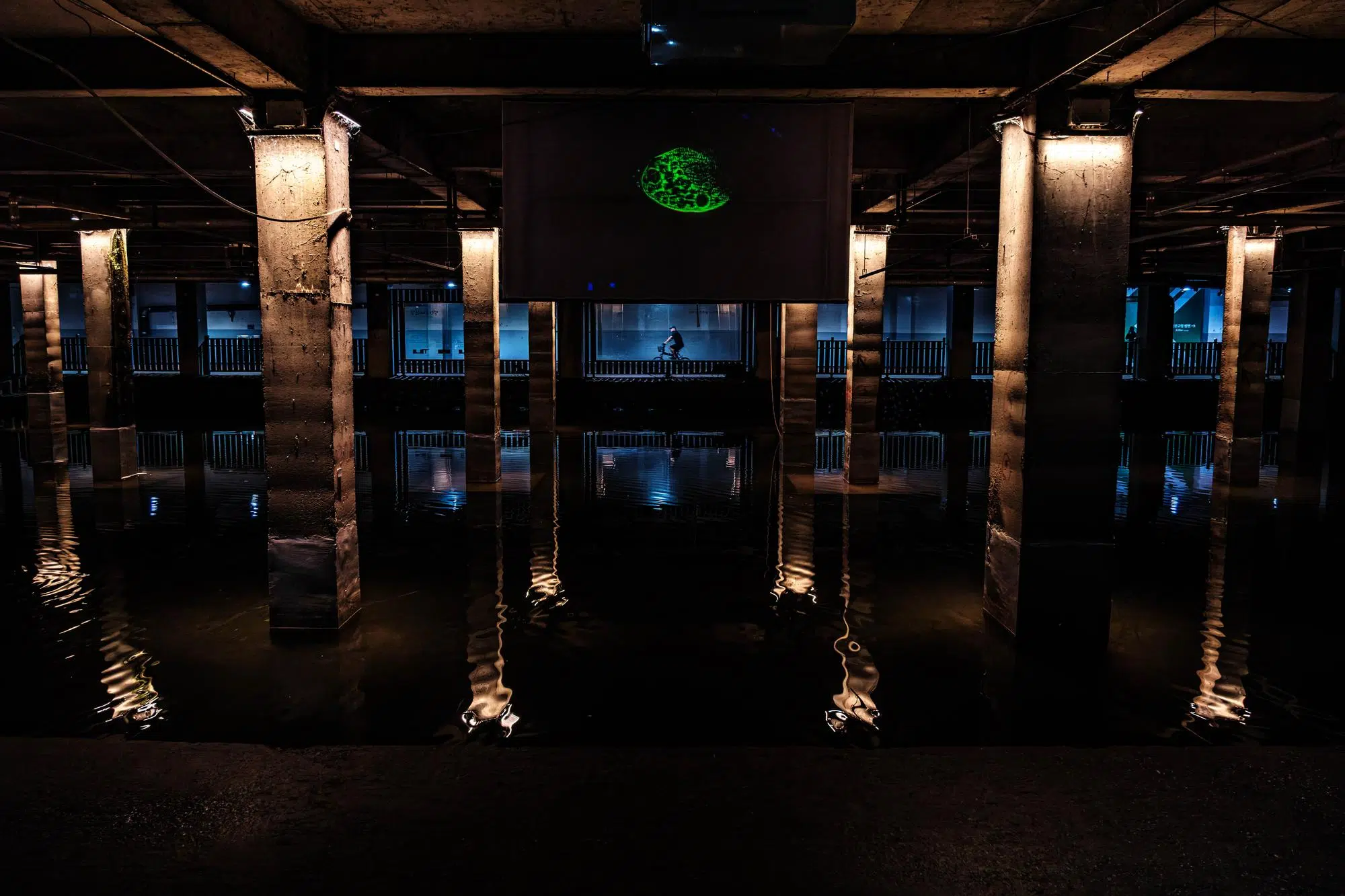
On Seoul’s Tongil-ro, the main road linking the capital to the inter-Korean border (and a potential invasion corridor), stands the Yujin Shopping Complex. Built in 1970 over the Hongjecheon stream in Seodaemun District, this unremarkable building doubled as a hidden fortress. The ground floor was designed in a piloti structure so tanks could be positioned between the pillars in wartime, and engineered so that if one pillar were destroyed, the whole building would collapse lengthwise to block a North Korean advance toward the city. The underground space where the Hongjecheon flowed stayed sealed off from the public for 50 years. Since 2020, the Hongjecheon stream has flowed through a restored 250m stretch beneath the shopping mall, framed by around 100 of the original defense pillars. Hongje Yuyeon is now a free underground cultural spot featuring installations, sound and media art work (July 2026).

A visitor takes a virtual reality tour of Mount Kumgang, in North Korea, at the Phantom Mountain exhibition by artist Lijung in September 2026 in Seoul. Mount Kumgang (금강산) is Korea’s most beloved mountain. An old belief held that climbing it once before you died spared you from hell. It became accessible to South Koreans during a period of inter-Korean détente between 1998 and 2008. Nearly two million of them made the trip. On 11 July 2008, a South Korean woman was shot dead by a North Korean soldier at the site, and everything came to a halt. Since then, one can only catch a glimpse of the sacred mountain in the distance from south of the demarcation line on clear days, and dream of it. That was the subject of the exhibition. Lijung and curator Lee Hyewon built a virtual tourism service that reconstructed Mount Kumgang through collective memory, interviews, archival materials, and computer-generated landscapes. You entered not as a viewer, but as a tourist, and you could even take a virtual souvenir selfie with the mountain.
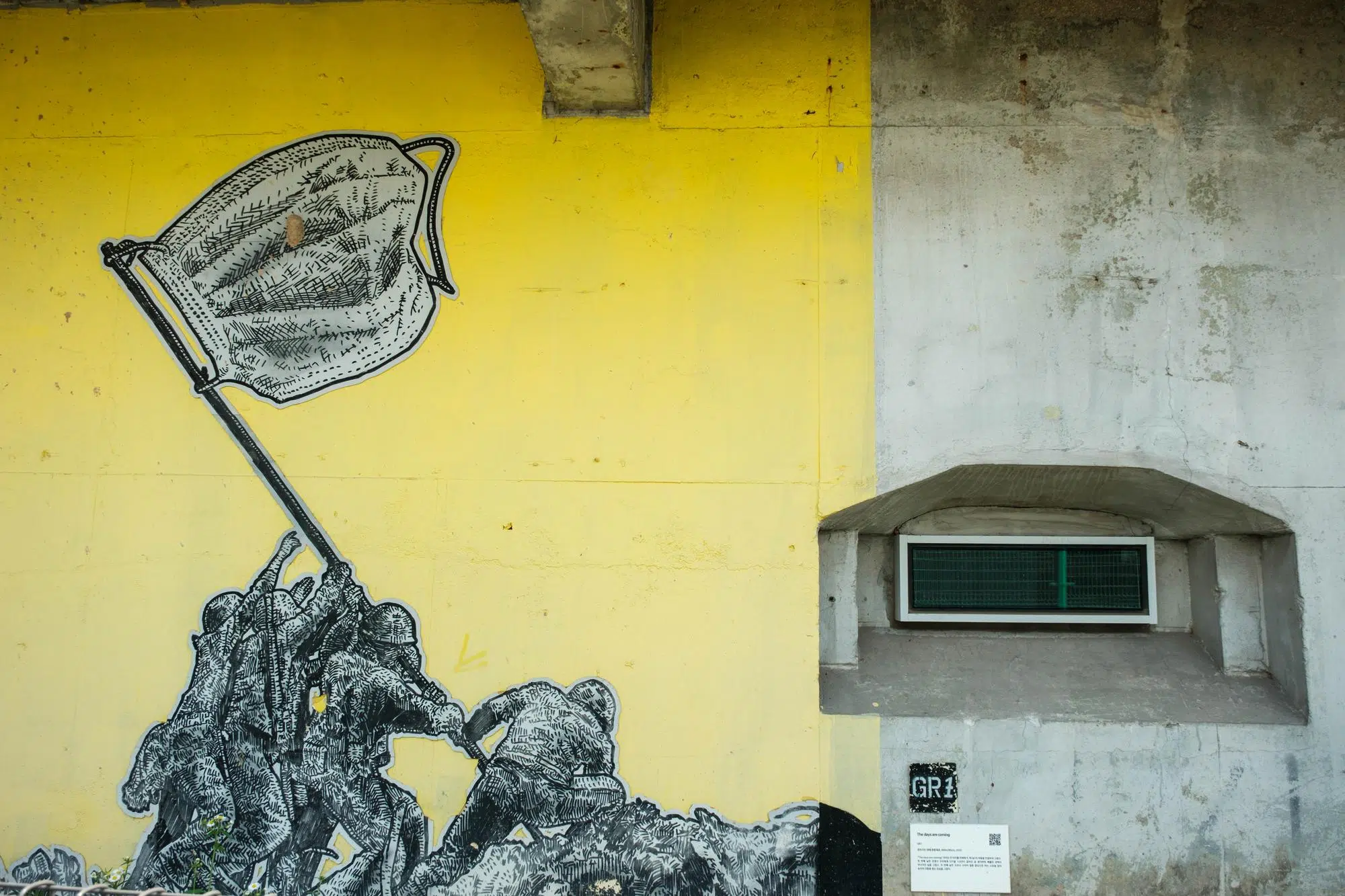
A pandemic-themed parody of “Raising the Flag on Iwo Jima” on one of the walls of the Peace Culture Bunker, a former secret fortress at the northern entrance to Seoul (June 2026).
This post was last updated on: September 19, 2026.


© Roland de Courson 2005 – 2026
All rights reserved. Reproduction of any texts, photographs, videos, graphics, maps or other original material published on this website, without the author’s prior written authorization, is strictly prohibited. K-Scar and its logo are registered trademarks. Read the Terms of use.
© Roland de Courson 2005-2026. All rights reserved. Reproduction of any texts, photographs, videos, graphics, maps or other original material published on this website, without the author’s prior written authorization, is strictly prohibited.