DMZ Tours
접경지역 관광
Selfies, traffic jams of tour buses and fairground spectacles along Korea’s active front line.


A couple takes a selfie at the Third Infiltration Tunnel site, located inside the DMZ (May 2026).
Nowhere else in the world will you see, every day, thousands of carefree visitors wandering around and taking selfies in a restricted military area in what remains a genuine war zone. Although there are no comprehensive statistics on this subject, it is reasonable to estimate that tourism related to the inter-Korean border accounts for several million visits each year, including 1.2 million just to the Imjingak complex. For many foreign visitors, the DMZ area is one of the top day trips from Seoul, right up there with the royal palaces and the trendy neighborhoods.
The so-called “DMZ Tours” emerged from the 1970s onwards, with the gradual opening up of border areas that were previously strictly off-limits to civilians. The United Nations Command (UNC), which has jurisdiction over the DMZ (see the glossary), has itself designated 15 sites within the buffer zone which tourists may visit under escort when the security situation permits (as of 2026, however, most of these are closed).
One of the first border tourism sites was Imjingak, a pavilion built in 1972 in the city of Paju as a place of remembrance for families separated by the Korean War. Over the years, all manner of tourist facilities were built in the surrounding area, eventually transforming this site, situated 50 km north of Seoul and 5 kilometres from North Korea, into a veritable border-side theme park mixing mixed mourning, education and sightseeing.
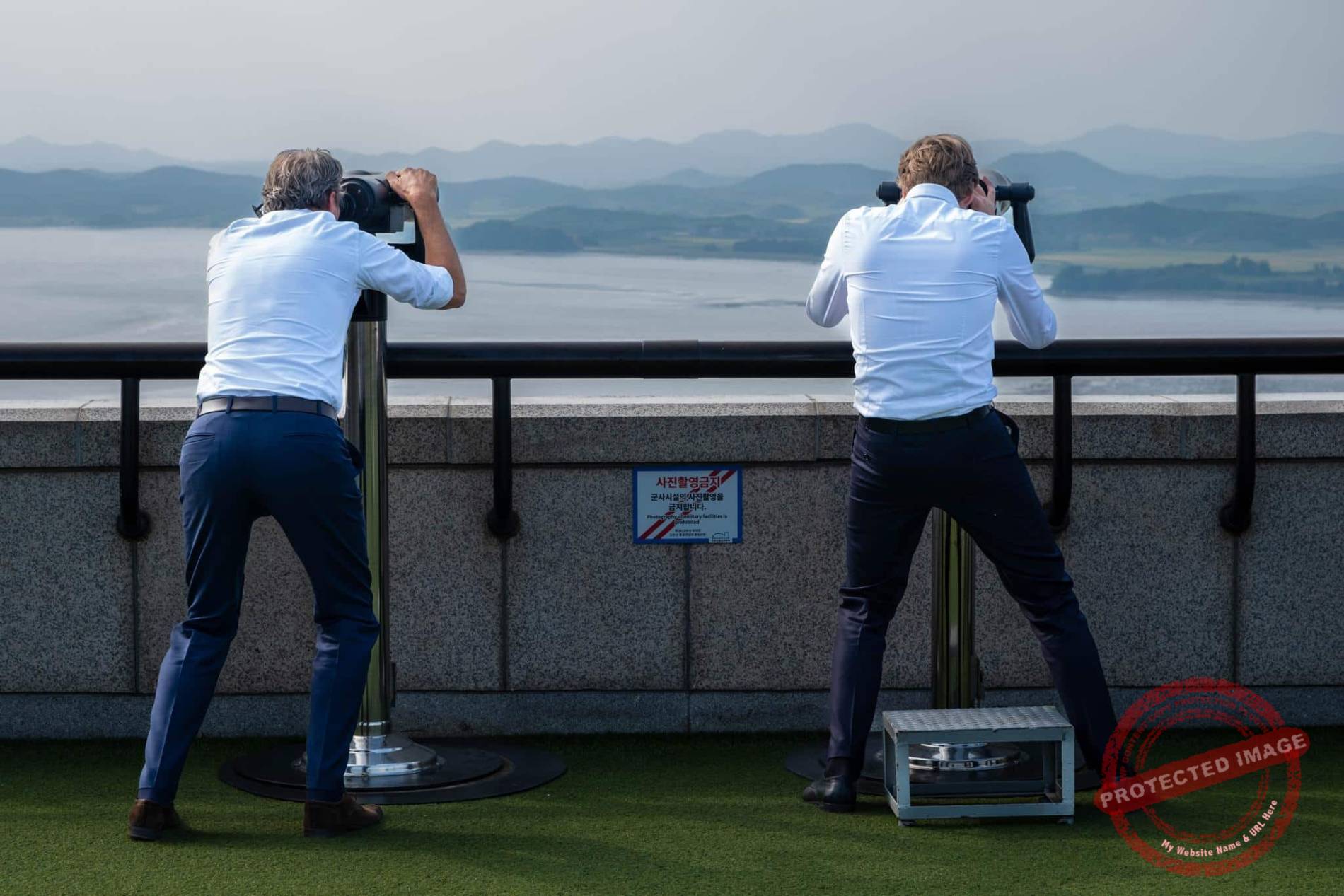
The first observation deck with a direct view of the North to open to the public, in 1984, was the one in Goseong, on the east coast, which remains the only one in Korea managed by veterans’ associations. It was followed by the Dora Observatory in Paju three years later.
The discovery of several infiltration tunnels dug by North Korea under the Demilitarized Zone in preparation for an invasion of the South gave the authorities the idea of transforming these sites into tourist attractions to raise public awareness of the security risks posed by Pyongyang.

Third Infiltration Tunnel souvenir shop (May 2026).
It should be noted that when it comes to border tourism in South Korea, conservative governments like to promote “security tourism,” while left-wing governments prefer to talk about “peace tourism.” The places visited are the same, but the narrative changes: “security tourism” emphasizes the danger posed by the aggressive communist enemy right next door, while “peace tourism” focuses on hopes for reconciliation and reunification. The many travel agents and shop keepers who profit from this don’t care anyway.
Thanks to, or because of, its proximity to Seoul, just an hour away by bus, Imjingak has become the archetype of a tourist factory. Over the years, all kinds of border-related attractions have been added to the original places of contemplation, from a “DMZ Gondola” to a virtual “DMZ Experience Center” and even a small “Peace Land” amusement park equipped with a pendulum ride, all seasoned with countless fast-food restaurants, selfie spots and souvenir shops selling grenade-shaped water bottles, fridge magnets warning of minefields or rifle bullet key chains.
In 2025, a new attraction opened there: a “North Korean Experience Center” where, for an admission fee, visitors can meet genuine North Korean defectors. There is also a scaled-down replica of Panmunjeom’s Joint Security Area (JSA), where visitors can have their photo taken wearing novelty military uniforms.
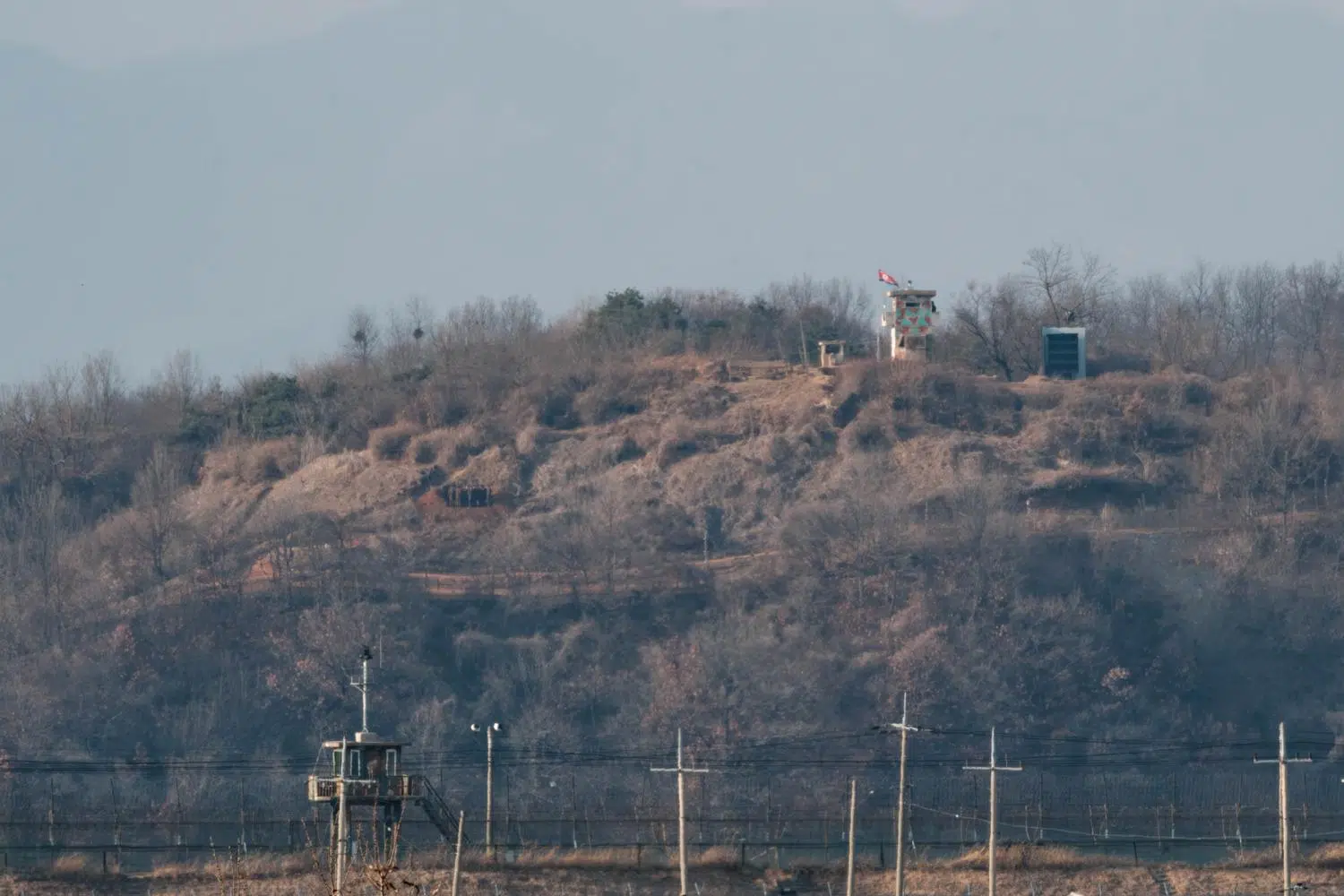
The paradox is that, although Imjingak is the most popular tourist site along the border, it is almost impossible to see North Korea from there (a few distant North Korean peaks are sometimes visible from the rooftop of one of the buildings, when the weather is good).
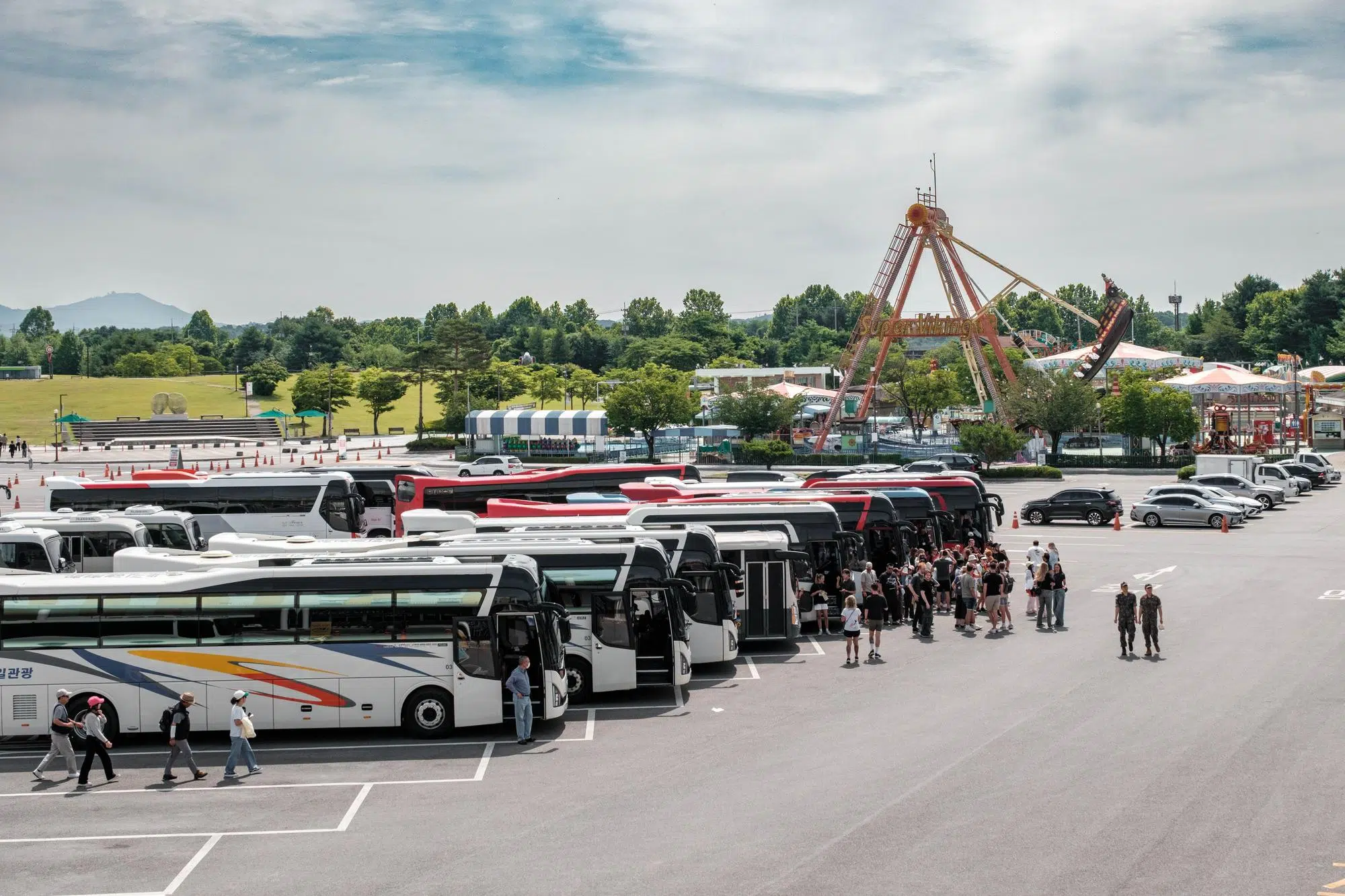
Buses in the main parking lot at Imjingak, the main gate to the DMZ area tourist sites, in front of the “Peace Land” amusement park and its pendulum ride (June 2026).
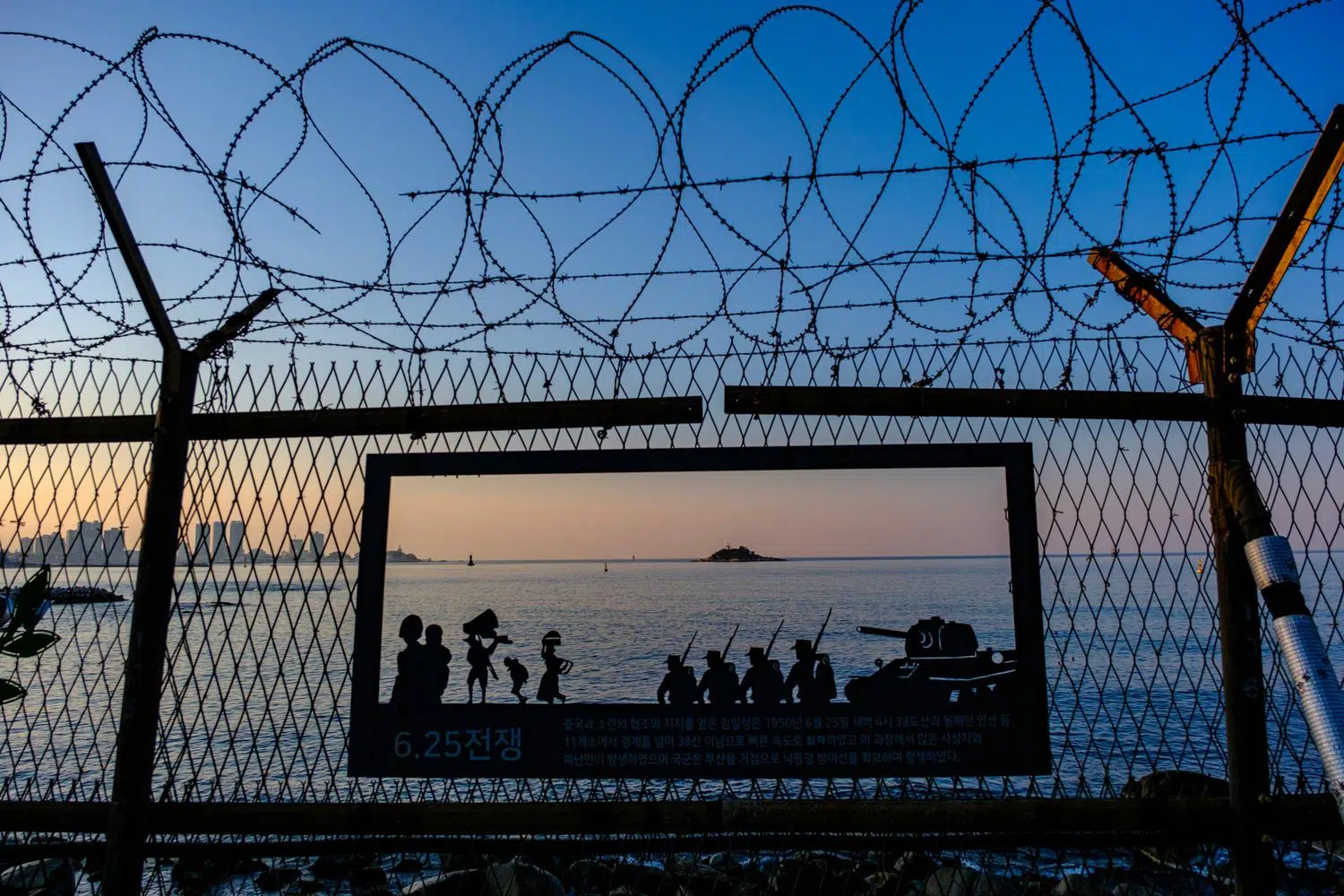
Dozens of travel agencies offer so-called “DMZ Tours” departing from Seoul, for better or for worse. The typical route starts at Imjingak, where guides line up to obtain permits to enter the Civilian Control Zone (CCZ) on a first-come, first-served basis, while their clients take photos of the Imjin River behind the barbed wire decorated with multicolored ribbons and grab a bite to eat at the many fast-food restaurants. The tour buses then pass through the military checkpoint leading into the CCZ on the Unification Bridge and stop at the Dora Observatory, which offers a spectacular view of the large North Korean city of Kaesong, and at the nearby Third Infiltration Tunnel.
Both sites are located less than two kilometers from the border, and thus technically within the DMZ, as the photo spots set up for tourists remind visitors. The trip usually ends with a stop at the souvenir shop and buffet restaurant in the Unification Village. Some itineraries include a detour to the scenic Gamaksan Suspension Bridge, which has little to do with the DMZ, even though it is officially dedicated to the British Army’s Gloucester Regiment, which fought heroically during the Korean War.
Much to the chagrin of travel agencies, the most spectacular tours—those that took visitors to Panmunjeom’s Joint Security Area, where they could look North Korean guards straight in the eye and even take a few steps across the border into one of the huts straddling it—have been suspended following the defection of a participant to the North in July 2023. Less crowded packages take visitors to Cheorwon, in the center of the peninsula, or Goseong, on the east coast. In addition, there are numerous artistic and cultural sites along the DMZ, which are often not very crowded.
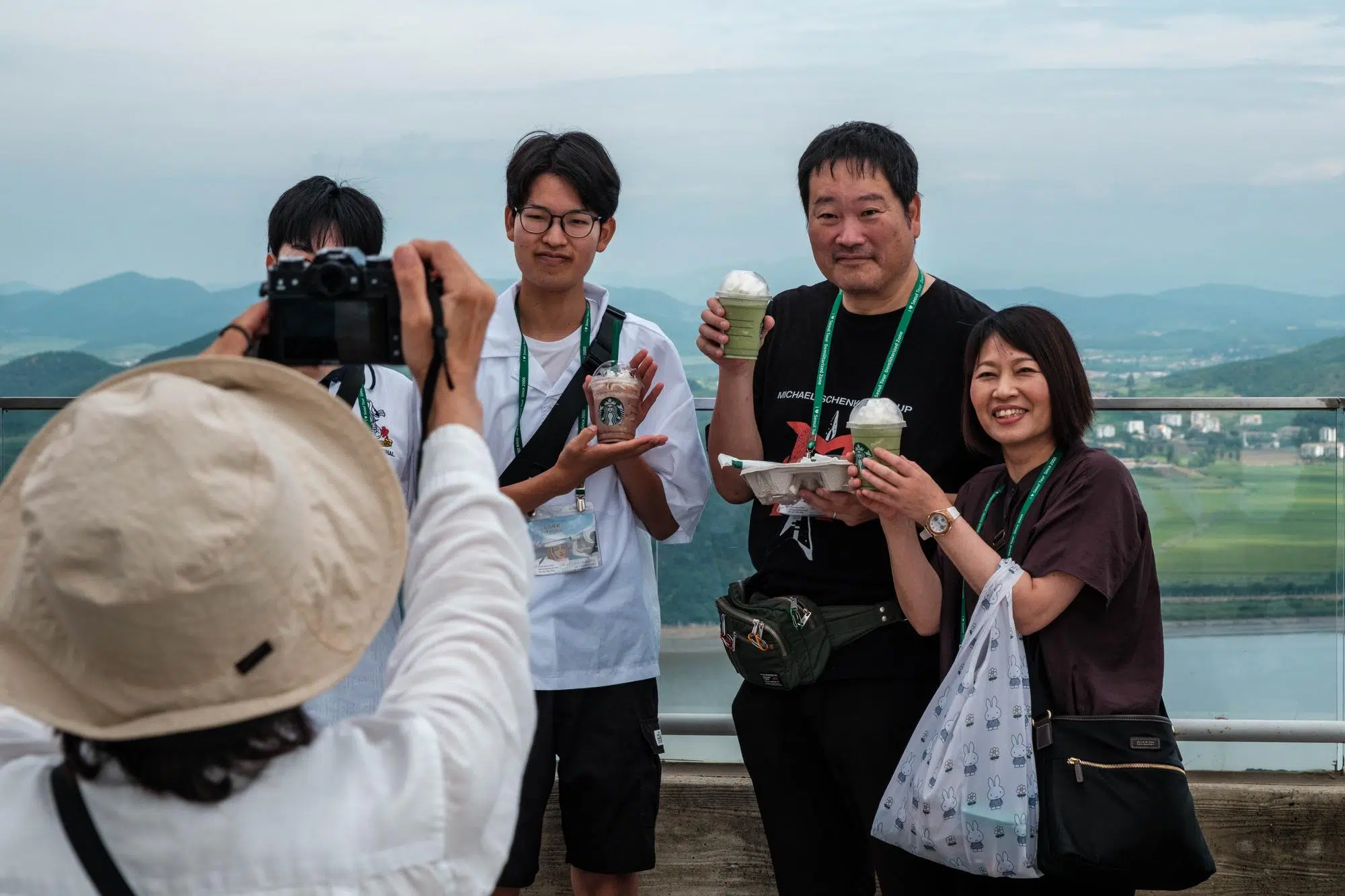
Starbucks Cafe at Aegibong Peace Eco Park, facing North Korea, in Gimpo (August 2026).
Since 2024, Imjingak has had a serious competitor: a Starbucks Cafe that opened in Aegibong, right in the Civilian Control Zone facing North Korea across the Han River Estuary. Hordes of tourists flock there every day to photograph their capitalist-style caramel macchiato or iced americano with the Workers’ Paradise in the background, as part of packages that also include duty-free shopping sprees at Lotte Paju Premium Outlet, the largest of its kind in South Korea.
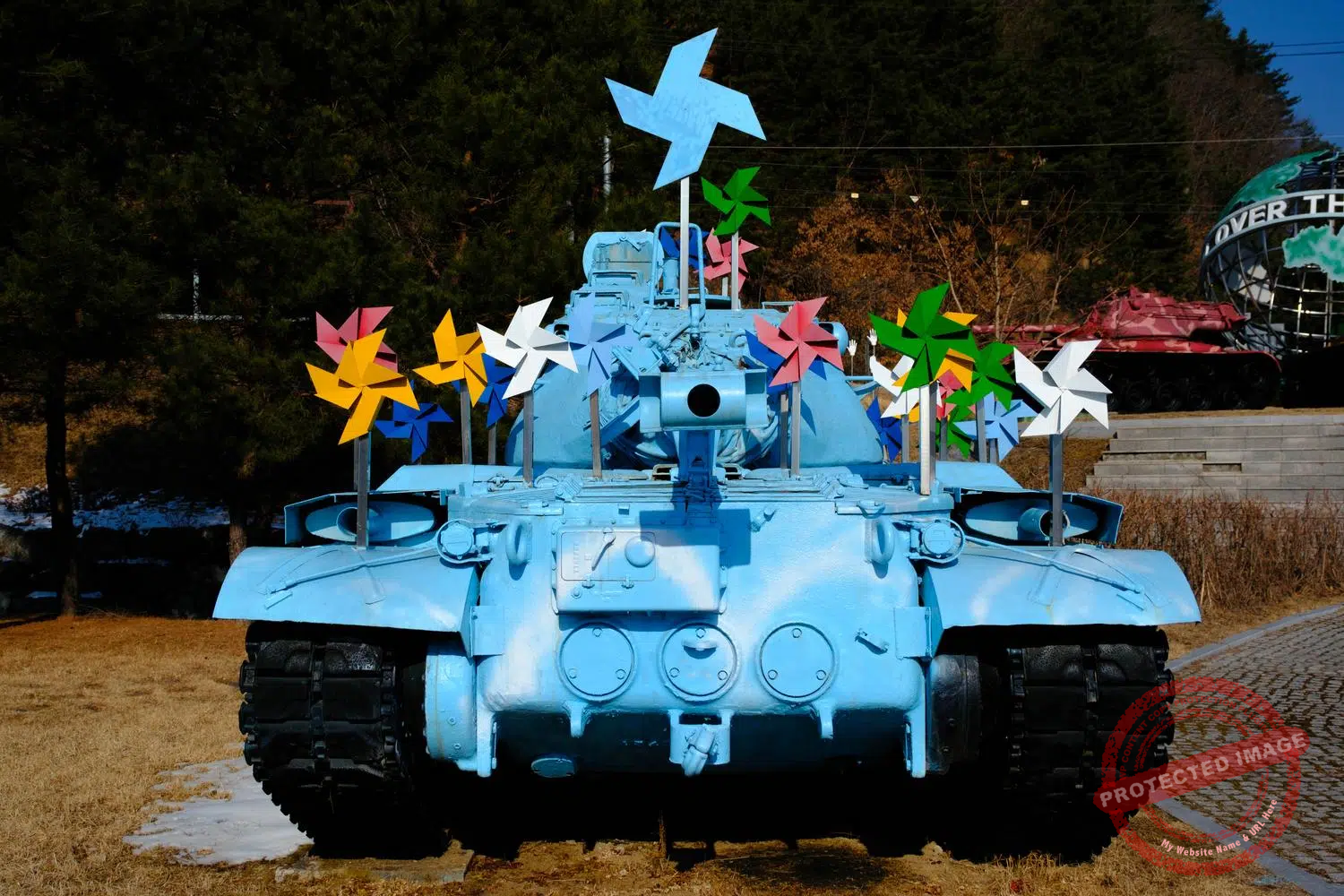
Taking one of these day trips is always a disconcerting experience in many ways, one in which you constantly swing between amusement, disgust, and astonishment. But who on earth came up with the idea of setting up an apple-shaped photo spot in front of an actual minefield, next to an oversized “mine” sign just to make it look better in the pictures? In 2026, this strange structure was removed and replaced by a decommissioned tank, its gun barrel pointing north, but the giant ‘mine’ sign remains.
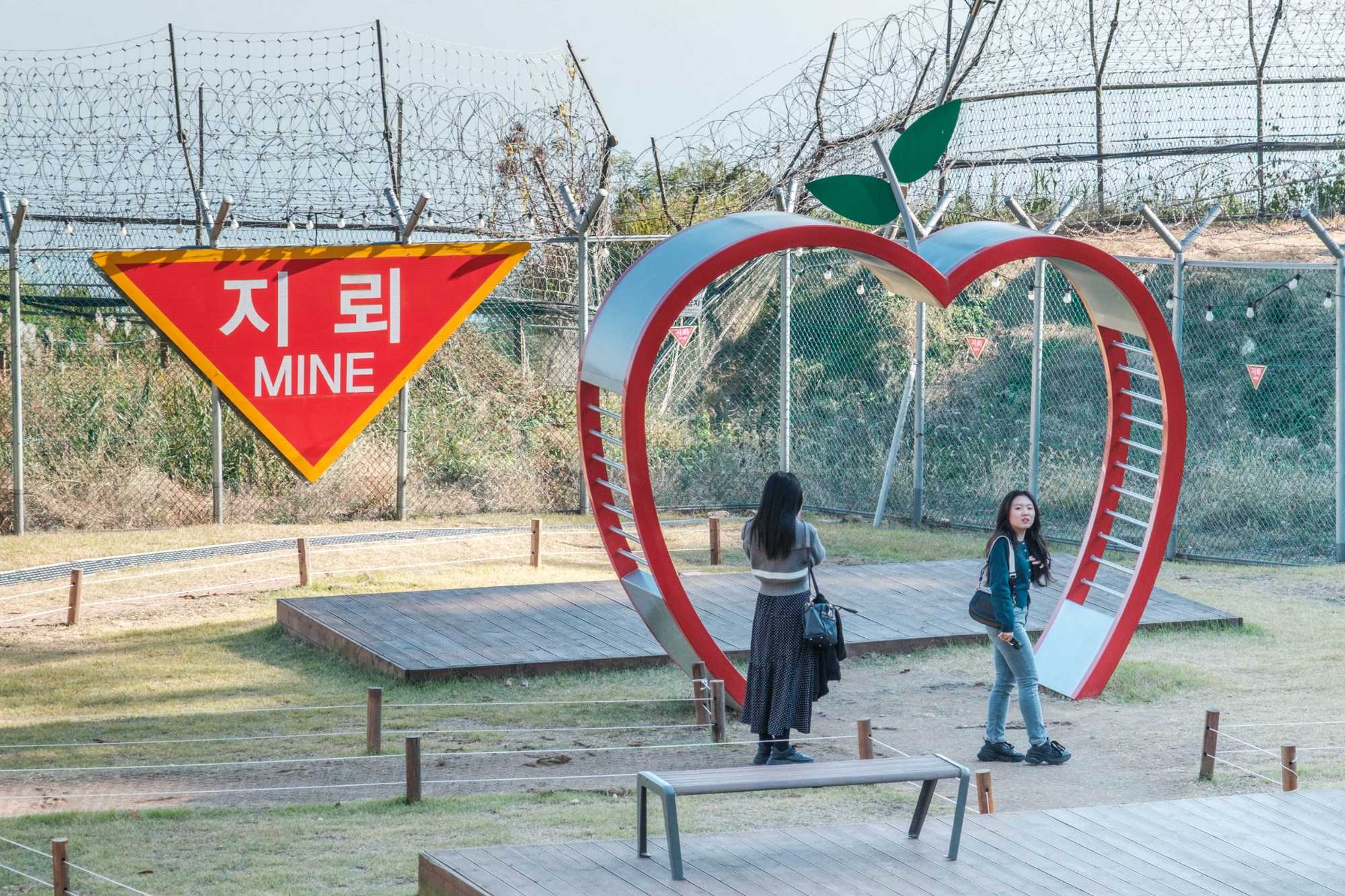
A selfie spot near a minefield in the Civilian Control Zone at Imjingak (November 2024).
Unless you take it with a grain of salt, it’s also something to avoid at all costs for those allergic to package tours, forced group photos in front of uninteresting monuments and photography bans on breathtaking landscapes, air-conditioned buses, souvenir shops selling DMZ cookies, yelling tour guides and schedules down to the second. In any case, that’s the price you have to pay to visit certain iconic sites that are off-limits to independent travelers, such as the Dora Observatory mentioned above—the only place from which you can see a major North Korean city.
To manage this situation—unique in the world, in which thousands of foreign tourists pour into a restricted military zone along an active front line every day—the system is well-established. Surveillance cameras are everywhere, the military police are never far away and the guides are strict when it comes to their visitors’ lack of discipline.

Third Infiltration Tunnel photo spot (May 2026).
Sometimes—rarely—a pebble gets stuck in the gears. Live-streaming one’s defection to North Korea to rack up YouTube views may be a dream for some, but it has become impossible since the Joint Security Area—the only place where this could possibly have been done—was closed to tourists for that very reason. Every tour guide’s worst nightmare, though, is that a guest strays from the group right in the middle of the CCZ, causing the military to completely freeze and shut down the zone until the missing person is found.
This does happen occasionally. One visitor, fearing he would miss his flight, reportedly managed to leave the CCZ by taxi to rush to the airport leaving hundreds of other tourists in a bind. A guide also told me that someone once had the bad idea of flying a drone near the Dora Observatory, right in the middle of the DMZ and within sight of North Korean guard posts. All the tour buses in the area were held up for hours and searched by soldiers until the culprit was unmasked.
It’s easy to complain about mass tourism, to mock its irrationality, or to judge it as immoral when it feeds off an endless tragedy like the division of Korea. But we need to ask the opposite question: what would the inter-Korean border be like without tourists? Entire communities near the DMZ, such as the border village of Tongilchon, would lose almost all their income and become ghost towns. Millions of foreign visitors would leave South Korea every year completely unaware of a cruel reality that was right under their noses. And the border would revert to what it was just after the Korean War: a desolate death zone, inaccessible to the civilian world, sealed off from all outside view. Better take selfies than wage war.
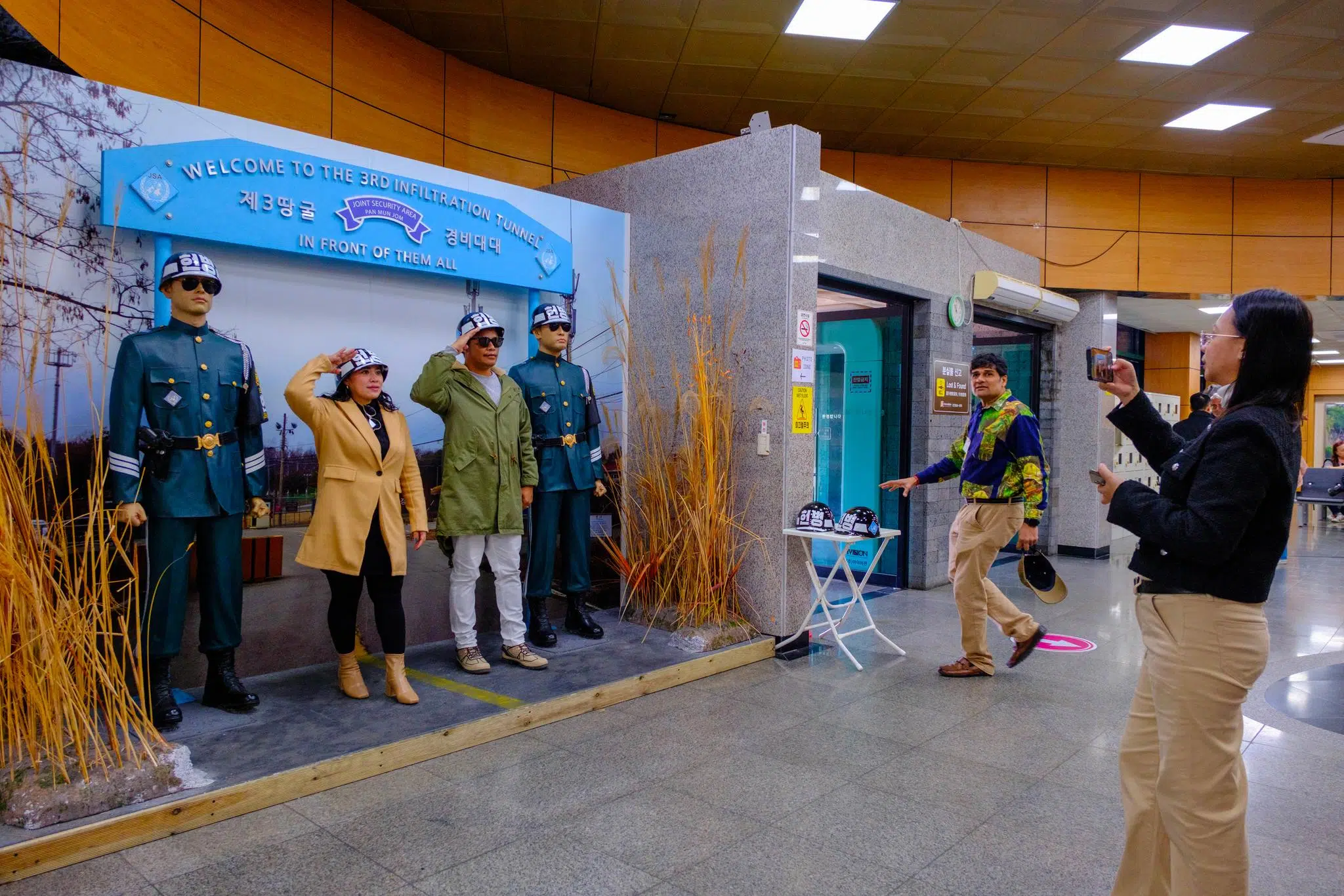
Third Infiltration Tunnel photo zone (November 2024).
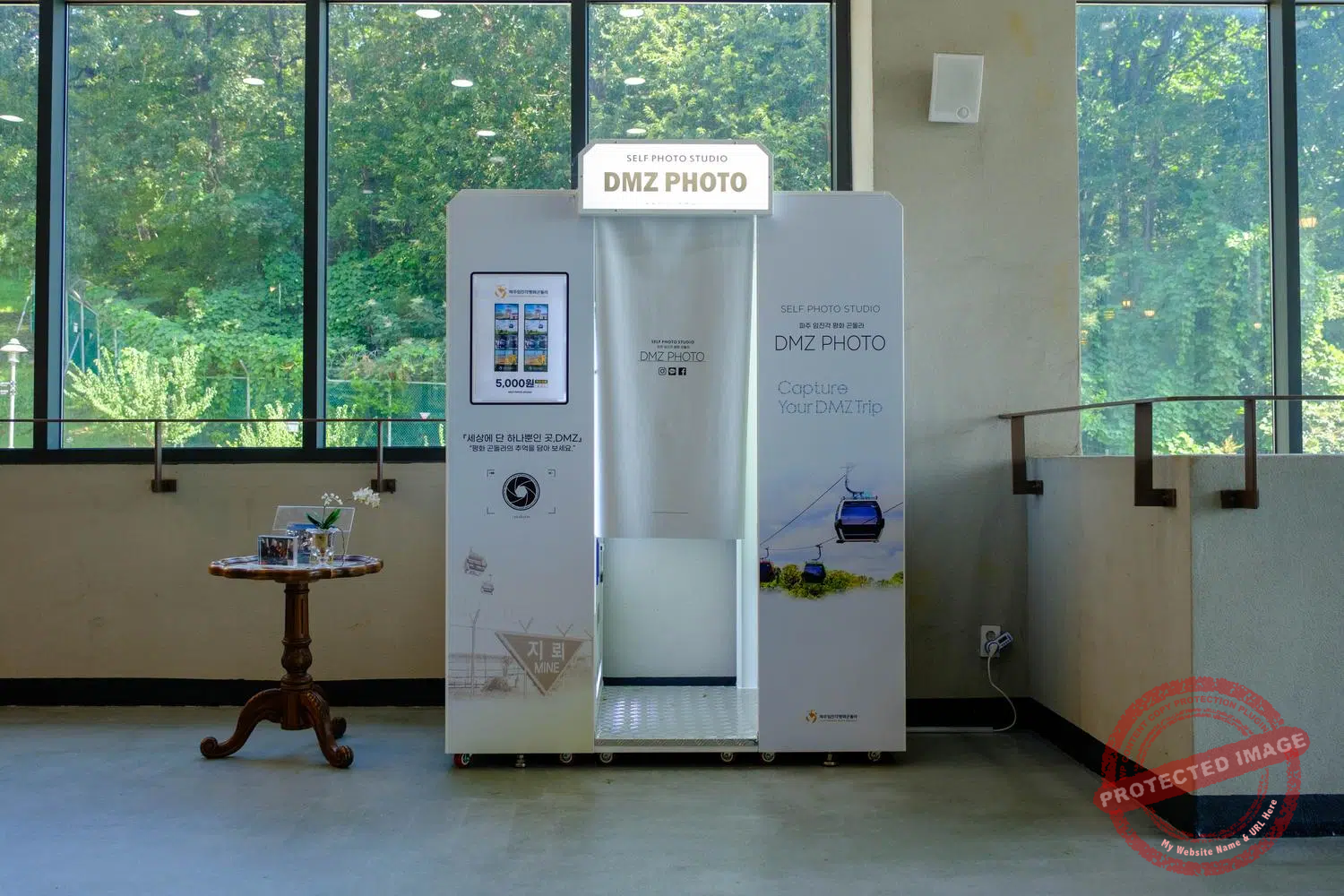
Imjingak (September 2025).
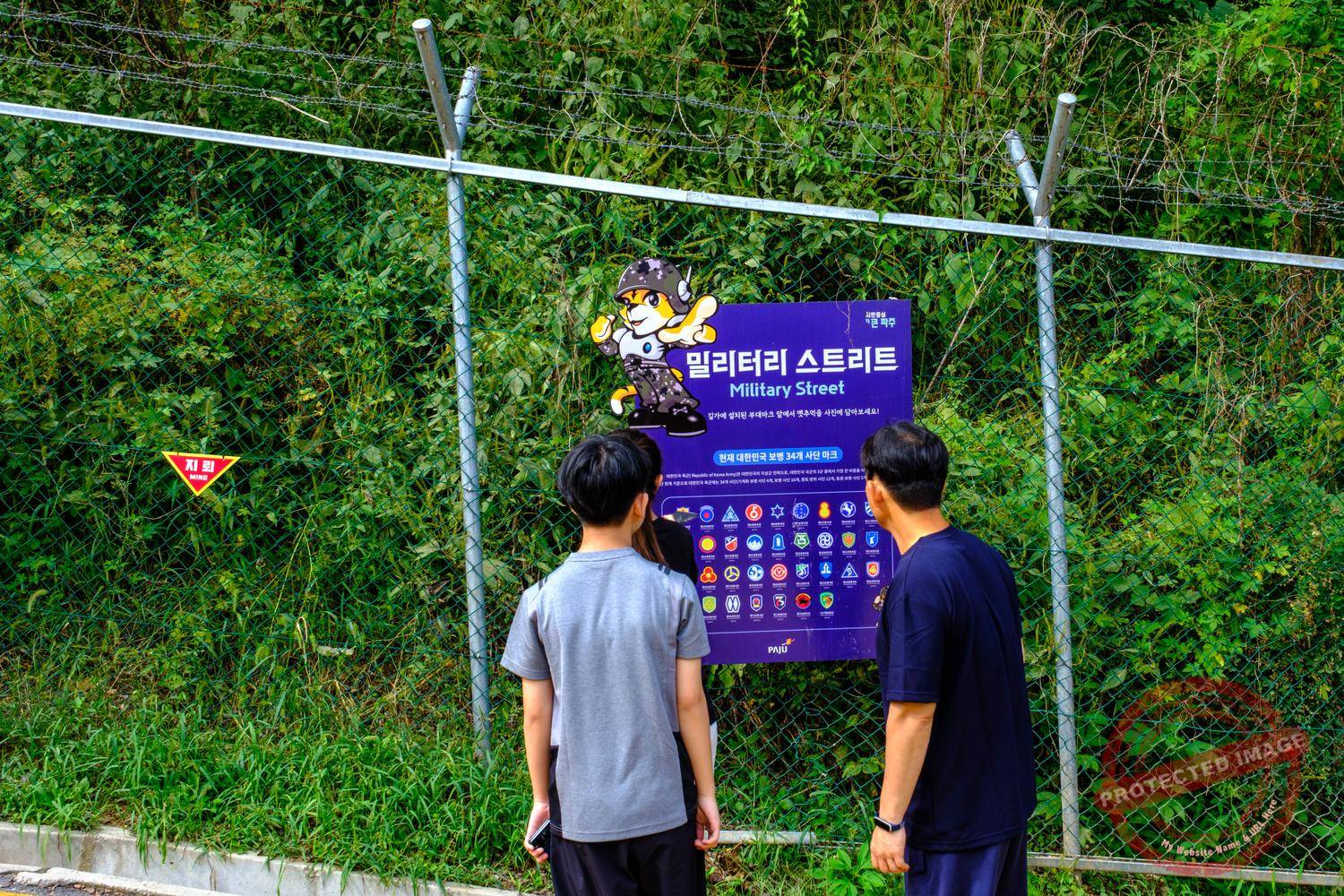
Imjingak (September 2024).
This post was last updated on : September 19, 2026.