Dora Observatory & 3rd Tunnel
도라전망대 제3땅굴
Two major tourist attractions located within the DMZ itself.


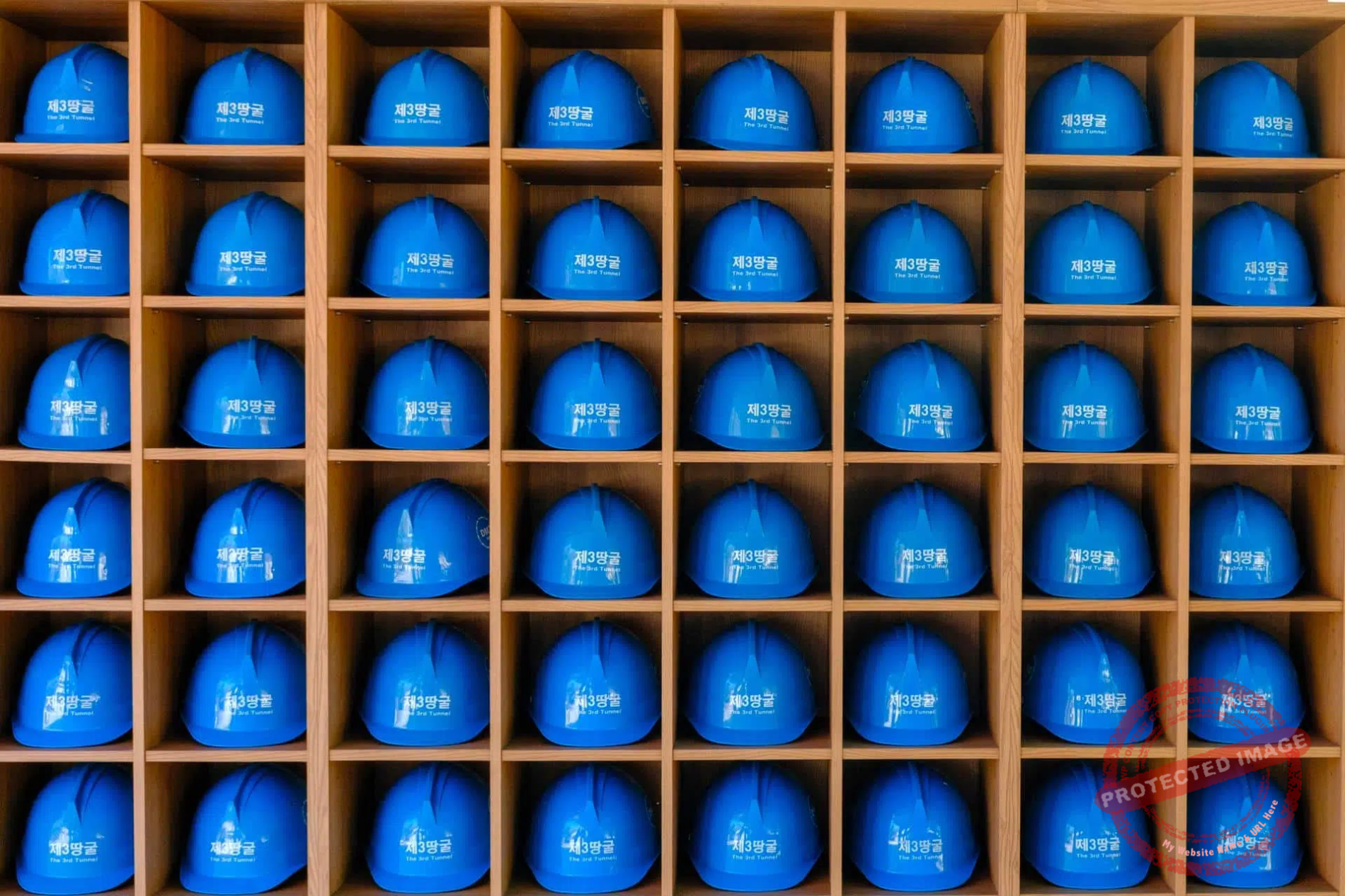
Helmets to prevent visitors from smashing their skulls against the tunnel of aggression’s ceiling (November 2024).
Like Imjingak, the Dora Observatory and the nearby Third Infiltration Tunnel are among the most visited tourist attractions along the border. In addition to these two sites is Dorasan Station, the last stop before North Korea, which reopened to rail traffic and the public in the spring of 2026 after years of closure.
The observatory and the tunnel are situated within the DMZ, less than 2 kilometers from the Military Demarcation Line, and are therefore subject to restricted access. This does not prevent them from being must-see stops on nearly all half-day “DMZ Tours” departing from Seoul.
The landscape is shaped by the Imjin River valley and a series of low hills overlooking the agricultural plains north of the city of Paju. Originally a military observation post, Dorasan became a public observatory in 1987—the second of its kind after the one in Goseong, on the east coast.

The Dora Observatory, overlooking the DMZ (May 2026).
For the average person, the only way to get to Dorasan is to book an organized tour departing from Seoul. This can be a nightmare for those who, like me, aren’t big fans of traveling in a herd, instructions bellowed over loudspeakers by authoritarian tour guides, tightly scheduled itineraries, forced group photos in front of boring commemorative monuments, and equally forced stops at souvenir shops.
Still, the view from Dorasan is worth a few sacrifices. Mount Dora itself rises to only 156 meters, but offers a spectacular panorama of the DMZ and North Korea. It is also the only place from the South where you can see what a major North Korean city looks like: Kaesong, less than twenty kilometers away.
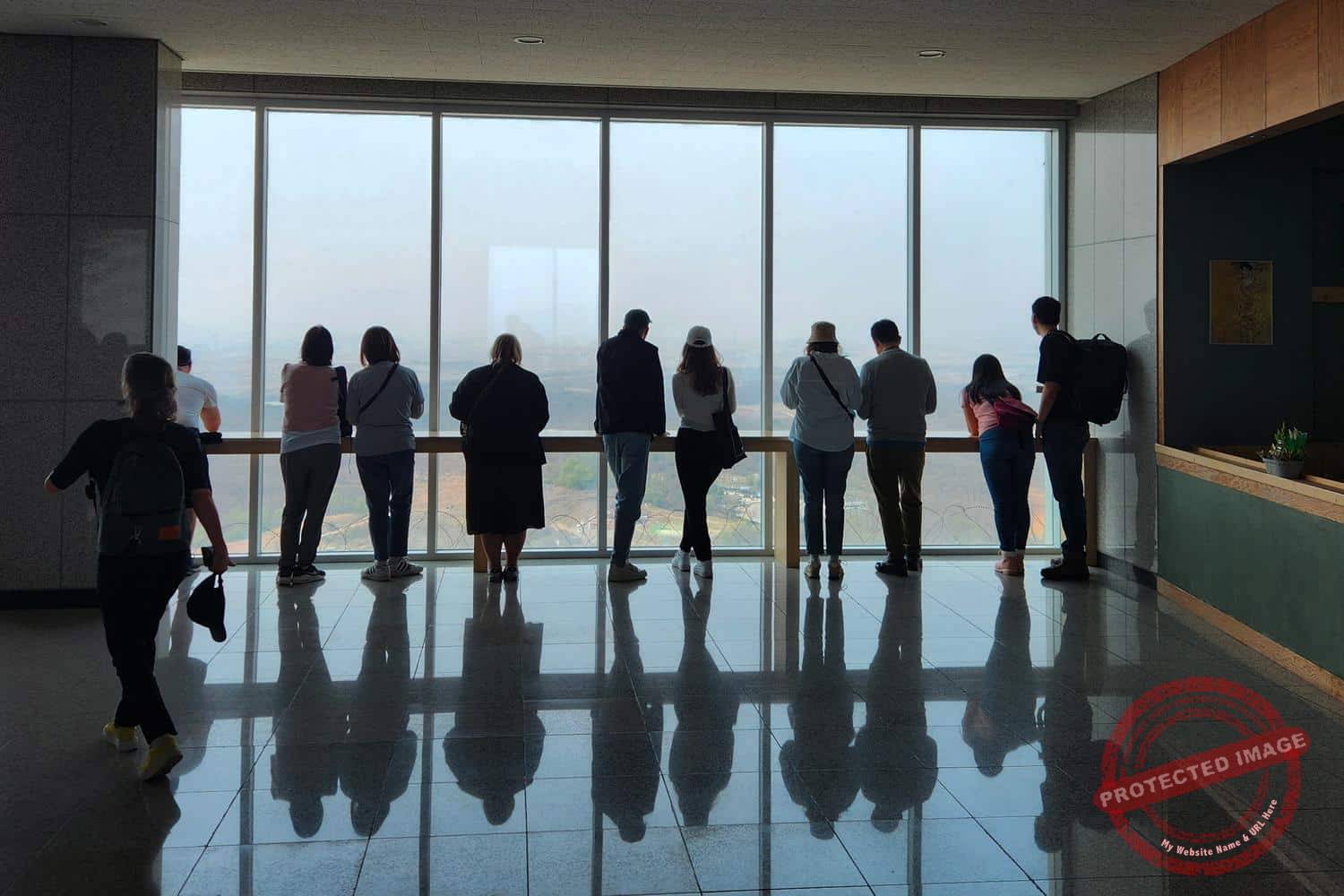
Tourists watch North Korea from the Dorasan Observatory (March 2023).
Since 2024, all photography has been banned from the Dorasan to prevent people from taking pictures of the imposing South Korean military facilities located in the DMZ, which are also clearly visible. Given such a spectacular landscape, the rule is heartbreaking, but the surveillance is tough and violators risk serious consequences (up to three years in prison and a hefty fine, as the signs posted everywhere remind visitors, even though I am not aware of any unruly tourist caught red-handed on his cellphone having to suffer anything worse than a completely erased memory card and a stern warning).
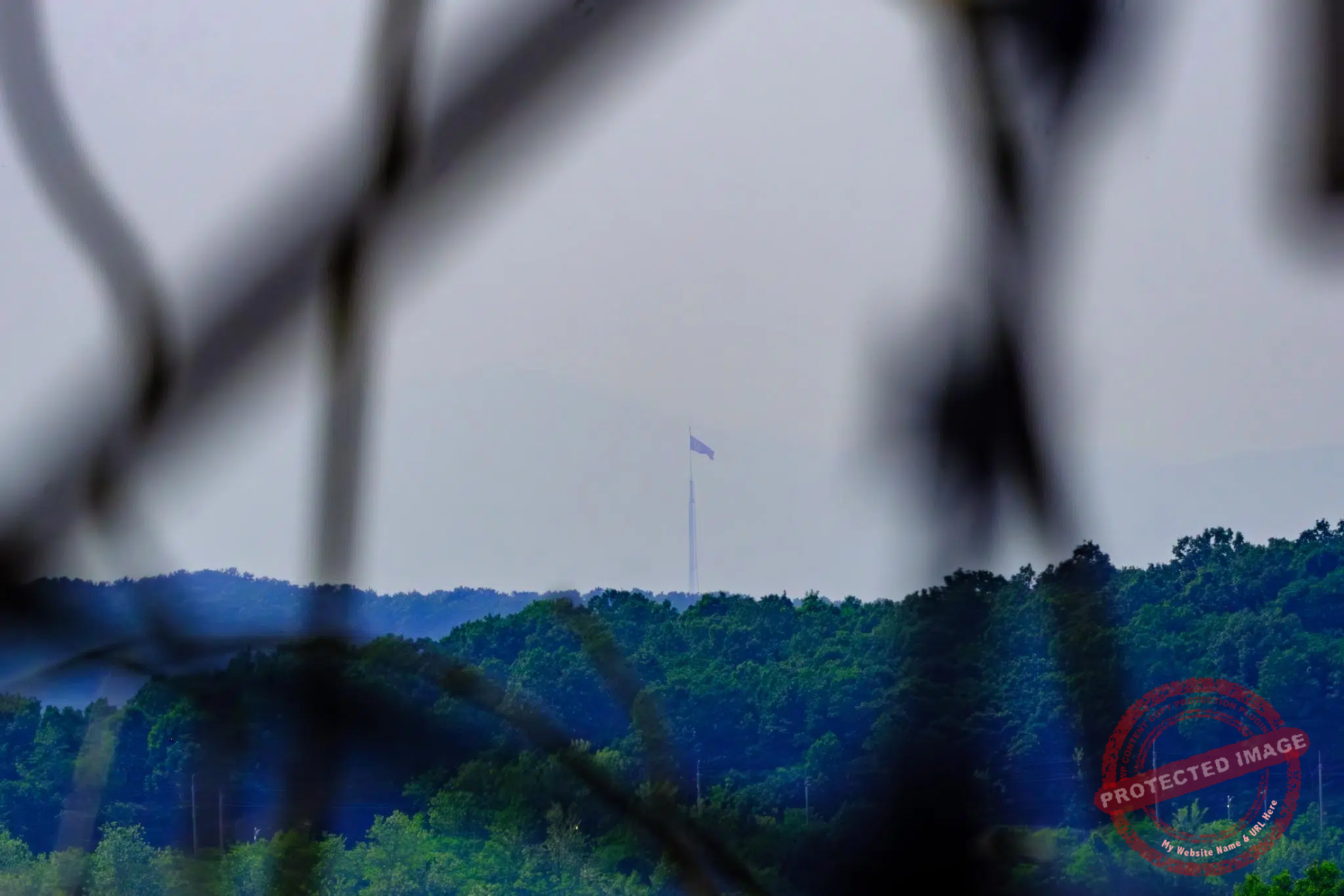
I shot the following photograph in 2023, a year before the ban. They do not show South Korean military installations (the image has been sharpened using generative artificial intelligence, but remains true to reality).
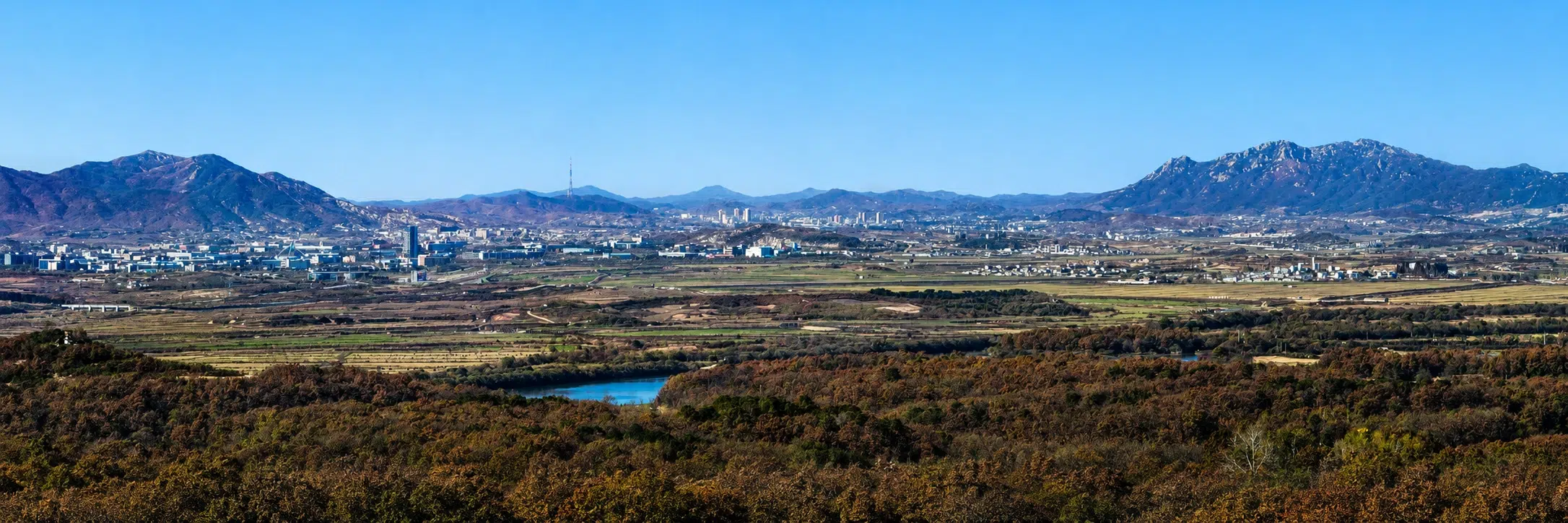
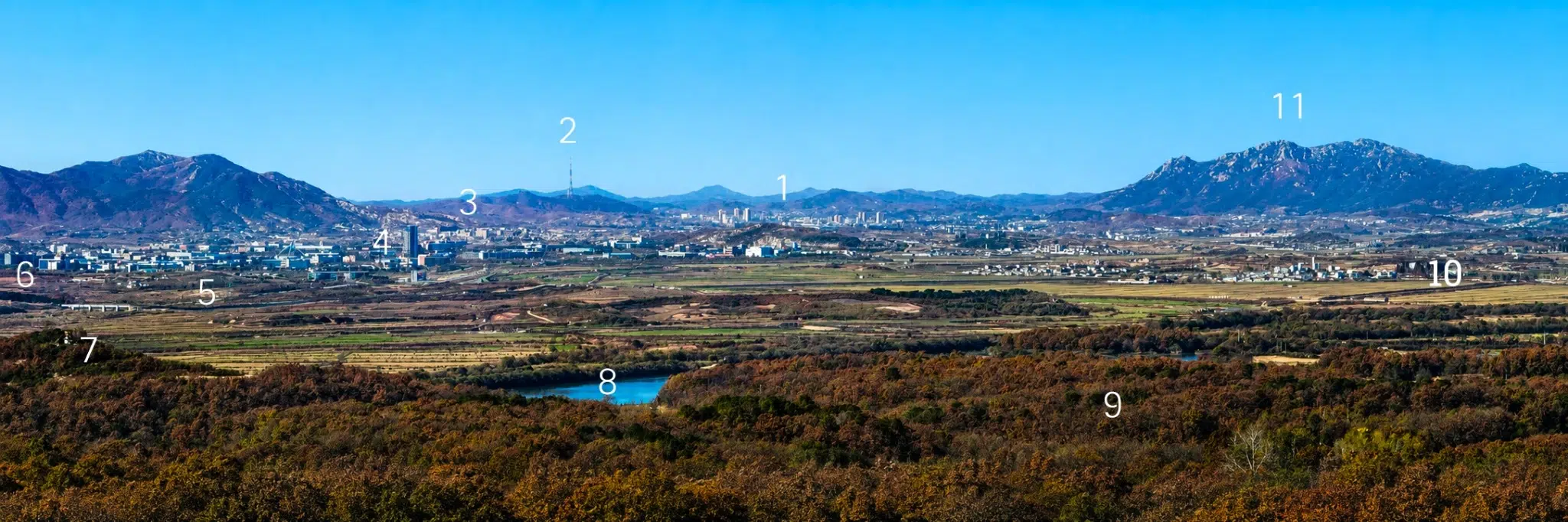
1. Downtown Kaesong. Kaesong served as the capital of the Koryo Dynasty (918–1392), a unified Korean kingdom, and is home to several UNESCO World Heritage Sites including the Koryo-era royal tombs and the Confucian academy (Sungkyunkwan).
Located south of the 38th parallel, which divided the Korean Peninsula between the Soviet-occupied North and the United States-occupied South following World War II, Kaesong was initially part of South Korea. After changing hands several times in 1950, during the first six months of the Korean War, the city was recaptured by North Korean and Chinese forces on New Year’s Day 1951 and has remained under North Korean control ever since. It is now North Korea’s 7th largest city with an estimated population of 310,000.
2. Transmission tower: located on the top of mount Yongsu, this 266 meter-high tower is used to jam South Korean GPS signals, causing occasional disruption to air traffic around Seoul-Incheon airport, which is just a few dozen kilometres away. It also blocks radio and TV waves to prevent the North Koreans from hearing or watching South Korean broadcasts.
3. Kaesong Industrial Complex (KIC): This project was launched in December 2004, largely financed by South Korea to increase co-operation with its neighbor while allowing South Korean companies to employ cheap labour from the North.
Up to 124 South Korean companies settled there, employing 100,000 North Korean workers and hundreds of South Korean supervisors. All goods produced at the KIC, from textile and leather to electronics, chemicals and machinery, were exported to the South. Although both governments were involved, this was a private venture led by the Hyundai Group. The complex also included a hospital, a sewage treatment plant, a branch of South Korea’s Woori Bank and even a Family Mart convenience store. KIC’s South Korean staff were ferried by bus daily from Dorasan.
For 11 years, the KIC survived several administration changes in Seoul, a series of severe military incidents at the border or at sea and a five month-long shutdown in 2013. In February 2016, South Korea’s president Park Geun-hye unilaterally closed the complex, asserting that Pyongyang was using money from it to fund its nuclear weapons and ballistic missiles programs.
Since then, North Korea operates parts of the complex without Seoul’s authorization. The factories, machinery and vehicles were never retuened to their South Korean owners and much of the equipment appears to have been transferred eleswhere, cannibalized for parts or left to deteriorate. In June 2020, the North Koreans blew up the former Inter-Korean Joint Liaison Office in the KIC after South Korean groups sent balloons loaded with propaganda leaflets and flash drives containing k-pop music and k-dramas into North Korea. This spectacular demolition marked the beginning of Pyongyang’s current period of deep mistrust toward Seoul following the resounding failure of the 2019 Hanoi summit between Kim Jong Un and Donald Trump, after years of détente under South Korean President Moon Jae-in.
To supply the complex with electricity, South Korea had built a high-voltage power line consisting of 48 transmission towers (33 in the South and 15 in the North) from the Munsan substation, north of Seoul. This line, now inactive, can still be seen crossing the Imjin River north of Paju. In December 2024, the South Korean government released a video showing two of the pylons on the North Korean side losing their balance and collapsing after the cables had been removed, likely to recover the copper. A North Korean worker, lacking any safety equipment, was seen falling from one of the pylons from a height of about ten meters, an accident that was likely fatal.
4. Panmun Station: This station is located on the Gyeongui railway line, which before the Korean war linked Busan to Sinuiju, on the Chinese border, via Seoul and Pyongyang. The station, as well as the disused rail section from Kaesong across the DMZ to Dorasan Station, was rebuilt in 2003. A special train inaugurating the reopened line ran in May 2007. Regular freight service briefly linked the South and the Kaesong Industrial Complex but was suspended amid tensions the following year.
In 2018, at a time of détente in North-South relations, a train carrying 28 South Korean engineers crossed the border for the first time in a decade. During 18 days, the experts inspected 1,200 km of tracks and other infrastructure in North Korea as part of a project to help the country modernise its rail network.
In October 2024, North Korea carved at least two large trenches across roads and rail lines on its border with the South, a month after blowing up the northern sections of cross-border routes.
5. Gyeongui Line: This single railway line connecting the South Korean border to Kaesong is now unused. In 2024, North Korea blew up a section near the Demilitarized Zone—along with the highway that ran alongside it—to symbolically mark its definitive break with South Korea.
6. Kim Il Sung Juche Idea Research Center: Little is known about this facility. Juche (주체사상 – juche sasang) is the official ideology and quasi-religion of the Democratic People’s Republic of Korea (DPRK). It was introduced by the country’s “eternal president” Kim Il Sung as a variant of Marxism-Leninism, and transformed by his son and successor Kim Jong Il who emphasized the loyalty to the leader.
The North Korean constitution states that “the DPRK is guided in its activities by the Juche idea”. Juche is often described as a combination of self-reliance, nationalism and socialism, serving as the guiding principle for everything in the country, from governance and policies to arts, literature, movies and even scientific research. It has justified North Korea’s isolationism, suppression of dissent and emphasis on the cult of personality surrounding its leaders.
Starting from elementary school, Juche is a central part of the curriculum in the North Korean education system, designed to indoctrinate students with the principles of the ideology and instill loyalty to the Kim family.
Students participate in songs, plays, and activities celebrating Juche and the Kims. They are tested on their understanding of Juche and the achievements of the leaders. Success in these subjects is essential for academic and career advancement. Juche shapes the worldview of North Korean citizens from an early age, promoting conformity and loyalty to the regime.
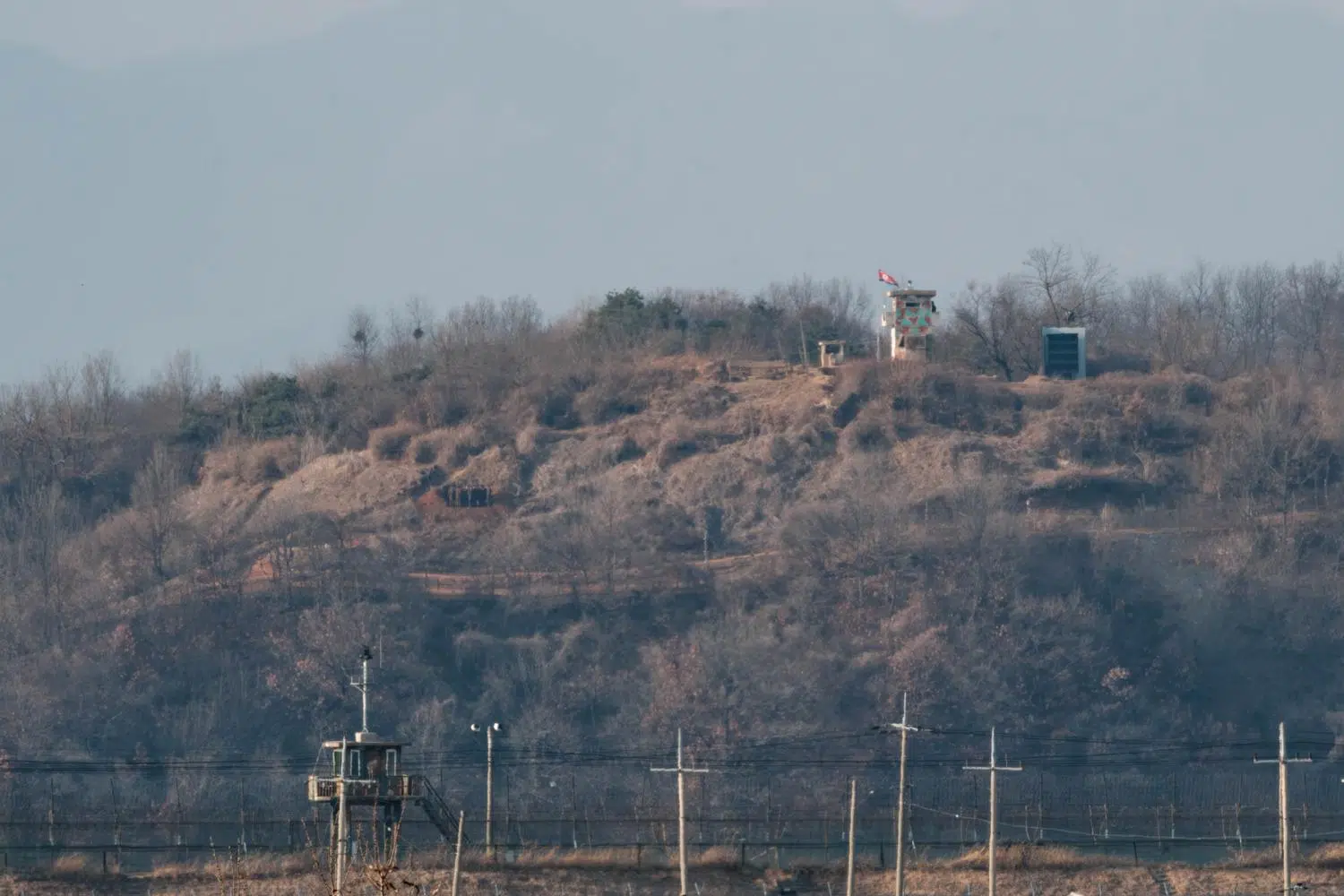
7. North Korean guard post.
8. Sachon River. At this point, the Military Demarcation Line crosses this tributary of the Imjingang. The river then flows southward within the North Korean side of the Demilitarized Zone.
9. Demilitarized Zone (DMZ). The invisible border between the two Koreas runs through this heavily mined woods. The Military Demarcation Line (MDL) is marked only by a series of rusted signs, most of which—having received no maintenance since 1953—have disappeared.
10. Kijong-dong. The North Korean “propaganda village”. Kijong-dong faces its South Korean counterpart, Daesong-dong (not visible in the photo), with no physical barrier separating the two. The existence of these two farming villages, the only ones within the DMZ, is expressly stipulated by the armistice agreement. While Daesong-dong is inhabited by a handful of farmers who enjoy tax privileges and exemptions from military service, Kijong-dong is considered by Seoul to be nothing more than an uninhabited theatrical set.
11. Songaksan (alt. 489 m).
12. Immortality Tower. Like all municipalities across North Korea, this village on the outskirts of Kaesong features this obelisk, also known as the “Tower of Eternal Life,” erected in honor of the “eternal president” Kim Il Sung—who remains the official head of state of the Democratic People’s Republic of Korea despite his death in 1994—and his son, “the Eternal General Secretary” Kim Jong Il.
"Third Tunnel of Aggression"

Foreign tourists and South Korean soldiers arrive at the entrance of the “Third Tunnel of Aggression” (November 2024).
Along with Dorasan and Imjingak, the ‘Third Infiltration Tunnel’, also called ‘Third Tunnel of Aggression’, is one of the busiest tourist attractions of the border area. Located 1.2 kilometres from the demarcation line, this tunnel is technically inside the DMZ as defined by the armistice agreement. Like Dorasan, it can only be reached on an organised tour.
It is one of four known tunnels dug by North Korea under the border (the three others are located in Yeoncheon, Cheorwon and the Punchbowl) with the aim of launching a surprise invasion of the South, the closest to Seoul and, as its name suggests, the third to have been discovered. That happened in October 1978, after the South Korean military heard mysterious explosions coming from underground. The discovery is reportedly also linked to intelligence provided by a North Korean defector. After several unsuccessful searches (nothing is more difficult than finding a narrow tunnel in an area covering several square kilometers, without knowing how deep it is) South Korean military personnel used drilling techniques and finally hit the mark.
The tunnel was carved out of extremely hard granite, which makes its construction particularly impressive, and equipped with rails and electrical systems. It is 1,635 meters long, 1.95 meters at its maximum height and 2.1 meters wide. Like its equivalent discovered 3 years earlier in Cheorwon, in central Korea, the Third Tunnel would have allowed for 30,000 soldiers with light weapons and full gear to pass through per hour. It had been blackened by construction explosions, and North Korea pretended it was part of a coal mine, although it is geologically impossible to find coal in this granite soil.

A couple takes a photo of themselves next to mannequins depicting South Korean soldiers at the entrance of the Third Infiltration Tunnel (May 2026).
In the 1980s, the tunnel was partially converted for visitors, with the aim of raising awareness about national security and demonstrating to the world the aggressiveness attributed to North Korea. A long and steep inclined gallery (or sometimes a monorail) takes tourists, provided with helmets to prevent them from smashing their heads against the rocky ceiling, to 73 metres below the surface of the DMZ. Photography is forbidden within the tunnel. Visitors must leave their mobile phones and cameras in a locker and pass through a metal detector before going down.
This adventure is not recommended for people in poor health or those who suffer from claustrophobia. It is dark, the slope is steep and the humidity is high. The low ceiling often forces visitors to walk hunched over, which heightens the oppressive feeling of the expedition.
The South Korean Army has blocked the tunnel near the Military Demarcation Line with three massive concrete barricades. Visitors can walk as far as the third barricade. The second barricade is visible through a small window in the third. It is likely that other secret security measures and contingency plans are in place in case North Korea suddenly decides to blow up these barriers and start reusing its tunnel in the middle of the peak tourist season.
Based on intelligence and on defectors’ accounts, it is estimated that there are around twenty more North Korean infiltration tunnels that have never been discovered, and are virtually impossible to detect. Modern ISR capabilities (sensors, seismic monitoring, round-the-clock surveillance) make a surprise underground attack much more difficult and unlikely today than it was in 1978, and the strategic focus has for a long time shifted from a Korean War-like classic terrestrial invasion to North Korean artillery, missiles and nuclear weapons.
However, the South Korean military still views the tunnels as a potential threat. Units specializing in tunnel detection are still in place. Some military analyses suggest that undiscovered tunnels could be used to infiltrate North Korean special forces for the purposes of sabotage, limited attacks, or psychological warfare operations.

A South Korean tour guide explains the Third Infiltration Tunnel to her clients (May 2026).
This post was last updated on : September 21, 2026.