Frozen Line, Shifting Border
멈춘 선, 변하는 경계
From the 1953 armistice to Pyongyang’s “two hostile states” doctrine, how the inter-Korean border has mirrored the hopes and failures of reconciliation.


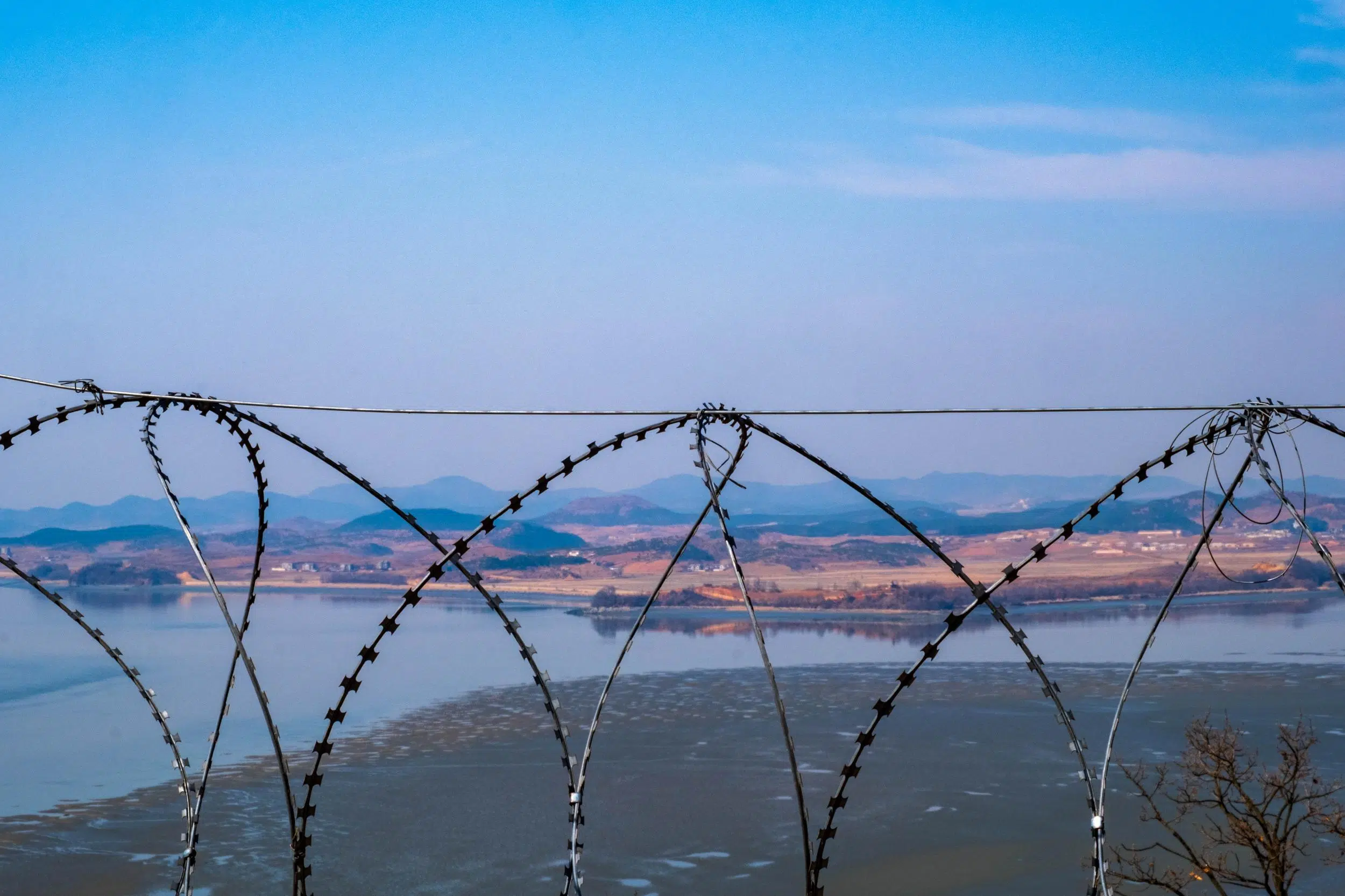
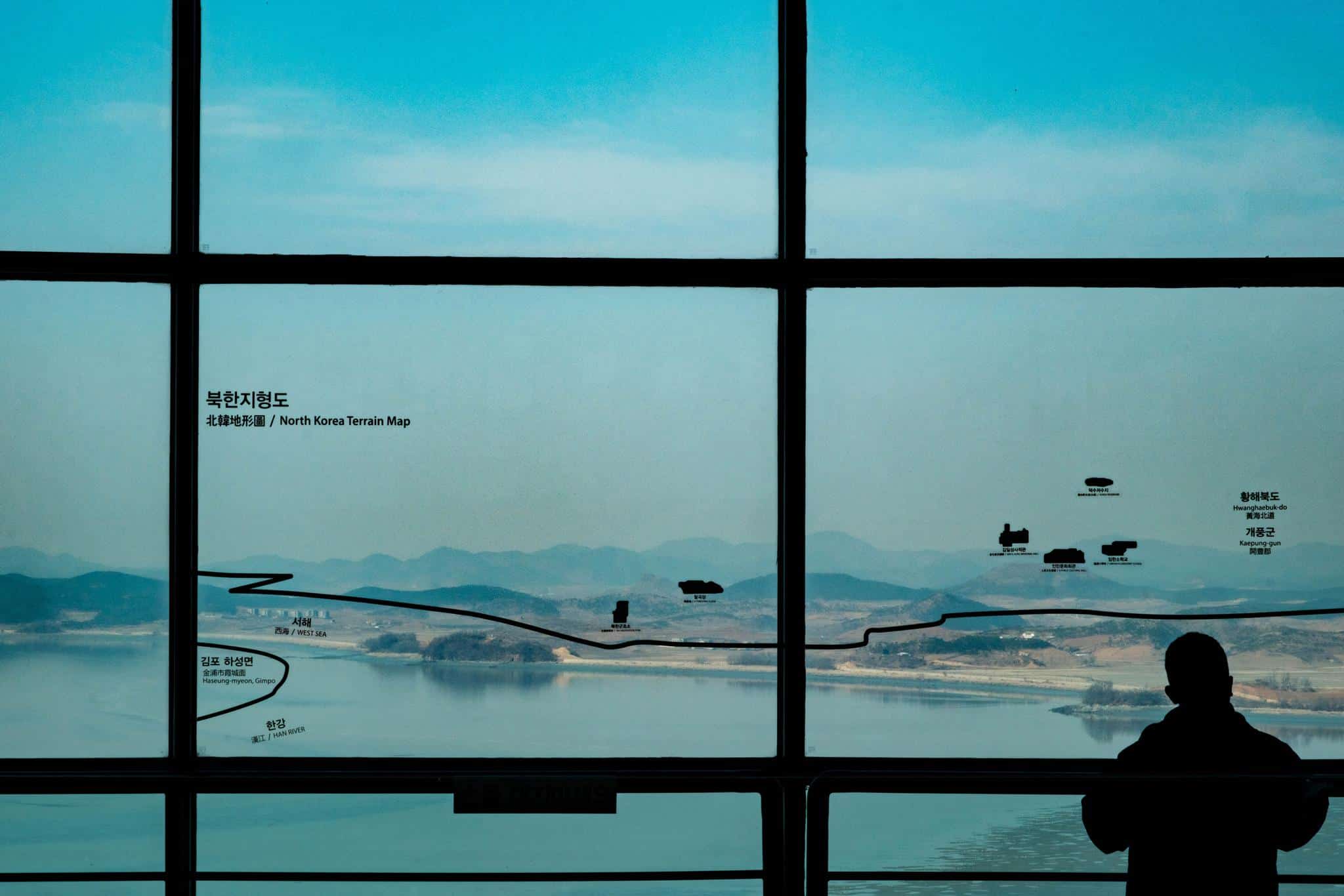
North Korea seen from the South, at the confluence of the Han and Imjin rivers (February 2025).
Although the divide between the two Koreas has remained frozen since the 1953 armistice, the physical appearance of the border has changed greatly over more than seven decades. Like a pendulum, these transformations have swung radically one way or the other depending on periods of détente or confrontation between Pyongyang, Seoul and Washington, and on the succession in South Korea of hawkish conservative governments and dovish liberal ones.
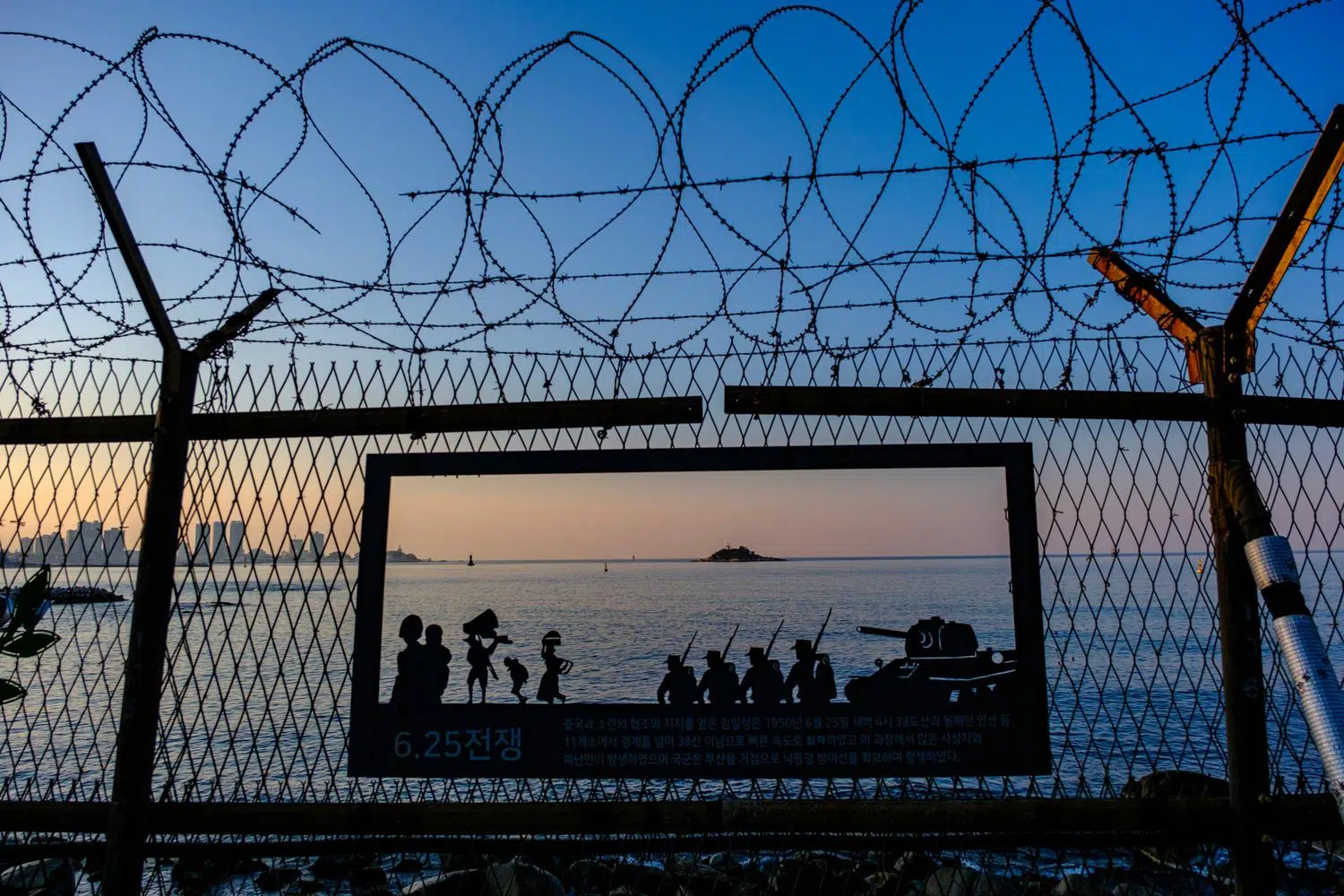
Minefields, guard posts and observation posts began to be installed by both Koreas in the Demilitarized Zone (DMZ) as early as 1953. The Civilian Control Zone (CCZ), an additional buffer area on the southern side (refer to the glossary for the definition of all technical terms mentioned here), was added alongside the DMZ in February 1954, less than a year after the end of the Korean War. But only between 1967 and 1969, following numerous armed clashes and infiltrations (including the infamous Blue House Raid) did the South completely seal the southern edge of the DMZ with continuous fencing. These fortifications have been constantly reinforced and modernized ever since. Motion detectors and surveillance cameras have in many places replaced sentries and floodlights, but the double or triple rows of concertina wire, the watchtowers, and the minefields are still there, sinister as ever.
Initially off-limits to civilians, the southern side of the border area gradually opened up. As early as the 1950s, some farmers were allowed, under strict military supervision, to cultivate land located in the CCZ. In the 1970s, South Korea authorized permanent civilian settlement in several “unification villages” near the DMZ, the best known of which is Tongilchon, in Paju.
In 1972, the Imjingak complex, at the edge of the CCZ, became the first “showcase” of the inter-Korean border area for the South Korean public and foreign tourists. This opening coincided with the July 4, 1972 Joint Communiqué, the first major political agreement between North and South Korea since the war, which recognized the principle of peaceful reunification without foreign intervention.
This diplomatic thaw, however, led to virtually no military easing inside the DMZ. Several North Korean infiltration tunnels were even discovered in the following years. In 1984, however, the first observatory was opened on South Korea’s east coast, allowing South Korean civilians for the first time to get a glimpse of the other side of the demarcation line.
The collapse of the Soviet Union, Pyongyang’s main ally, marked an acceleration in North Korea’s efforts to acquire nuclear weapons in order to ensure the survival of its regime. From that point on, this race to acquire weapons of mass destruction became the main source of tensions and crises between the reclusive nation, its southern neighbor and the international community.
Nevertheless, the December 13, 1991 North-South Basic Agreement and the December 31 Joint Declaration on the Denuclearization of the Korean Peninsula marked another major step toward reconciliation. Pyongyang and Seoul notably pledged not to use force against each other and to institutionalize dialogue through various joint commissions. Once again, this did not lead to any significant mine clearance or dismantling of fortifications in the DMZ. But it was around this time that the army and police checkpoints that had systematically monitored movements to and from the border area since the 1950s were gradually dismantled on Seoul’s northern outskirts.
Significant steps toward peace took place between 1998 and 2007, the golden age of the “Sunshine Policy” pursued by South Korea’s progressive presidents Kim Dae-jung and then Roh Moo-hyun. Two historic summits in Pyongyang between Kim Jong Il and Kim Dae-jung in June 2000, then Roh Moo-hyun in October 2007, produced unexpected progress, the most striking of which was the organization of extraordinarily emotional reunions of families separated since the Korean War. And this despite North Korea’s continued pursuit of its military nuclear and ballistic missile programs (the country had conducted its first nuclear test on October 9, 2006).
These two summits brought about the most important physical changes to the border since 1953. Sections of the DMZ were cleared of mines to create transportation corridors, and two cross-border roads and two cross-border rail lines were opened, together with their respective customs posts. The Mount Kumgang tourist zone was established in 1998 in North Korea, accessible to South Koreans (more than two million of whom visited it), and the Kaesong Industrial Complex (KIC) opened in December 2004 just north of the DMZ.
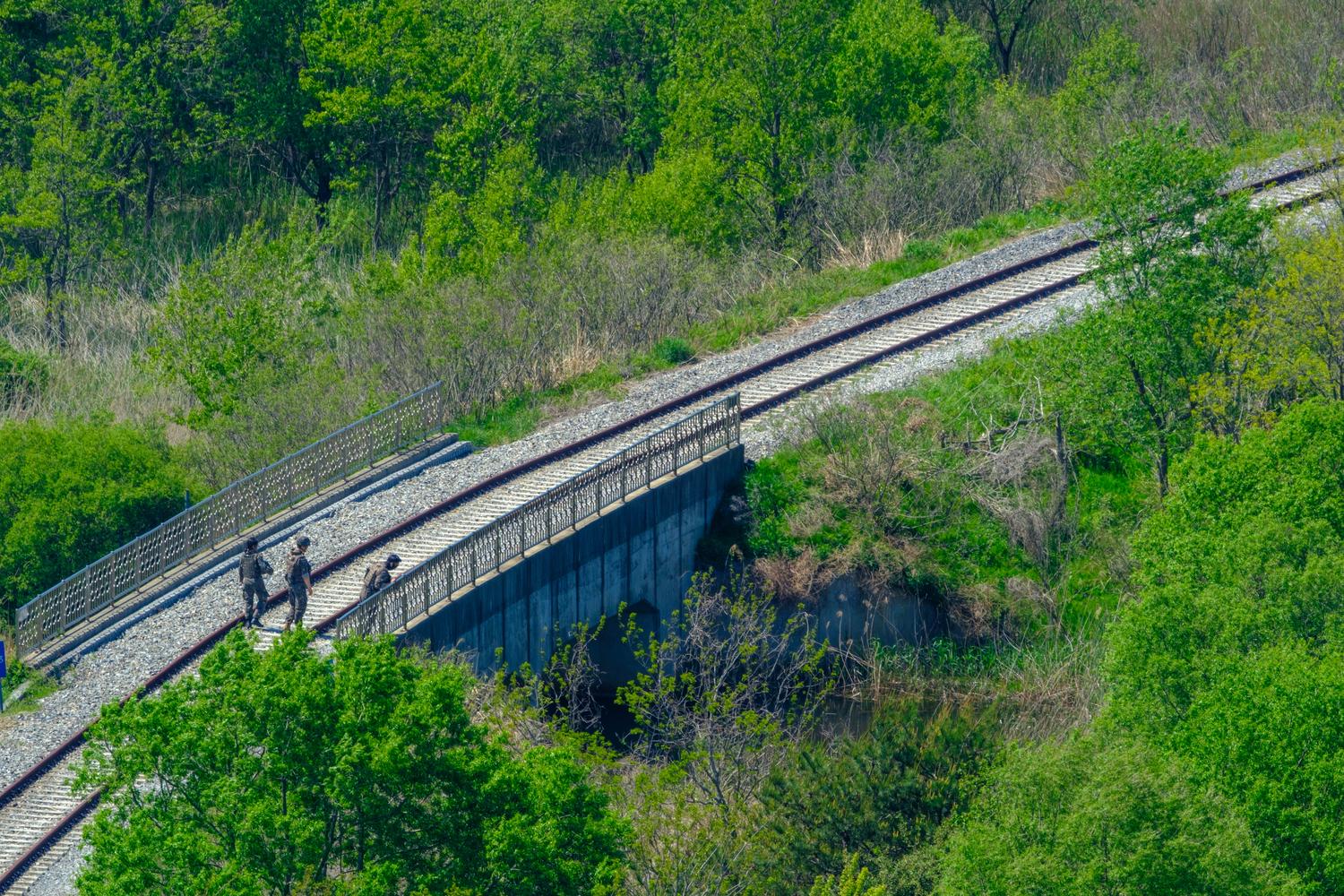
South Korean soldiers inspect the abandoned Donghae Bukbu railway line between Jejin (South Korea) and Kamho (North Korea), which was built during the Sunshine Policy, a period of inter-Korean détente in the early 2000s, but never entered service except for a test run in 2007 (May 2025).
Designed to combine South Korean capital, technology, and know-how with cheap North Korean labor, the KIC hosted more than a hundred South Korean companies and employed up to several tens of thousands of North Korean workers. It was both an important source of hard currency for Pyongyang and a symbol of economic cooperation between the two Koreas. Yet despite the fact that South Korean engineers now crossed the border daily by bus to go to work at the KIC, the frontier remained heavily militarized throughout this period.
The return of conservatives to power in South Korea in 2008 marked a return to confrontation. In July 2008, a South Korean tourist was shot dead by a North Korean soldier in the Mount Kumgang tourist zone, leading to the permanent suspension of tours from the South. In 2010, North Korea sank the South Korean corvette Cheonan in the Yellow Sea, killing 46 sailors, then shelled the remote South Korean island of Yeonpyeong, killing four people and bringing the two Koreas to the brink of all-out war. At the border, this translated into reinforced video surveillance and thermal sensors, and the reactivation of some defensive positions. In 2016, after a series of North Korean nuclear and ballistic missile tests, South Korea permanently closed the Kaesong Industrial Complex.
“Little Rocket Man”
The year 2017 was probably the most dangerous period on the peninsula since the 1960s, marked by extraordinarily vitriolic exchanges of threats between Donald Trump, who took office in January in the United States, and Kim Jong Un, whom the U.S. president dubbed “Little Rocket Man” based on a song by Elton John.
At the same time, North Korea, having tested an intercontinental ballistic missile and conducted its sixth nuclear test, believed it had achieved its goal of acquiring a credible deterrent and felt it was negotiating from a position of strength. The arrival in power in South Korea in May 2017 of the liberal Moon Jae-in, who favored dialogue with the North, also changed the equation. From the start of his term, Moon sought to reopen inter-Korean channels despite the political risks at home and to play the role of mediator between Washington and Pyongyang.
The Pyeongchang Winter Olympics in February 2018 offered him an ideal diplomatic opportunity. North Korea agreed to send athletes, artists, and a high-level delegation led by Kim Yo Jong, Kim Jong Un’s powerful sister. It was the first visit by a member of the North’s ruling family to the South since the war.
Contrary to all previous U.S. administrations, and to general surprise, Donald Trump quickly agreed to the idea of a summit with Kim Jong Un, opening an extraordinary window of opportunity just a few months after the two leaders had threatened each other with mutual nuclear destruction. This led to the inter-Korean summit at Panmunjom, in the DMZ, in April 2018, during which Kim Jong Un became the first North Korean leader to set foot in South Korea, and two months later, to the first Trump-Kim summit in Singapore.
This thaw had notable consequences at the border. On September 19, 2018, during another inter-Korean summit in Pyongyang, North and South signed the Comprehensive Military Agreement (CMA, officially titled the “Agreement on the Implementation of the Historic Panmunjom Declaration in the Military Domain”). This agreement contained significant advances: a ban on artillery fire and regiment-level or larger maneuvers within five kilometers of the demarcation line, demilitarization of the Joint Security Area (JSA) at Panmunjom, demolition of ten guard posts (GPs) on each side in the DMZ plus one already-abandoned North Korean post, joint operations to recover soldiers’ remains in the DMZ, and the creation of maritime buffer zones and a no-fly zone along the border.
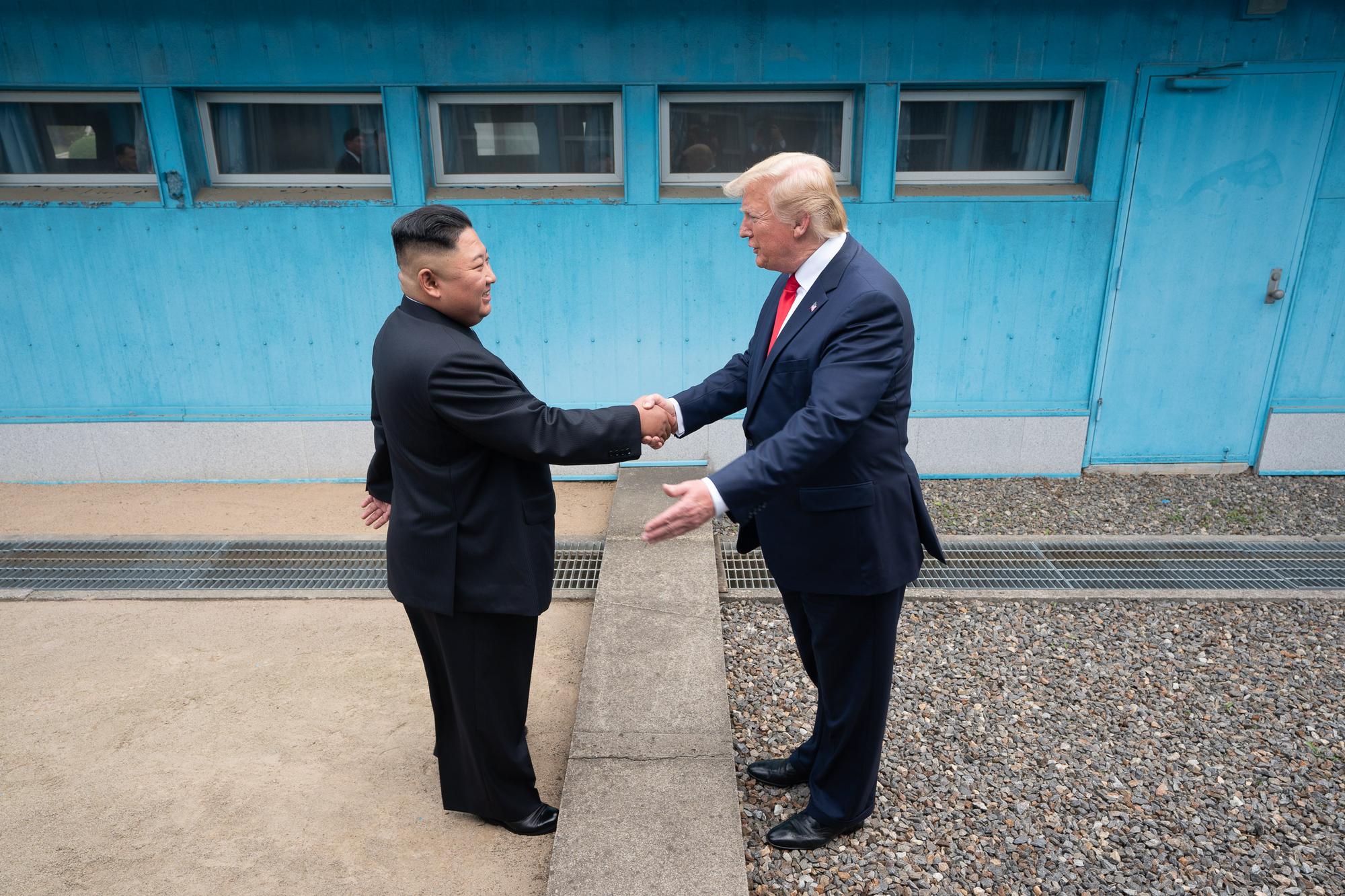
Third party content – Kim Jong Un and Donald Trump shake hands over the Military Demarcation Line at Panmunjeom’s Joint Security Area during their third summit, on 30 June 2019 (Official White House photo by Shealah Craighead).
But the fundamental problem was already apparent: while Washington insisted that North Korean denuclearization must precede any easing of international sanctions against Pyongyang, North Korea insisted that sanctions relief must accompany or even precede nuclear concessions.
This disagreement burst into the open at the second Trump-Kim summit in Hanoi in February 2019, which the U.S. president ended prematurely. The failure of the talks gradually led to the collapse of the rapprochement process, despite a third and final meeting between the North Korean and U.S. leaders, hastily arranged in June 2019 at Panmunjom. On that occasion, at Kim’s invitation, Trump crossed the Military Demarcation Line and took a few steps into North Korean territory, becoming the first sitting U.S. president to set foot in the country. Despite this theatrical episode, the summit produced no results: Kim later complained that Trump had promised, as a gesture of goodwill, to cancel annual U.S.–South Korean military exercises that the North views as a threat, but later went back on his word.
Cutting the Lines
After the failure of the Hanoi summit, Pyongyang concluded that Moon Jae-in had overestimated his ability to obtain sanctions relief from Washington and to fulfill his promises of inter-Korean cooperation. In a speech to the Supreme People’s Assembly on April 12, 2019, Kim Jong Un accused the South Koreans of being subservient to Washington and called them to stop playing the mediator or facilitator. Pyongyang stopped cooperating on implementing the outcomes of 2018 and launched personal attacks against Moon in its propaganda.
In October 2019, Kim ordered the dismantling of South Korean facilities at Mount Kumgang. In June 2020, as North Korea had completely sealed its borders due to the Covid‑19 pandemic, Pyongyang cut all communication lines with South Korea. A few days later, using as a pretext the sending of propaganda balloons by South Korean activists, North Korea blew up the inter-Korean liaison office that had been established in September 2018 in Kaesong. The official KCNA news agency explained that this spectacular destruction, filmed by South Korean surveillance cameras, reflected “the mindset of the enraged people.”
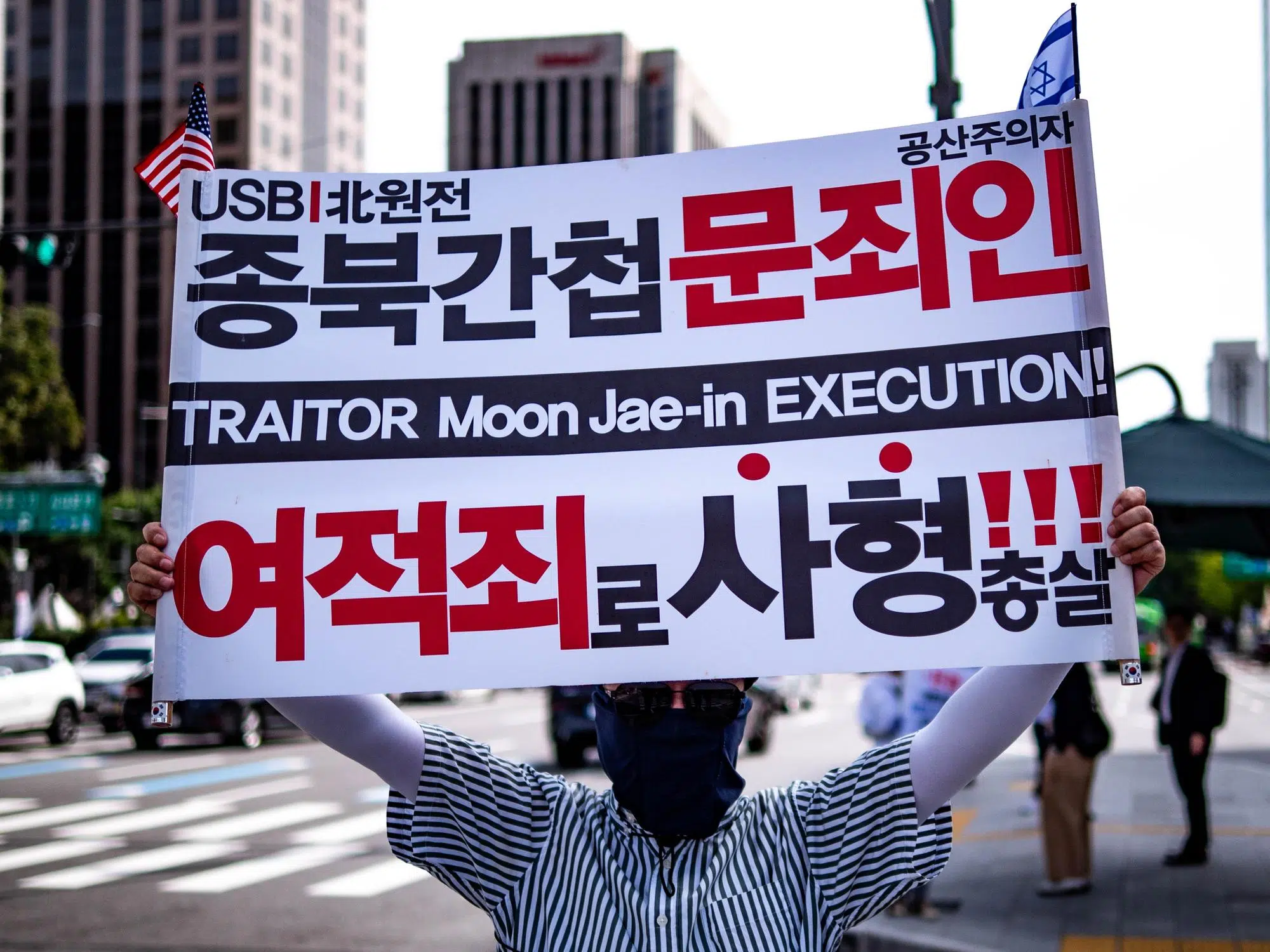
A far-right protester in Seoul accuses former President Moon Jae-in of being a North Korean agent (September 2023).
The rise to power in May 2022 of conservative Yoon Suk Yeol in South Korea, with his harsh rhetoric toward North Korea, further aggravated relations.
On November 22, 2023, after North Korea launched a military reconnaissance satellite, the Yoon government partially suspended the 2018 Comprehensive Military Agreement (the clause targeted by this suspension concerned restrictions on aerial reconnaissance and surveillance near the border, in order to resume surveillance operations against North Korea). The next day, Pyongyang announced the complete termination of the agreement. This notably implied the reestablishment of guard posts and heavy weaponry in the DMZ and the removal of restrictions on military activities near the border. The CMA was completely ditched on the South Korean side on June 4, 2024.
“Two Hostile States”
Kim Jong Un’s speech to the plenary meeting of the Workers’ Party, published on December 31, 2023, marked the most significant doctrinal rupture in inter-Korean relations since the 1970s. The leader explicitly abandoned the idea that the two Koreas form a single nation destined for reunification and declared that North–South relations were now those of “two hostile states.”
The North Korean regime quickly moved from words to deeds. From January 2024, all North Korean institutions dedicated to reunification were dissolved or profoundly restructured. The reunification monument in Pyongyang was blown up. All references to reunification were erased from North Korea’s Constitution. Since the time of Kim Il Sung, even during the tensest periods, Pyongyang had continued to affirm that North and South belonged to a single Korean nation. The rupture of 2024 brought this historic doctrine to an end. The North now regarded the South as a foreign country and as its worst enemy.
The regime continued its ballistic missile tests and repeatedly declared that, in the event of conflict, South Korea, seen as nothing more than a U.S. lackey, would be a direct target of its nuclear forces. At the same time, Kim Jong Un moved closer to Russia, with which he signed a mutual defense agreement, and strengthened his ties with China. In exchange for Russian technological and economic assistance, North Korea supplied the Russian army with munitions for its war against Ukraine and even sent thousands of its soldiers to fight at the front.
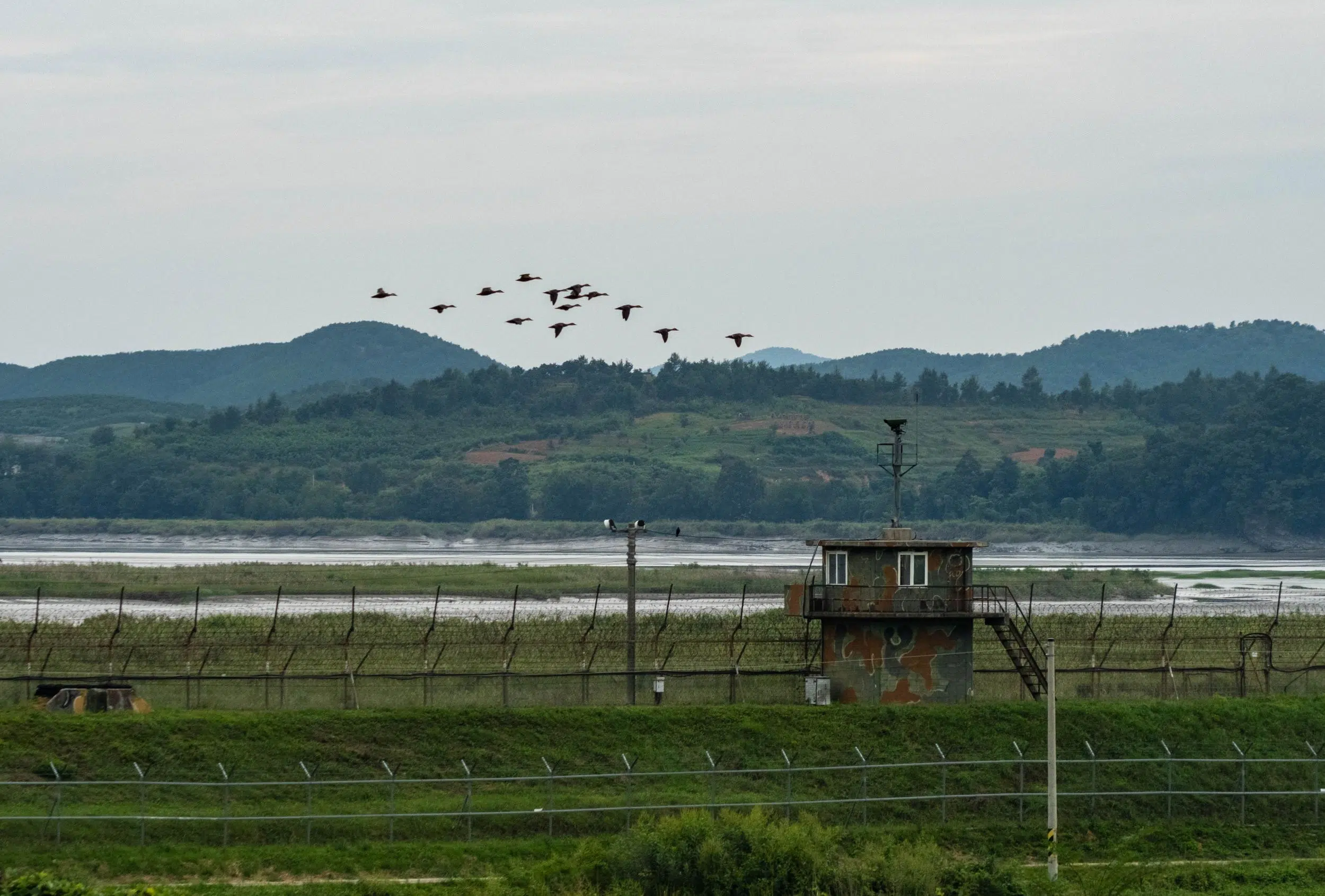
A flock of wild ducks flies over the Imjin River, which marks the border between South Korea and North Korea (September 2026).
This new situation led to major changes in the DMZ. From spring 2024, the North Korean army embarked on extensive remilitarization work there, clearing wide swathes of forest, building new tactical roads, and installing new fences, anti-tank obstacles, and minefields. The former cross-border roads and rail lines were blown up just north of the demarcation line.
To this were added North Korean GPS jamming campaigns that disrupted air navigation around Seoul, the resumption after a six-year hiatus of the “noise war” via loudspeakers across the DMZ, and the sending from the North of drones and balloons loaded with household trash toward the South. In October 2024, President Yoon, weakened politically at home, sent two drones carrying anti-communist propaganda toward Pyongyang, hoping to trigger an armed incident that would have justified imposing martial law and silencing the opposition in the South. North Korea reacted with restraint but warned that any similar incident in the future would trigger a war.
The impeachment of Yoon for attempting a self-coup and the election in June 2025 of a new progressive president, Lee Jae Myung, changed little. The only tangible improvement at the border was the end of the loudspeaker war. All attempts by the Lee administration to reestablish contact with the North went unanswered. Back in power, Donald Trump also tried to reopen communication with Kim Jong Un in the hope of organizing a new summit, without the slightest success.
The demarcation line has barely budged since the 1953 armistice. Yet the inter-Korean border has never stopped changing. Road after road, tunnel after tunnel, guard post after guard post, it tells the story of the hopes and failures of Korean reconciliation. Today, a North Korea entirely hostile to South Korea and the West continues to fortify its side of the DMZ, installing barriers, digging trenches, and laying new mines sometimes just a few meters from the demarcation line, etching into the landscape the border between two nations it intends to remain enemies forever. The missed opportunities for peace in 2018 now seem a distant memory.
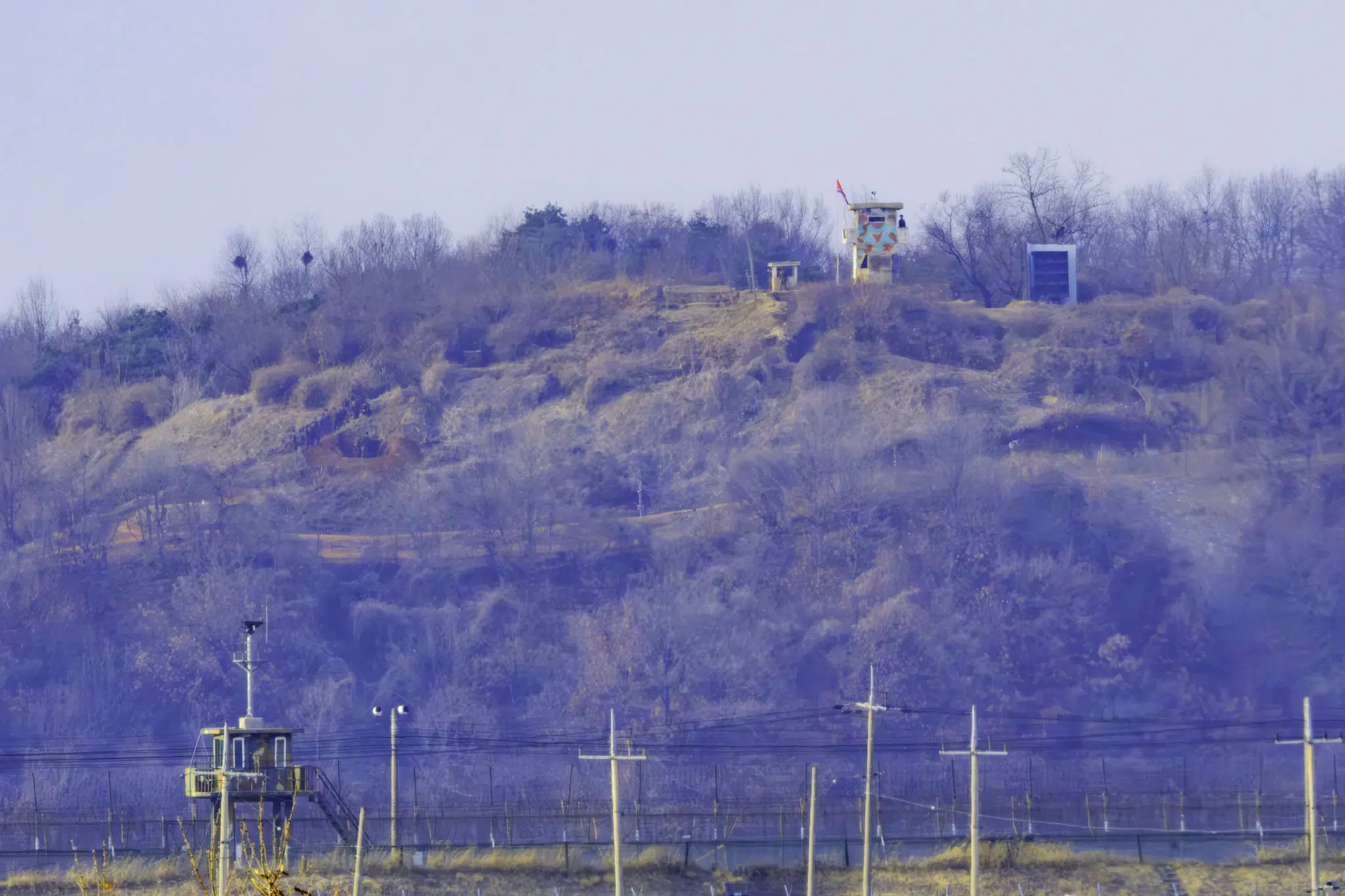
North Korean soldiers (center, left) carry out fortification work in the DMZ, across from a South Korean guard tower (February 2025).
This post was last updated on : September 25, 2026.